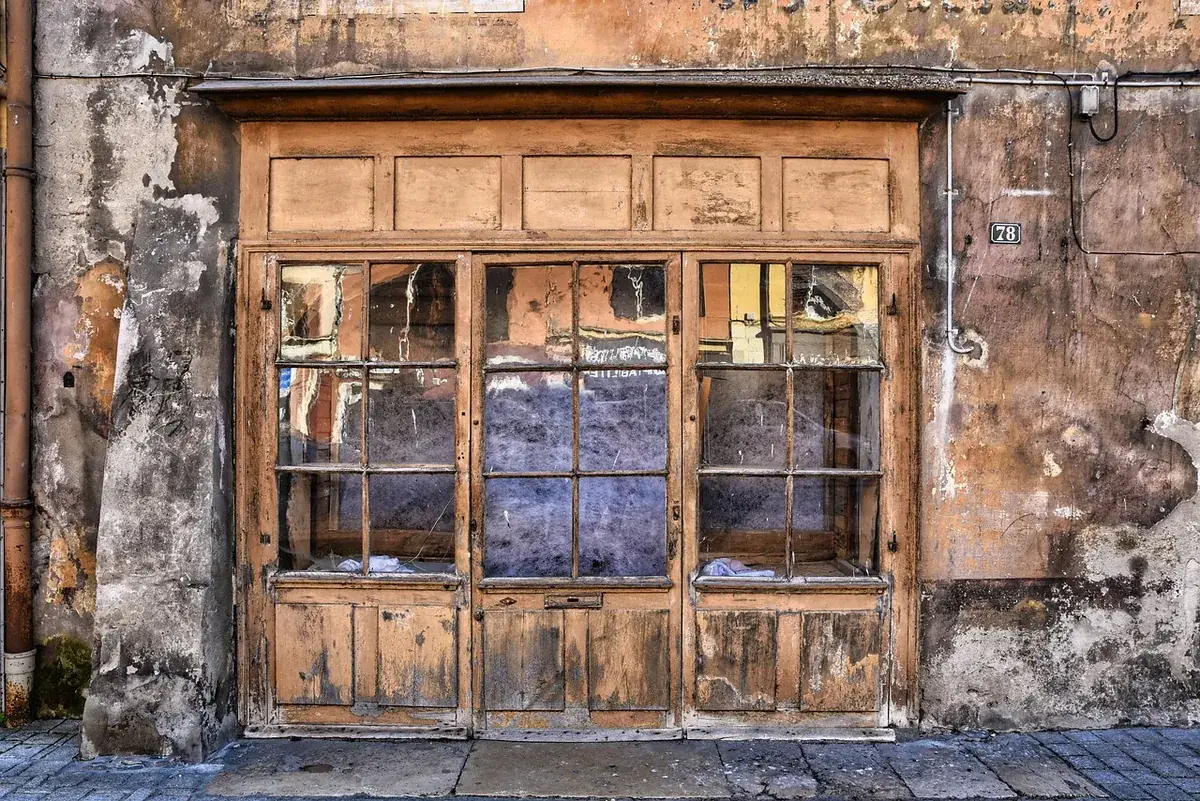
Historic window glass restoration: working pre-1940 cylinder glass without ruining it
Pre-1940 cylinder glass is a different substrate than modern float glass — softer, thinner, optically distinctive, and one mistake away from a panel you cannot replace. Here is what cylinder glass is, why so much of it has survived, and the conservation-grade protocol for cleaning it without producing the failure mode every preservation board has seen too many times.
PUB. MAY 11, 2026
Pre-1940 cylinder glass is not modern float glass. The differences matter for cleaning:
- Cylinder glass is softer. Mohs hardness measurably below modern float glass. Scrapers that work fine on modern stock will gouge it.
- It is thinner. Typical pre-1900 cylinder glass runs roughly 2.0 to 2.5 mm. Modern residential float runs 3 to 5 mm. Thinner glass flexes under pressure that modern glass would absorb without flex.
- Surface irregularities are original. The waves, the imperfections, the slight optical distortion — that is the material. Treating it as a defect to be polished out destroys the heritage value of the panel.
- Most restoration failures come from one of three things: a steel blade taken to soft glass, an alkaline cleaner left to dwell on weathered surfaces, or a heritage panel mistaken for a damaged modern panel and "corrected."
- The single most useful tool for working historic glass is restraint. Slow pacing, hand-detail finish, conservative chemistry, no scraping unless you are certain of the substrate.
The owner of a pre-1900 residence with surviving original glass owns something that cannot be replaced. Modern restoration glass exists and is good, but it is restoration glass — a reproduction. The original cylinder panels are the heritage feature. Treating them accordingly is the entire job.
I get a version of this call a few times a year. It usually comes from a homeowner who has just bought a pre-1900 house in Old Louisville, or one of the older blocks in Cherokee Triangle, or sometimes from a property manager working a heritage commercial property downtown. That particular market has its own rhythm — the Old Louisville heritage book and the Bluegrass regions around it covers how the work is priced and scheduled there. The call goes something like this: I had the windows cleaned by a guy and now there are scratches on the front parlor panes. Is there a way to fix that?
There is usually not. The scratches are almost always from a steel scraper taken to soft cylinder glass that the operator assumed was modern float glass. Once it happens, the panel is functionally compromised. You can polish out some surface damage with cerium oxide, but the polish removes the wavy-glass character along with the scratch, and what you end up with is a panel that is technically clean and structurally fine but no longer historic. The whole point of the original panel — the slight optical distortion, the period-correct waves, the way it bends the light differently than a modern pane — is gone.
This is the article I write so the next homeowner can avoid that call, and so the next operator entering the heritage residential market can avoid being the cause of it. The material is genuinely interesting to me — I have been around pre-1900 residential heritage stock for the better part of two decades, and I think the trade has not done a great job of writing down what the working knowledge actually is — so this is also partly a record of what I have learned from the field about handling this substrate.
What cylinder glass actually is
The window glass in a pre-1940 American residential property is, in almost every case, cylinder glass. The manufacturing process that produced it is genuinely different from the float-glass process that produces modern window glass, and the differences in process produce real differences in the material.
The cylinder-glass process worked roughly like this.1 A glassblower would gather a quantity of molten glass on the end of a blowpipe — somewhere between 15 and 30 pounds of glass in skilled hands — and swing the pipe in a controlled motion to elongate the gather into a long cylindrical bubble, typically four to six feet long and twelve to fourteen inches in diameter. The closed ends of the cylinder were then cut off, and the cylinder was scored lengthwise along one side. The scored cylinder was returned to a flattening kiln, reheated, and split open along the score line. The heat caused the cylinder to flatten under gravity into a roughly flat sheet, which was then annealed and trimmed.
This process produced glass with several characteristic features. The flattening was never perfectly uniform — the sheet retained subtle waves and ripples from the splitting and flattening operation. The thickness varied slightly across the sheet, typically running between 2.0 and 2.5 mm with regional variation. The surfaces were not perfectly parallel, which is the source of the optical distortion that we read today as the visual signature of historic glass. And the glass composition itself was different — pre-1940 soda-lime glass typically ran lower in iron content than modern float glass, which gave it the very slight greenish-tinged-but-clearer optical character that distinguishes it from modern stock.2
The float-glass process that replaced cylinder glass in commercial production over the period roughly 1959 to 19753 produced glass with none of these features. Float glass is manufactured by floating molten glass on a bath of molten tin, which produces sheets that are perfectly flat, perfectly uniform in thickness, and optically clear in a way that is industrially impressive and, in the heritage residential context, completely wrong.
This is the first thing to internalize about working historic glass. The waves are not a defect. The slight thickness variation is not a defect. The optical distortion that bends the light differently when you walk past the window is not a defect. All of these features are the material itself. A heritage panel that has been "polished smooth" has had its heritage character removed, and the panel is no longer the original artifact even if it is still the original piece of glass.
Why so much of it has survived
The other thing worth knowing about cylinder glass is that a remarkable amount of it has survived. The original-glass survival rates on the best-preserved pre-1900 residential and commercial properties run somewhere between 30 and 60 percent on a panel-by-panel basis, with substantial regional variation.4 The surviving glass concentrates in the upper sashes (which see less mechanical impact than lower sashes) and in lower-traffic facades.
The survival rate is higher than people expect because pre-1940 single-family residential glass was bedded into wood frames using glazing putty, and the putty system was, for all its maintenance overhead, fundamentally compatible with thermal cycling. The glass moved with the frame, the putty deformed slightly with seasonal humidity, and the system tolerated the constant low-level motion that a wood-frame building experiences across decades. Modern aluminum-framed and vinyl-framed glazing systems are less forgiving in some respects and more forgiving in others, but the surviving cylinder glass we see today is the population that survived the original glazing system.
The implication for cleaning is that the panel you are working on may have been in continuous service for 110 or 130 years. The surface has been weathered, slightly etched by acid rain in industrial regions, and worn in subtle ways that modern glass has not been. Working it like new glass is not a category error — it is a failure to recognize what you are looking at.
The substrate differences that matter for cleaning
There are three substrate differences between pre-1940 cylinder glass and modern float glass that change the cleaning protocol.
Hardness. Cylinder glass is measurably softer than modern float glass. Modern float glass runs a Mohs hardness of approximately 5.5 to 6.5 depending on composition.5 Pre-1940 soda-lime cylinder glass runs slightly lower, and the surface of the panel is softer still because of the cumulative surface weathering over a century-plus of exposure. The practical implication is that the steel blade of a window-cleaning scraper, which works without leaving any mark on modern float glass, will produce visible surface scratching on weathered cylinder glass. The scratches may not be immediately visible at oblique angles in the right light, but they will be visible on the panel, and the damage is permanent.
This is the single most common preventable failure I see on heritage residential. An operator runs a steel scraper across the lower sash to clear what looks like adhesive residue or paint overspray, and walks away leaving a faint cross-hatch pattern on the panel that the homeowner notices three days later when the morning light hits the window. By then there is nothing to do.
Thickness. Cylinder glass at 2.0 to 2.5 mm is meaningfully thinner than modern residential float at 3 to 5 mm. Thinner glass flexes more under applied pressure. A water-fed pole technique that applies firm pressure against a modern panel without difficulty can produce visible flexing on a pre-1900 panel, and on the worst-preserved historic glass — surface-weathered, very thin, and bedded into a slightly-deteriorated glazing putty — sustained pressure can crack the panel.
Surface character. A century of weathering has produced surface character on the panel that modern glass does not have. Faint pitting, faint etching from acid rain in industrial regions, slight surface haze from cumulative environmental exposure. Aggressive cleaning attempts to remove this surface character read as "polishing," and the polishing destroys the heritage value of the panel. The surface haze on a 130-year-old window is not a cleaning problem to solve. It is part of the panel.
The conservation-grade protocol
The protocol I run on confirmed pre-1940 cylinder glass is a substantial departure from production-residential cleaning. The departures are not optional. Each one corresponds to a substrate difference described above.
No scraping. Ever. A steel scraper does not touch a heritage panel under any circumstances. If there is paint, adhesive, or organic residue on the panel that would normally come off with a blade, it comes off with solvent application, soak time, and hand-detail technique with a soft cloth. The soak times are longer than production-residential cleaning will tolerate. That is by design. Conservation-grade pacing is part of the protocol, not a workaround.
Hand detail only, or water-fed pole at minimum pressure. I do not run a power-applied pole on confirmed heritage panels except on upper sashes where hand access is genuinely not feasible. When I do run a pole, it is at the lightest pressure that will still rinse, and the pole tip never makes the kind of contact that flexes the panel. The hand-detail technique with a wand or cloth is the default. Squeegee finish is fine on heritage glass — that is what the squeegee is for — but the wand wash that precedes it should be at low pressure and slow.
Conservative chemistry. The cleaning solution on heritage panels is the simplest one in the kit. A pH-neutral surfactant in distilled water, at low concentration. The standard House Standard recipe runs fine. Alkaline cleaners are kept off heritage panels because the cumulative surface weathering on the glass makes the surface more reactive to alkaline chemistry than modern glass is — the alkaline cleaner can produce surface dulling that does not appear on modern glass. Acidic cleaners are similarly kept off. Citric acid handling on the perimeter putty or frame is fine; on the panel itself, only if I have first verified the panel can tolerate it with a discreet test in an inconspicuous area.
Inconspicuous test first. On any heritage panel I have not worked before, I test the protocol on the smallest, least-visible portion of the panel I can find. Usually a lower corner behind a curtain or shutter. The test is the protocol the panel will receive — same solution, same dwell, same hand-finish technique. If the test produces any visible change in the panel surface beyond the removal of soiling — any new haze, any visible scrub pattern, any change in optical character — the protocol is wrong for that panel and needs to be adjusted before it is run across the rest of the glass.
Document before cleaning. On commercial heritage and high-end residential heritage I document the panel condition before cleaning with photographs taken from a consistent angle. This is partly customer-service — the homeowner has a baseline for the panel condition. It is also self-protection. The most frequent dispute I have seen in heritage residential is the homeowner who claims a panel was damaged in cleaning when the damage was pre-existing. A photograph from before the cleaning settles the question quickly.
Conservation-grade pacing. Production residential runs at maybe ten minutes per double-hung sash on a normal house. Heritage residential runs at twenty to thirty minutes per sash on the most-preserved properties. The pricing has to reflect this. Operators who try to run heritage residential at production-pacing rates either lose money on the work or produce damage that costs more than the job. There is no middle path.
Recognizing heritage glass on a property you are about to clean
The protocol above is only useful if you can tell when you are looking at heritage glass. There are five practical field indicators.
Visual distortion at oblique angles. Stand to the side of the panel and look across it at a low angle. Cylinder glass will visibly distort the reflected scene — straight lines outside the window will appear slightly wavy in the reflection. Modern float glass shows no such distortion.
Surface irregularity to touch. Run a fingertip across the panel. Cylinder glass has subtle surface unevenness that you can feel. Modern float glass is flat to the touch.
Greenish edge color. The edge of a cylinder-glass panel, where you can see it through the glazing putty bevel, will show a faint greenish tinge that modern low-iron glass does not have. This is the iron content in pre-1940 soda-lime glass.
Mounting in wood frame with putty. Heritage panels are almost always bedded in glazing putty in a wood sash. Modern panels are typically aluminum-framed or vinyl-framed with rubber gaskets. Mixed-glazing properties exist — a pre-1900 house with replacement modern sashes is common — but the original sashes hold the original glass, and if the sash is wood with putty, the glass is probably original.
Panel-to-panel inconsistency. If you can see meaningful panel-to-panel variation in surface character on the same window — different waves, different thickness, slightly different optical character — you are almost certainly looking at heritage glass. Modern float glass within a single window will be uniform.
When all five indicators are present on a panel, run the heritage protocol. When two or three are present, run the heritage protocol and verify with the inconspicuous test. When one or none is present, the panel is probably modern restoration glass or modern replacement glass and the production-residential protocol is fine.
The two replacements
When a heritage panel is genuinely compromised — cracked, severely scratched, or surface-failed in a way that no protocol can recover — the homeowner has two replacement options, and the difference between them matters.
Modern float glass. Inexpensive, widely available, structurally fine, and visually wrong. A modern float-glass panel installed into a pre-1900 sash will look noticeably different from the surviving cylinder-glass panels around it. The new panel will be perfectly flat, perfectly uniform, and the reflected world outside will appear undistorted in the new panel while still appearing distorted in the original panels. For most homeowners the visual mismatch is jarring. The replacement should not be done with modern float glass except in the lowest-visibility positions where the homeowner has explicitly accepted the visual impact.
Modern restoration glass. Several manufacturers — most notably Bendheim in the United States, and a few European houses — produce restoration glass designed specifically to match the visual character of pre-1900 cylinder glass.6 The restoration glass is manufactured by a partially-revived cylinder process and produces panels with characteristic waves, slight thickness variation, and the period-correct optical distortion. It is not the original artifact, but it is visually convincing in a way that modern float glass is not.
Restoration glass costs substantially more than modern float — typically four to ten times more depending on grade and panel size — and homeowners committed to preservation standards generally accept the cost. The homeowner who is replacing a panel because of an avoidable cleaning failure rather than because of pre-existing damage understandably tends to be less philosophical about the cost. This is part of why the protocol matters.
The operating reality
The reality of heritage residential is that it is meaningfully more demanding, meaningfully slower, and meaningfully more profitable per hour than production residential, and the property-owner segment that owns the most-preserved heritage stock tends to be educated about preservation standards and intolerant of operators who treat the work as anything other than heritage-grade. The trade rewards operators who get this right. It punishes operators who do not, sometimes immediately and sometimes through the slower channel of preservation-community word of mouth.
The work is also genuinely satisfying. There is something about cleaning a window that has been in continuous service for 130 years, doing it correctly, leaving the heritage character intact, and walking off the property knowing the panel will probably still be there for the next operator in another twenty years. That is not a feeling production residential gives you. It is part of why I have stayed in the heritage segment for as long as I have.
The advice I would give any operator entering the heritage segment is to slow down on the protocol before slowing down on the pricing. The pacing is the discipline. The pricing follows.
Footnotes
-
The cylinder-glass process is sometimes called the broad-sheet process, particularly in the British literature. The American trade vocabulary settles on "cylinder glass" for the residential panels produced by this method from roughly 1830 through the 1920s. Earlier American crown glass and bullseye glass are functionally extinct in residential service. ↩
-
The lower iron content in pre-1940 soda-lime glass is a function of the sand sources and the refining technology of the period. Modern float glass typically has higher iron content unless specifically produced as low-iron glass, which is a premium product. The visible difference at edge angles is reliable but subtle. ↩
-
The float-glass process was developed by Pilkington in the United Kingdom and patented in 1959. Commercial U.S. adoption was substantially complete by the mid-1970s. Properties built after about 1975 are essentially never going to have cylinder glass. ↩
-
Original-glass survival rates vary substantially by region and by building stewardship. The 30 to 60 percent figure is a working operator's estimate based on field observation across several markets and is not a published statistic. Better-preserved neighborhoods (Old Louisville, Pittsburgh's Mexican War Streets, the Garden District in New Orleans, the Strivers' Section in Washington DC, parts of the Beacon Hill and Back Bay heritage residential corridors) run at the higher end. Heavily-renovated heritage districts run lower. ↩
-
Glass hardness is conventionally measured on the Mohs scale by reference, with modern soda-lime float glass generally placing in the 5.5 to 6.5 range. Direct Mohs testing of heritage glass is not standard practice in the trade because the test would damage the panel; the working understanding that cylinder glass is softer than float glass is based on the observed susceptibility to scraper damage rather than on standardized hardness testing. ↩
-
Bendheim's restoration-glass product line is the most widely available restoration glass in the U.S. residential market. The product comes in several grades corresponding to different periods and different intensity of optical distortion. Specifying the correct grade for a given heritage property is the kind of decision that benefits from a conversation between the homeowner, the glazier, and the local preservation board where one is active. ↩
Wade Marler
Regional contributor covering Kentucky and the Ohio Valley for Window Washing Guide. Coverage under this byline addresses Louisville river-corridor commercial work, Bluegrass karst-water residential routes, and Derby Week scheduling, researched with the Giordano Inc. editorial team from practitioner interviews and published trade references.