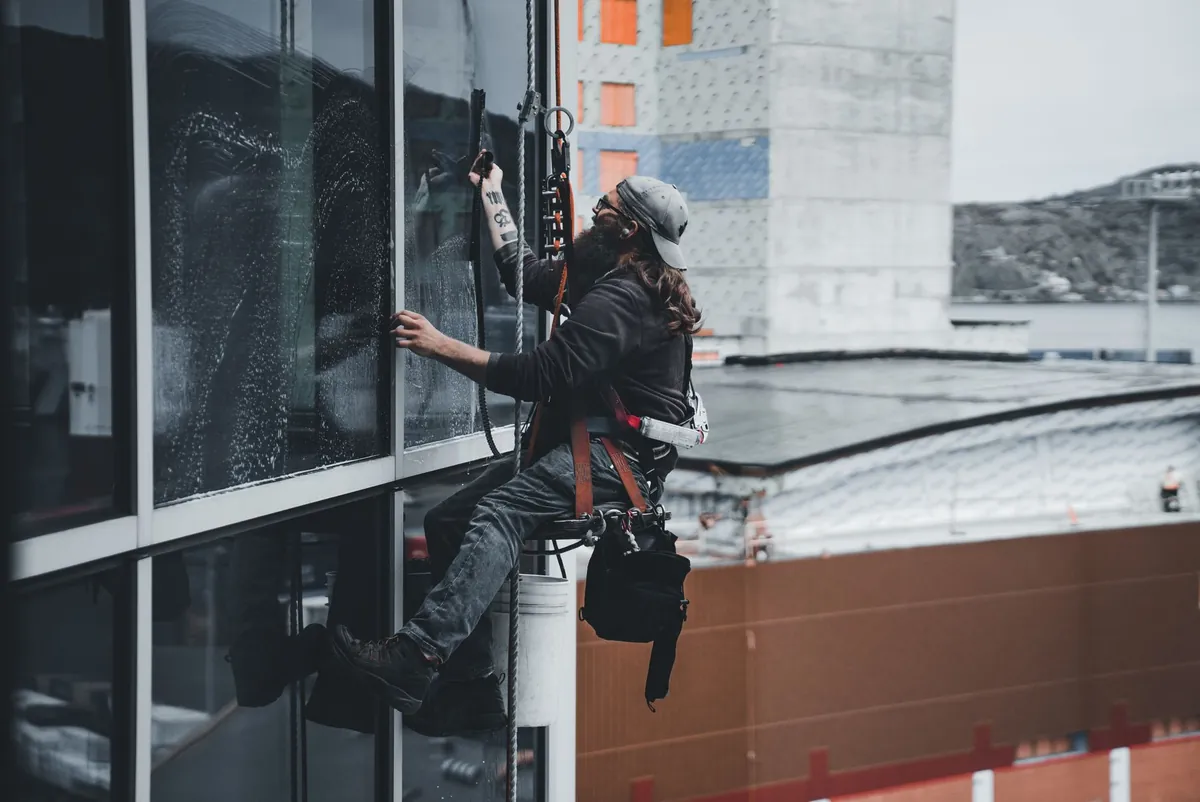
Working at height: a cleaner's safety primer
Most window cleaners working in residential and light-commercial routes treat ladder work as the unexamined background of the job — until the first time something goes wrong. Here's the framework I use after eleven years on a route, after one fall I should have prevented, and after watching cleaners I respect get hurt by mistakes I'd made myself.
PUB. MAY 10, 2026
Six rules I wish I had followed from year one, not year three:
- Six feet is the OSHA threshold for fall protection in general industry, but the floor of injury risk is a lot lower than that. Most career-ending falls in this trade happen between eight and fourteen feet.
- Ladder work is governed by physics, not effort. The 4-to-1 angle, the duty rating, and the kick-out condition decide whether you go home that day.
- Three points of contact is not a slogan, it's the rule that keeps your spine intact. Two hands and a foot, or two feet and a hand. Always.
- The water-fed pole is the single best safety investment a residential route can make. I bought mine in 2018. It removed roughly 60% of my ladder hours.
- Insurance, OSHA, and your physical body all draw the line at the same place. If you're tempted to ignore one, you're already ignoring the other two.
- Some buildings should be subcontracted, not climbed. Knowing which is the difference between a thirty-year career and a five-year cautionary tale.
Working at height is the part of this trade that costs people their backs, their incomes, and occasionally their lives. The framework here is what I'd give my younger self in 2015, before the wet aluminum extension ladder kicked out from under me on a Birmingham Cape Cod and I learned the difference between getting lucky and being competent.
The first time a ladder kicked out from under me, I was on a Cape Cod in Birmingham, Michigan, in late October 2017, working second-story exterior glass at the back of the house. The yard sloped slightly. The grass was damp. I'd set the ladder at what I thought was the right angle, climbed eleven feet, and reached out maybe eight inches farther than the safe envelope to get the corner of a transom window that was annoying me.
The ladder didn't fall, exactly. It rotated. The base slid backward across the wet grass, the top pivoted off the gutter, and the whole assembly began to lower itself toward the lawn with me on it like the world's slowest amusement-park ride. I rode it down. I had time to think the words "this is bad." The fall was about nine feet by the time I let go and landed on my left hip on the lawn. Nothing broke. I limped for two weeks. I drove home that day and wrote a list of every mistake I had just made, and I have not made any of them since.
That list, expanded and refined over the next nine years, is this article.
Working at height is the part of residential and light-commercial window cleaning that the trade publications skim past because most cleaners learn it on the job and the people who learned wrong are no longer in the trade to tell you about it. The cleaners who got injured are running a different business now, or no business. The cleaners who didn't get injured got lucky, and most of the time they don't know which of their habits saved them and which ones almost killed them. I want to be specific about the difference, because I almost made the wrong decision and I want to give you the reasoning that would have made the right one obvious.
This piece focuses on the height work that residential routes and small commercial accounts actually involve: extension ladders, step ladders, and the water-fed-pole alternative. It does not cover suspended scaffolding, bosun's chairs, or rope access — that's a different specialty with its own training pipeline, and Drew covers that side of the trade in his Field Notes pieces. If you're working high-rise, you should be reading IRATA and SPRAT material, not this.
The threshold question: when is it height work?
Federal OSHA's general-industry rule for fall protection is that any work performed at four feet or more above a lower level requires fall protection (different industries have different thresholds; construction is six feet). For window cleaning, the practical answer is that ladder work over twelve feet should be treated as height work for pricing, equipment, and decision-making purposes — and ladder work over twenty feet should be treated as specialty work that requires either fall arrest gear or a water-fed pole.
Below twelve feet, you're in standard ladder territory. A six-foot step ladder reaching a first-story transom is height work in the technical sense but not in the consequence sense — a fall from that ladder hurts and may injure you, but it rarely ends a career. Above twelve feet, the math changes. The energy of a fall scales with the square of the velocity at impact, which means a fall from sixteen feet hits roughly twice as hard as a fall from eight, and a fall from twenty-five feet hits four times as hard. Most career-ending residential falls in this trade happen in the eight-to-fourteen-foot range — high enough to do real damage, low enough that cleaners stop respecting the threat.
The OSHA threshold isn't where injury starts. It's where the regulators decided the paperwork should start. Your body's actual injury threshold is closer to the ground than that. Plan accordingly.
Ladder work, in five rules I learned the hard way
If I could only give a new residential cleaner five rules about ladder work, they would be these. They are not novel — every one of them is in the OSHA literature and the IWCA training materials — but they are the five rules that, on the day I broke them, the consequences came for me.
Rule 1: The 4-to-1 angle is non-negotiable
For every four feet of ladder height, the base of the ladder should be one foot away from the wall. A ladder that reaches a sixteen-foot gutter line should have its base four feet from the building. This angle (about 75 degrees from horizontal) is the mechanical compromise between two failure modes: too steep and the ladder tips backward when you climb, too shallow and the base slides out from under you when you load the top.
There is a stupid little trick I learned in trade school and ignored for years before I started using it: stand at the foot of the ladder with your toes against the rails. Extend your arms straight out. Your palms should just touch the rungs at shoulder height. If your arms are bent, the ladder is too steep. If you have to lean forward to reach, it's too shallow. Five seconds, every setup. The day I started doing this on every ladder placement was the day I stopped having close calls on extension ladders.
Rule 2: Set on a level base or don't climb
The ladder accident on the Cape Cod in Birmingham happened because the lawn sloped about three degrees and the grass was damp from morning dew. I knew both facts and climbed anyway. The base shifted because the friction coefficient of damp grass on aluminum is not what you want it to be when you're nine feet up.
The fix for uneven ground is a ladder leveler — a hinged extension on one rail that lets you adjust the foot height to compensate for slope. They cost about seventy-five dollars. I now own three of them. They live in the truck. The cost of the leveler is several orders of magnitude less than the cost of one fall, and there is no other way to safely set an extension ladder on uneven ground.
The fix for slick ground is more complicated. If the surface is wet grass, wet leaves, or any surface where the rubber feet of the ladder will not bite, you need either a different ground (move the ladder to where the surface is dry and grippy) or ladder mitts — rubber covers that grip the surface better than the bare feet — or a spotter holding the base. On serious slopes, a stake-and-strap setup that anchors the base mechanically is sometimes appropriate; on residential work it almost always means you should not be on the ladder.
Rule 3: Three points of contact, every move, no exceptions
Three points of contact means two hands and a foot, or two feet and a hand, in stable engagement with the ladder at every moment of climbing, descending, or working. It is the rule that keeps you on the ladder when something unexpected happens — a wasp, a shifting wind, a weight shift in the bucket on the rung above you.
The temptation to break this rule is constant on residential work. You're holding a squeegee in your dominant hand. You're holding a strip washer or a pole in the other. You want to swap them. You want to reach a corner. You want to wipe sweat off your face. Every break of the three-points-of-contact rule is a moment when one unexpected event becomes a fall.
The discipline that makes this rule workable is the bucket-on-a-belt — a rigid plastic bucket clipped to your tool belt that holds a strip washer, a squeegee, a small detail towel, and your scrubbing solution. Tools come out one at a time, used with the working hand, and returned to the bucket before the working hand goes back to the ladder. The non-working hand never leaves the rail. This is the only working method that lets you maintain three points of contact through real productive cleaning. Anything else — tools in cargo pockets, tools tucked into your belt without a holster, tools held in your teeth (don't laugh, I have seen experienced cleaners do this) — is a workflow that eventually puts you on the ground.
Rule 4: Don't reach past the rails
If you have to lean out from the ladder to reach a corner, you are working in the failure envelope. The center of gravity of your body needs to stay between the rails of the ladder. The standard test is the belt-buckle rule: your belt buckle stays inside the rails. If it crosses outside, you've moved your center of mass off the ladder's footprint and the ladder is now resisting a tipping moment that it was not designed to resist.
The right move when you can't reach a corner from your current ladder position is get down and move the ladder. This is slower. It is also the difference between a cleaning that takes ten extra minutes per house and a cleaning that takes you out of the trade for six months because you ruptured a disc.
I lost half an hour a day to this discipline at first. I added a small surcharge to my hourly rate to compensate. The customers absorbed it without comment, because the alternative — me, in a hospital, not finishing their house — was worse for them too.
Rule 5: Two hands on the rails, descending
The fall scenarios that produce the worst injuries on residential routes happen in the descent, not the ascent. You're tired. You're carrying tools. You're thinking about the next house. The bucket on your belt is full of water and the wash arm is wet. You step down the ladder one rung at a time, but you reach for the rail with one hand and your bucket pulls you slightly off balance, and the foot you thought was on the rung is on the rung's edge, and the foot slips, and now you are taking the rest of the ladder face-first.
The protocol that prevents this: empty the bucket before you descend if it's full. Two hands on the rails. Eyes on the rung your foot is moving toward. Slow. The descent is not the moment to be efficient. The descent is the moment to be deliberate.
I have one scar on my chin from learning this rule by hand. The customer paid the bill and brought me a paper towel. The lesson stuck.
The water-fed pole, and what it actually changes
In 2018 I bought a Tucker water-fed pole system with a deionization tank and a forty-five-foot pole, and it changed the economics of my route. I want to talk about why, because the safety argument for the water-fed pole is the most underrated piece of equipment math in the residential trade.
The water-fed pole replaces ladder work for any glass that can be reached from grade level with the pole. For most two-story residential, that means roughly 60-70% of the exterior glass — every second-story exterior face, every gable transom, every dormer that the pole can reach. The pole stays on the ground. You stay on the ground. The fall risk on that 60-70% of the work goes from real to zero.
The math, the way I look at it now, is this: a water-fed pole system serious enough to handle a residential route runs $2,500 to $4,500 in 2026 dollars. The pole pays for itself in two ways. First, on direct labor: I move faster on second-story work with the pole than I did with the ladder, because there's no setup time per face. Second, on insurance: my general liability premium dropped about 14% the year after I documented to my carrier that I was running primarily water-fed-pole work on second stories. The discount alone amortized the equipment in about three years.
The safety argument is the third dividend, and the one nobody puts a number on. Every hour I'm not on a ladder is an hour I'm not at risk for the fall that ends my career. Over an eleven-year route, the cumulative risk reduction is real and meaningful. I cannot point to a specific fall the pole prevented because I cannot prove a counterfactual. I can tell you that my one ladder-related injury happened in 2017 and I have not had another one since I bought the pole, and I do not think that is a coincidence.
The pole has limits. It cannot do interior work. It struggles in high wind (above about 15 mph the pole becomes hard to control on extension). It does not work on glass that requires razor-blade scraping for sap, tar, or post-construction debris. It is not a replacement for ladder skills — it is a tool that lets you avoid using ladder skills on the work where you don't need them.
The cleaners I know who have not made the pole transition are mostly cleaners who started before 2010 and have not updated their fleet, plus newer cleaners who didn't have the capital to buy in. If you're starting now and you're scaling beyond a one-person residential operation, the pole is the equipment purchase that pays back the fastest. I would put it ahead of a second truck.
Fall protection: the harness conversation
Fall protection — meaning a body harness, a lanyard, and a properly engineered anchor point — is required by OSHA in any general-industry work performed at heights of four feet or more above a lower level when other measures (guardrails, scaffolding) aren't in place. For window cleaning, the practical reality is that very few residential routes have engineered anchor points to clip into, which means the legal compliance question becomes: at what point does the work justify either bringing your own anchor system or refusing the work?
For ladder work below twelve feet on stable ground, the field practice across most of the residential trade is that fall arrest is not used, because the ladder protocol itself is the protection. This is in tension with the strict reading of OSHA, but it is what the industry actually does and what enforcement actually focuses on. Above twelve feet, and especially when working from a bosun's chair or any work-positioning system, fall arrest becomes mandatory both legally and practically.
If you are doing height work that requires fall arrest and you don't have current training and inspected gear, the right answer is don't do the work. Subcontract it to a cleaner who has the gear and the certification. The cost of the subcontract is less than the cost of doing the work wrong. I have a list of three high-rise specialists in metro Detroit that I send my customers' tall buildings to. I take a small finder's fee. Everybody is happier than they would be if I tried to clean it myself.
When to walk away from a property
Some properties should not be cleaned. This is the hardest rule on the list because it conflicts with every instinct a working cleaner has — take the job, finish the job, take the money, go home. But the cleaners who stay in the trade for thirty years have all developed a list of property types they decline, and the list is roughly the same across everyone I know.
The properties to decline:
- Steep-pitched roofs with no anchor points and glass that's only accessible from the roof. Some Victorians and large Cape Cods have third-story dormers that can only be cleaned by walking the roof. The roof is the failure point. Subcontract it or decline.
- Properties with structural conditions that make ladder placement impossible. Decks built right against the house with no clearance, landscaping that prevents level ladder feet, hardscape with no soft fall zone. Walk the property before quoting.
- Properties where the customer is pressuring you to skip steps. "Just lean over a little, my grandfather always did it that way." Customers who push back on safety equipment or technique are customers whose property is going to find a way to hurt you. Walk away.
- Buildings where the previous cleaner had an accident. I have learned to ask. If a previous cleaner fell on a property, the property has a feature that produced that fall, and unless I can identify and mitigate it, I'm next.
The financial pressure to take everything is real, especially in the first three years when you're building the route. The financial pressure of an injury is also real, and lasts longer.
What this looks like at the start of a season
In early March, before the residential season opens, I do a fleet check. Every extension ladder gets inspected — rails for cracks, rungs for play, feet for wear, ropes and pulleys for fray. Anything questionable gets retired; ladders are cheap and replacements are not. The water-fed pole gets a full system check — DI resin condition, brush bristle wear, tubing for kinks. The harness, lanyard, and connectors get inspected per the manufacturer's protocol — any harness with frayed webbing, deformed hardware, or shock-pack indicators that have deployed gets replaced, no exceptions.
I also re-read my own protocols. I'm writing this article in part because the act of writing it is a re-read for me. The reason cleaners get hurt in year ten is not that they don't know the rules. It's that they stopped thinking about the rules because the rules became invisible. The discipline of the trade is to keep them visible.
The grass on the back of the Cape Cod was damp in 2017. I knew that and climbed anyway. The next time, I won't.
Glossary terms in this piece
- Bosun's chair — work-positioning seat for vertical work; specialty equipment requiring fall-arrest training
- Bucket-on-a-belt — clip-mounted tool holster that frees one hand for the ladder rail
- Duty rating — the load class of a ladder; Type IA (300 lb) is the minimum for working route cleaners
- Fall arrest — the harness, lanyard, and anchor system that catches a fall after it has begun
- Ladder leveler — hinged extension that adjusts ladder foot height to compensate for ground slope
- Ladder mitts — rubber covers for ladder feet that improve grip on smooth or damp surfaces
- Three points of contact — two hands and a foot, or two feet and a hand, on the ladder at all times
- Water-fed pole — telescoping pole with brush head and purified water delivery; the most valuable safety upgrade in residential work
Footnotes
Sources
-
Occupational Safety and Health Administration, 29 CFR 1910.23 — Ladders — the general-industry ladder rule: angle, footing, three points of contact, extension above the landing
-
Occupational Safety and Health Administration, 29 CFR 1910.27 — Scaffolds and rope descent systems — the rope-descent-system rule, including the 300-foot limit and anchorage certification
-
Occupational Safety and Health Administration, 29 CFR 1910.28 — Duty to have fall protection and falling object protection — the four-foot trigger for fall protection in general industry
-
Occupational Safety and Health Administration, 29 CFR 1926.501 — Duty to have fall protection (construction) — the six-foot trigger that applies when the work is classed as construction
-
American Ladder Institute, ANSI/ALI A14.2 Portable Metal Ladders — 2017 — the standard governing the construction, design, testing, care and use of portable metal ladders. Published by ALI as secretariat of ASC A14; ANSI accredits it rather than publishing it, which is why the designation is ANSI/ALI.
-
Bloswick D.S. and Chaffin D.B., An ergonomic analysis of the ladder climbing activity, International Journal of Industrial Ergonomics 6(1): 17–27, 1990 — hand and foot forces, torso EMG and L5/S1 loading measured across rung separation, ladder slant (70–90°), climbing speed and direction. Read the scope before leaning on it: it concludes there is no significant slip hazard for climbers of reasonable strength and mobility, and it does not address the placement geometry of a leaning ladder. Bloswick was at the University of Utah; the Center for Ergonomics affiliation is Chaffin's.
Jan Davenport
Editorial team contributor covering the Midwest and Great Lakes beat. Articles bylined by Jan are researched and reviewed in collaboration with the Giordano Inc. editorial team and informed by interviews with practicing window-washing operators in the region, plus published trade and small-business operations references.