Window Washing in Miami
Miami lovebug residue is acidic enough to etch glass within roughly 48 hours, and Brickell, South Beach and the barrier islands take extreme salt aerosol.
Miami-Dade publishes no hardness figure for this system, so plan around what actually does the damage: lovebug residue, acidic enough to etch glass within about 48 hours, and heavy salt spray on Brickell, South Beach and the barrier islands. November to April, the dry season, is the time to wash. The Brickell and barrier-island towers are rope-access work at their own rates, while a single-story exterior runs $340 to $570.
What the water means for the glass
The utility publishes no hardness figure. What distinguishes Miami is the aquifer rather than the number: the Biscayne is shallow, unconfined and extremely permeable, so it responds to rainfall and to saltwater intrusion on a scale of weeks rather than decades. That makes a single annual figure a weaker description here than in a deep confined system, and the county's multiple treatment plants make a single county figure weaker still.
Miami tap water, by the numbers
| Hardness | not published Miami-Dade Water and Sewer publishes no hardness figure in its 2025 Water Quality Report, including the 2025 Water Quality Data table (miamidade.gov). |
|---|---|
| Sodium | 33 mg/L (range 23–33) |
| Disinfectant | chloramine |
| Source and treatment | Groundwater, per the EPA SDWIS federal record · Lime and soda ash softening, coagulation, sedimentation and rapid sand filtration, packed-tower aeration, chlorination with chloramines as the residual, fluoridation and pH adjustment · The plant softens. |
Not in the report: pH, alkalinity, corrosion index, iron, manganese, chloride and total dissolved solids.
SOURCE · Miami-Dade Water and Sewer Department 2025 Water Quality Report, 2025 Water Quality Data table, Main System column · How we source these numbers
When a wash holds
What sets the cleaning clock
Lovebug season is the one loading that genuinely cannot wait. Twice a year, in April and May and again in August and September, the residue is acidic and begins etching glass within about forty-eight hours — this is the rare case where a delayed clean causes permanent damage rather than just a worse result. Salt aerosol on the barrier islands and Brickell runs continuously underneath that.
FLORIDA SEASON BY SEASON →What's specific to Miami
Miami-Dade draws the shallow, unconfined Biscayne Aquifer and publishes no traceable hardness figure; because the county runs several plants, a single county-wide number may not exist at all. Lovebug season is the defining operational fact — twice a year the residue is acidic and etches glass within about forty-eight hours, making it a deadline rather than a preference. Salt aerosol on Brickell and the barrier islands drives both frequency and method, and the high-rise concentration makes rigging rather than glass area the basis of a commercial day.
Miami-Dade draws the Biscayne Aquifer, and the department's report prints no hardness figure even though it says its regional plants lime-soften the water. The Biscayne is shallow, unconfined and highly permeable, quite unlike the deep confined Floridan that supplies north Florida — it responds to rainfall and saltwater intrusion in weeks rather than decades.
The county runs several treatment plants serving different areas, an arrangement that usually means the figures vary by plant. A single county-wide figure may not exist, and which plant serves an address may matter more than which city it is in.
Lovebug season, in April and May and again in August and September, is the dominant operating challenge and the only loading on this site that etches. The residue is acidic and begins damaging glass within about forty-eight hours, so it is a deadline rather than a scheduling preference.
Coastal salt aerosol is extreme on Brickell, South Beach and the barrier islands, and it is hygroscopic — it reactivates in overnight humidity rather than drying off. East-facing high-rise glazing needs a salt-clearing routine and a shorter interval than anything a few miles inland.
The high-rise concentration along Brickell and the beaches makes rope-and-stage rigging the norm rather than the exception, with permits, wind limits and building-management scheduling shaping the day far more than glass area does.
Hialeah is served by the same department from the same aquifer, so a figure located for one would settle both — but the two cities have completely different building stock and route economics, and should not be quoted alike on anything except the water.
How old the glass is
- Before 1940 · 8%wood sash and older glass
- 1940–1959 · 22%steel casements, early aluminium
- 1960–1979 · 21%aluminium sliders, often single-pane
- 1980–1999 · 13%double-pane units become standard
- 2000–2009 · 17%vinyl frames, low-E spreading
- 2010 or later · 19%low-E common: gentle cleaners only
The city, by neighborhood
What window cleaning costs in Miami
Brickell and the barrier-island towers are rope-and-stage work with building-management scheduling and wind limits, and that sets a rate nothing at street level approaches. Salt exposure on east-facing high-rise glazing drives frequency as well as method, so the same tower can support several visits a year where an inland building supports one.
Doing it yourself
High-rise glazing is the obvious professional line, but the sharper one is lovebug timing. A homeowner who waits a week after a heavy flight is not facing a harder clean, they are facing etched glass, and no method recovers it. Anyone maintaining their own property here needs to treat those two windows as a deadline rather than a preference.
OPEN COST ESTIMATOR →2025 annual mean at the Miami Fire Station monitor, 1200 NW 20th St, Miami, FL 33142, 2.2 km north of the city (EPA site 12-086-1016).
Largest air release: Titan Florida-Buena Vista II RMC Plant, 1801 NW Miami Court (nonmetallic mineral product), inside the city limits, 1.2 lb in 2024.
Miami-Dade's countywide rules limit lawn sprinklers to two days a week by street address, never between 10 in the morning and 4 in the afternoon, under the South Florida district's year-round rule. They govern landscape irrigation only, and the county lists car washing and pressure cleaning of paved surfaces among the uses they don't cover.
Miami-Dade landscape irrigation restrictions, as restated by Bal Harbour · Miami Springs, outdoor water restrictions (SFWMD Chapter 40E-24) · checked September 2026
Miami makes it unlawful to discharge wastewater or other non-potable fluids into the city's stormwater management system unless the Resilience and Public Works Department's rules for that discharge have been met. Soapy wash water from a window job counts as a non-potable fluid, so it needs to be kept out of the drains.
Miami City Code §49-4: discharges into the city stormwater management system · checked September 2026
Miami requires a certificate of appropriateness for any new construction, alteration, relocation or demolition within a designated historic site or historic district, and for thematically related resources in a multiple property designation. Exceptions or waivers from the zoning code on those properties need one too.
Miami City Code §23-6.2: certificates of appropriateness · checked September 2026
What actually shows up on Miami glass
Atomized salt deposited on glass within ~3 miles of either coast. Within a half mile of the water, the deposit rate is high enough to produce visible haze in 7–14 days. Salt is hygroscopic — pulls humidity from the air and rebuilds overnight.
Two annual swarms across most of the state. The acidic body chemistry of lovebugs can etch glass and paint within 24 hours if not removed. Surfactant pre-soak required; do not scrape.
Miami, answered
How hard is the water in Miami, Florida?+
The utility publishes no hardness figure. What distinguishes Miami is the aquifer rather than the number: the Biscayne is shallow, unconfined and extremely permeable, so it responds to rainfall and to saltwater intrusion on a scale of weeks rather than decades.
How much does window cleaning cost in Miami?+
Residential window cleaning in Miami typically runs $12–17 per pane or $340–570 for a standard single-story exterior. Brickell and the barrier-island towers are rope-and-stage work with building-management scheduling and wind limits, and that sets a rate nothing at street level approaches.
When is the best time of year to clean windows in Miami?+
Miami's drier, frost-free months are November to April, by NOAA's 1991–2020 normals for the Miami Beach station, where September brings the most rain. The calendar on this page marks February (after the January 23 bloom). Frost nights essentially never come here.
Can I rinse windows with Miami tap water?+
Miami-Dade Water and Sewer publishes neither hardness nor dissolved solids, so rinse one pane and let it dry in sun; a white ring means switch to pure water. Iron, manganese, sodium and chloride all sit under this site's flags (highest: sodium up to 33 mg/L). Treatment starts with lime, soda ash softening, coagulation and sedimentation.
Why do my windows look dirty so quickly in Miami?+
In Miami the dominant residue patterns include acidic lovebug residue, etching within roughly 48 hours and extreme salt aerosol on brickell, south beach and the barrier islands. Lovebug season is the one loading that genuinely cannot wait.
Do I need a professional to clean my windows in Miami?+
High-rise glazing is the obvious professional line, but the sharper one is lovebug timing. A homeowner who waits a week after a heavy flight is not facing a harder clean, they are facing etched glass, and no method recovers it. Anyone maintaining their own property here needs to treat those two windows as a deadline rather than a preference.
What sets Downtown Miami / Brickell apart for window cleaning in Miami?+
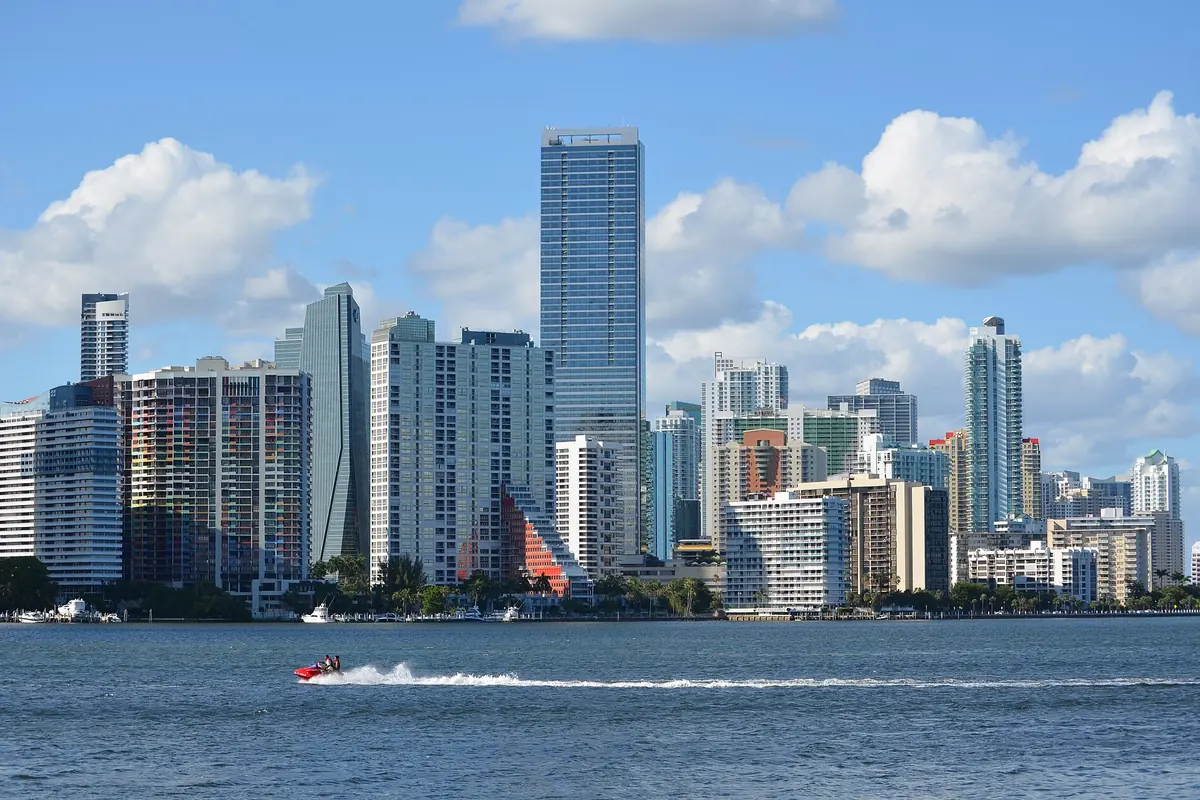
Dense financial-district towers in full-height glass facing Biscayne Bay. Rope-and-stage rigging with wind limits, building-management scheduling, and the heaviest salt exposure of any commercial stock in the city. Coral Gables and Coconut Grove have their own housing stock and glazing as well.
Other cities we cover in Florida
Nearby cities in neighboring states
Just over the Florida line