Window Washing in Tulsa
Tulsa water runs 89 to 140 mg/L hard, Permian red-bed dust abrades and stains glass, and spring hail and wind-driven grit cover the whole market.
Tulsa's water depends on the plant: A.B. Jewell delivers hard water that spots sunlit glass if it dries before the blade reaches it, while Mohawk's is moderately hard. Red Permian dust abrades and stains the glass, and spring hail and wind-driven grit hit the whole city, so July to October is the steadiest window. Storm cleanup is built into this market's prices, and a single-story exterior runs $240 to $430.
What the water means for the glass
There is no single Tulsa figure, and the city says so itself: the A.B. Jewell plant delivers 140 mg/L while Mohawk delivers 89, a difference that crosses a band boundary. On Jewell water a sunlit pane will spot if it is allowed to dry before the blade reaches it; on Mohawk water the same pane is far more forgiving. Because the city publishes a service-area map, this is one of the few places where an address can be placed on the harder or softer supply before the first visit rather than after the first callback.
Tulsa tap water, by the numbers
| Hardness | 89–140 mg/L as CaCO₃ Published per plant — Mohawk at 89 mg/L is moderately hard, A.B. Jewell at 140 mg/L is hard on the operator’s own ladder. |
|---|---|
| pH | 7.5–8.5 |
| Sodium | 10.3 mg/L (range 8.36–12.4) |
| Chloride | 13.9 mg/L (range 10.5–18.2) |
| Disinfectant | chloramine |
| Source and treatment | Lake Oologah to the A.B. Jewell plant and Lakes Eucha, Spavinaw and Hudson to the Mohawk plant · Powdered and granular activated carbon, coagulation and sedimentation, chlorine dioxide for byproduct control, pre and post chlorination with chloramines as the residual, fluoridation and pH adjustment · No softening step. |
Not in the report: alkalinity, corrosion index, iron, manganese and total dissolved solids.
SOURCE · City of Tulsa / Tulsa Metropolitan Utility Authority 2026 Water Quality Report (January-December 2025 data), secondary contaminants and other required monitoring rows · How we source these numbers
When a wash holds
What sets the cleaning clock
Surface supply means the seasonal movement is in the reservoir rather than in a well field, and a drawn-down lake in late summer concentrates whatever it carries. Overlaid on that, Green Country humidity keeps shaded elevations damp enough for biological film, and the spring storm season delivers the year's abrupt loadings — wind-driven grit and mud rain in a single afternoon rather than gradual accumulation.
OKLAHOMA SEASON BY SEASON →What's specific to Tulsa
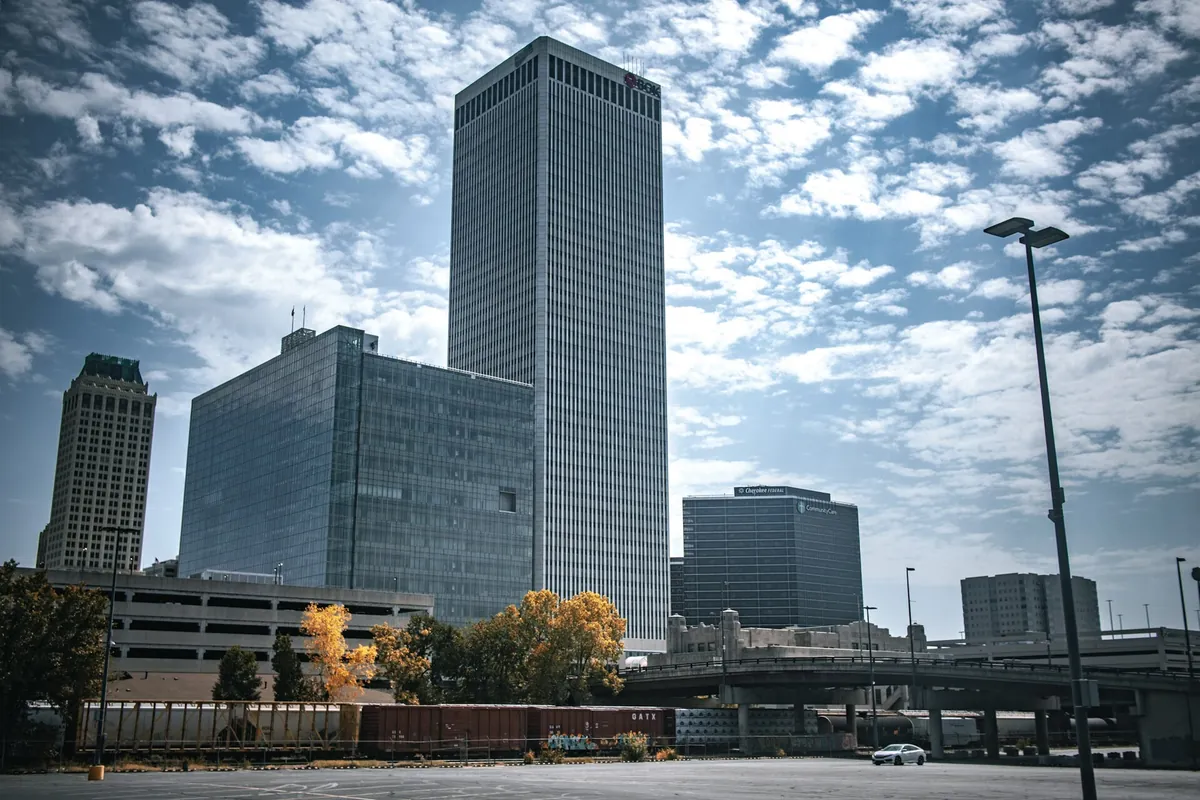
Tulsa publishes a full hardness page — the chemistry, the five-band ladder in both units, the symptoms — and never states its own figure, the exact inverse of Greensboro. Its ladder does match the USGS boundaries, which is a useful independent corroboration. Eastern Oklahoma runs on lake water while the centre of the state runs on Garber-Wellington groundwater, so the state splits in two. Spring storms set the commercial rhythm, red-bed dust is abrasive and staining, and the downtown Art Deco stock is the specialist segment.
Tulsa publishes its hardness by treatment plant rather than as one city number, and the two are far apart: the A.B. Jewell plant, fed by Lake Oologah, averages 140 mg/L or 8.2 grains per gallon, while the Mohawk plant on Lakes Eucha and Spavinaw averages 89 mg/L or 5.2 grains. The city points customers at a service-area map to find out which plant feeds an address, and the north and west of the city are usually on Mohawk.
The ladder Tulsa publishes matches the USGS boundaries exactly — soft below 17.1 ppm, moderately hard 60 to 120, hard 120 to 180, very hard above 180. That is worth knowing because other operators use their own scales, and a customer quoting a band label from a different utility may be working off different boundaries entirely.
Oklahoma is not one water. Tulsa states that eastern Oklahoma public supply comes largely from lakes, while central Oklahoma — Oklahoma City, Norman, Edmond — runs on Garber-Wellington groundwater. A figure or a method carried across the state will be describing the wrong source at one end of it.
The city publishes separate water quality reports for Tulsa and for Spavinaw, which is a per-source disclosure shape rather than a single citywide table. Where a utility splits its reporting like that, the per-source documents are what to pull rather than a summary.
Oklahoma's Permian red beds put iron-oxide fines into the air across the region, and they behave differently from ordinary dust — abrasive enough to scratch under a dry cloth and staining rust-toned rather than grey. The first pass on a loaded pane has to be a flood, not a wipe.
Downtown holds one of the denser concentrations of Art Deco commercial architecture in the country, a legacy of the oil boom. Ornamental metal, original glazing and detailed spandrel work take longer per opening and want gentler handling than a standard commercial route allows for.
How old the glass is
- Before 1940 · 9%wood sash and older glass
- 1940–1959 · 21%steel casements, early aluminium
- 1960–1979 · 34%aluminium sliders, often single-pane
- 1980–1999 · 21%double-pane units become standard
- 2000–2009 · 7%vinyl frames, low-E spreading
- 2010 or later · 7%low-E common: gentle cleaners only
The city, by neighborhood
What window cleaning costs in Tulsa
Storm exposure is priced into this market whether or not it is written down. Spring hail and wind events put work on every route in the city simultaneously and the restoration passes that follow run for weeks. Downtown's Art Deco concentration gives a small commercial core a genuinely specialist segment, where ornamental metal and heritage glazing support rates the volume market does not.
Doing it yourself
Ordinary residential glass is manageable. The two local hazards are storm-related and neither is a technique question: hail drives grit into screens and frame channels that must be floated off rather than wiped, and the red-bed dust common across Oklahoma stains rust-toned as well as abrading. Art Deco downtown stock adds a third category, where ornamental metal and original glazing want gentler handling than a commercial route allows.
OPEN COST ESTIMATOR →2025 annual mean at the Tulsa Central monitor, 3520 1/2 N. Peoria, 10.8 km north-west of the city (EPA site 40-143-1127).
Largest air release: HF Siinclair Tulsa Refining LLC East Facility, 902 W 25TH ST (petroleum), inside the city limits, 210,976 lb in 2024.
Tulsa's water-shortage chapter lets the mayor restrict or prohibit particular uses of city water by an order filed with the City Clerk, backed by a written report on the supply figures relied on. Outside use, as the chapter defines it, takes in washing and sprinkling done outside a building, so a hose rinse on exterior glass can fall under such an order.
Tulsa Revised Ordinances Title 11-C §1301: mayor authorized to implement water conservation measures · Tulsa Title 11-C §1300: definitions (outside use) · checked September 2026
Tulsa counts wash water from cleaning driveways, parking lots and other pavement as an allowable discharge to its storm sewer only when the person cleaning uses best management practices, absorbent materials among them, to hold back pollutants, and removes floating debris from the surface before washing. Crews rinsing storefront glass over a paved lot can follow the same steps.
Tulsa Revised Ordinances Title 11-A §504: pavement wash waters · checked September 2026
Inside any of Tulsa's HP historic preservation zoning districts, an HP permit is needed before work is done on an existing building unless the zoning code expressly exempts it. Alteration, renovation and even painting are listed as examples, and the permit is required whether or not the job needs a building permit.
Tulsa Zoning Code §70.070: HP permits · checked September 2026
What actually shows up on Tulsa glass
Same chemistry pattern as Kansas wheat-belt drift. Wet-rinse-first to avoid spreading before alkaline-soap wash. Heaviest in dry-stretch years.
Tulsa, answered
How hard is the water in Tulsa, Oklahoma?+
There is no single Tulsa figure, and the city says so itself: the A.B. Jewell plant delivers 140 mg/L while Mohawk delivers 89, a difference that crosses a band boundary.
How much does window cleaning cost in Tulsa?+
Residential window cleaning in Tulsa typically runs $8–13 per pane or $240–430 for a standard single-story exterior. Storm exposure is priced into this market whether or not it is written down.
When is the best time of year to clean windows in Tulsa?+
Tulsa's drier, frost-free months are July to October, by NOAA's 1991–2020 normals for the Tulsa International Airport station, where May brings the most rain. The calendar on this page marks July (after the March 29 bloom) and October (after smoke season and before frost). Frost nights usually run from November 4 to March 31. Normal highs reach 90°F in July and August.
Can I rinse windows with Tulsa tap water?+
Not as the final rinse: Tulsa Water and Sewer publishes hardness of 89–140 mg/L, enough to spot as it dries, so finish with pure water. Water left to dry leaves mineral scale; fresh spots lift with a mild acid. It draws on Lake Oologah to the A.B. Jewell plant and Lakes Eucha, Spavinaw and Hudson to the Mohawk plant.
Why do my windows look dirty so quickly in Tulsa?+
In Tulsa the dominant residue patterns include permian red-bed iron-oxide dust, abrasive and staining and spring hail and wind-driven grit across the whole market. Surface supply means the seasonal movement is in the reservoir rather than in a well field, and a drawn-down lake in late summer concentrates whatever it carries.
Do I need a professional to clean my windows in Tulsa?+
Ordinary residential glass is manageable. The two local hazards are storm-related and neither is a technique question: hail drives grit into screens and frame channels that must be floated off rather than wiped, and the red-bed dust common across Oklahoma stains rust-toned as well as abrading.
What sets Downtown / Deco District apart for window cleaning in Tulsa?+
Pre-1930 art-deco commercial heritage core (the Tulsa oil-money skyline) with substantial heritage glazing. Maple Ridge and Brookside have their own housing stock and glazing as well.
Other cities we cover in Oklahoma
Nearby cities in neighboring states
Just over the Oklahoma line