Window Washing in Nashville
Nashville's Cumberland supply runs 62 to 113 mg/L with a warm-season algal film, while suburban wells beyond the Metro system carry karst minerals.
Nashville's Cumberland River water tests moderately hard on calcium alone, so its total hardness runs higher, and the utility's own index shows it leaning aggressive rather than scale-forming; the river supply also carries a warm-season algal film. July to October is the best stretch for exterior work. The Gulch and SoBro towers built a rope-access market that sets the top rates, while a single-story exterior runs $300 to $550.
What the water means for the glass
Two things about this figure matter more than its size. It is calcium hardness only, so the total is higher than the number suggests and a softener sized to it will be undersized. And the operator's own Langelier index is negative, meaning the water is undersaturated and mildly dissolving rather than depositing — so despite a moderate reading, Nashville water is not a strong scale-former on glass. Residue here is more likely to be organic or airborne than mineral.
Nashville tap water, by the numbers
| Hardness | 62–113 mg/L as CaCO₃ Averaging 78 mg/L; moderately hard — but published as CALCIUM hardness rather than total, so the true total runs somewhat higher. |
|---|---|
| pH | 7.19 (range 7.05–7.41) |
| Alkalinity | 65.2 mg/L as CaCO₃ (range 54.3–88.1) |
| Corrosion index | Langelier index -0.95 (range -1.3 to -0.7) — undersaturated: this water dissolves scale rather than depositing it |
| Iron | not detected |
| Manganese | 0.0012 mg/L (range 0.0005–0.0019) |
| Sodium | 12.2 mg/L (range 11.7–12.9) |
| Chloride | 13.5 mg/L (range 7.5–16.4) |
| Total dissolved solids | 146 mg/L (range 128–189) |
| Disinfectant | free chlorine |
| Source and treatment | The Cumberland River, screened for debris and treated at two plants: Omohundro, built 1889 and rated 90 million gallons a day, and K.R. Harrington, built 1976 and rated 112 MGD. About 109 million gallons a day to more than 226,500 customers across Davidson County, through 3,100 miles of main, 54 pumping stations and 35 reservoirs. · Screening, pre-treatment and flash mix, alum coagulation, flocculation and sedimentation, filtration, then hypochlorite disinfection and fluoridation · No softening step. |
SOURCE · Metro Water Services, Complete Water Quality Report for Jan-Dec 2025, PWSID TN0000494, 'Secondary Standards' and 'Miscellaneous' tables, entry point to distribution annual averages (nashville.gov), read with the 2025 Consumer Confidence Report for the treatment process and disinfectant residual · How we source these numbers
When a wash holds
What sets the cleaning clock
Summer sets the pace through the river rather than through minerals. Warm-season algal and organic load in the Cumberland puts a faint biological film into the supply that shows most on shaded glass, and the river's own temperature swings from under 8°C to over 30°C across the year. Suburban properties on Middle Tennessee karst groundwater run on a completely different clock, which matters for any crew working beyond the Metro boundary.
TENNESSEE SEASON BY SEASON →What's specific to Nashville
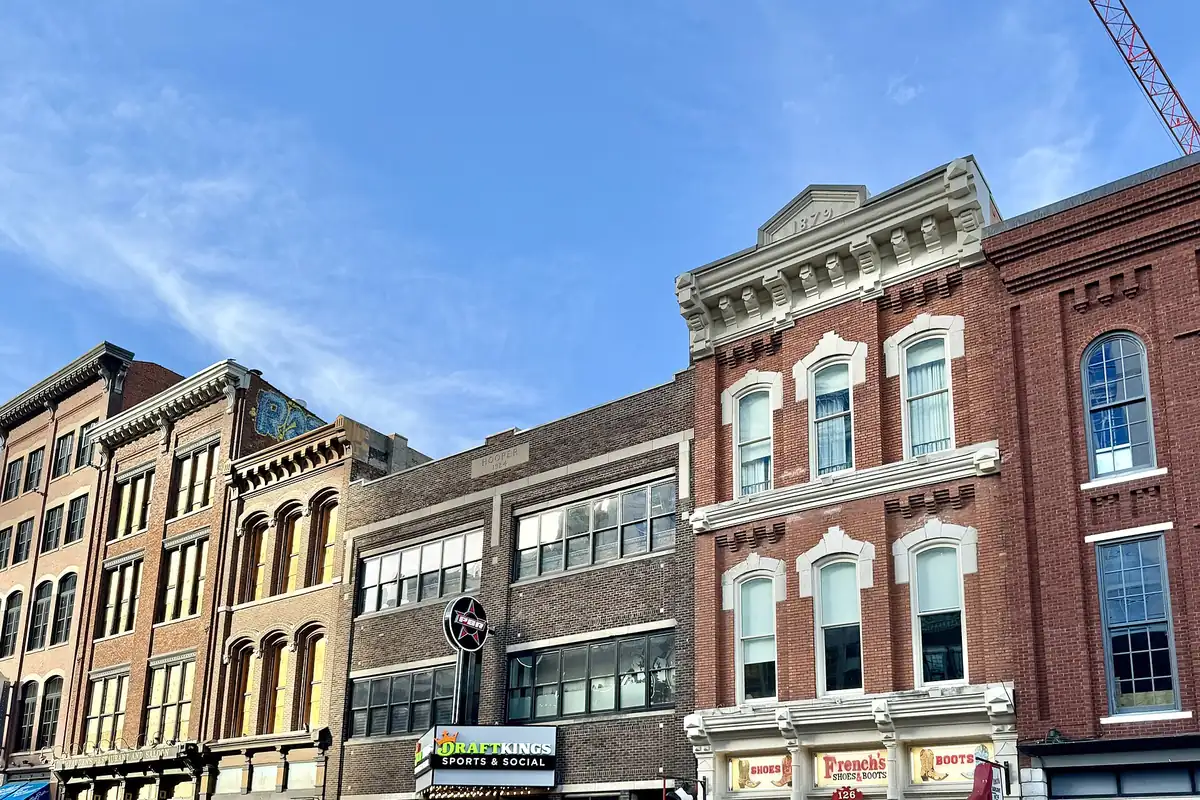
Metro Water Services publishes 78.2 mg/L across 61.8–113.2 — but as calcium hardness rather than total, with no magnesium reported, so the true figure runs higher. More useful for glass is the operator's published Langelier index of −1.0: the water is undersaturated and mildly dissolves scale rather than depositing it, so residue here is usually organic rather than mineral. Belle Meade heritage glazing and the post-2010 Gulch and SoBro rope-access towers are the two high-rate books, with Broadway running a short high-frequency route underneath them.
Metro Water Services treats Cumberland River water at the Omohundro and K. R. Harrington plants and publishes hardness as 78.2 mg/L averaged across a 61.8 to 113.2 range. Read the label carefully: the utility reports this as calcium hardness, not total hardness, and does not publish magnesium anywhere — so the real total is higher than the printed figure.
The same table gives a Langelier index of -1.0, ranging to -1.7. Negative means the water is undersaturated with calcium carbonate and mildly dissolves scale rather than laying it down. For glass that is unusually good news at this hardness level: residue in Nashville is more often organic or airborne than mineral, and acid-based scale treatments are rarely the right first reach.
Suburban Middle Tennessee sits on karst limestone and the groundwater there behaves nothing like the river supply in the city. A crew working across the Metro boundary into well-served areas is working two different waters, and a method proven downtown can underperform badly twenty minutes out.
The Cumberland carries a warm-season organic and algal load that the plants treat but do not eliminate, and the river's temperature swings from under 8°C in winter to over 30°C in summer. Shaded glass picks up a faint biological film through the warm months that reads as haze rather than as spotting.
The Gulch and SoBro went from low-rise to curtain wall inside fifteen years, and the city now supports a genuine rope-access market that did not exist before 2010. That work carries rigging, permits and wind limits, and it is priced on a scale entirely separate from the rest of the city.
Broadway's entertainment strip runs an interval closer to a transit hub than a high street. Foot traffic, spilled drink and constant hand contact put storefront glass beyond presentable within days rather than weeks, and the honest sell there is frequency at a route rate rather than a better clean.
How old the glass is
- Before 1940 · 6%wood sash and older glass
- 1940–1959 · 12%steel casements, early aluminium
- 1960–1979 · 23%aluminium sliders, often single-pane
- 1980–1999 · 24%double-pane units become standard
- 2000–2009 · 13%vinyl frames, low-E spreading
- 2010 or later · 22%low-E common: gentle cleaners only
The city, by neighborhood
What window cleaning costs in Nashville
The city has grown a rope-access market from almost nothing in fifteen years. Post-2010 high-rise through the Gulch and SoBro means curtain wall, stage rigging and permits, and that work sets a rate the ground-level market does not touch. Against it, tourism concentration on Broadway drives an unusually short interval on entertainment-district storefront glass, which is low-skill high-frequency work priced on route rather than difficulty.
Doing it yourself
Ordinary Nashville glass is forgiving — moderate, slightly aggressive water and a lot of accessible modern housing. Belle Meade is where that stops. Pre-1940 luxury residential there carries leaded and stained glass in original sash on elevations that are often two and three storeys, and the combination of irreplaceable glass and real height is not a weekend job. The Gulch and SoBro towers are rope work and not a homeowner question at all.
OPEN COST ESTIMATOR →2025 annual mean at the Lockeland monitor, 105 South 17TH ST @ Lockeland School, 4.2 km east of the city (EPA site 47-037-0023).
Largest air release: Arcosa Marine Products Inc PLT 296, 1050 Trinity RD (transportation equipment), 1.4 km outside the city limits, 34,378 lb in 2024.
Nashville sets no standing limits on hose use: Metro Code Chapter 15.28 bans only wilful waste and lets Metro Water Services order a customer to stop useless waste, such as faucets left running. The director can also ban hose sprinkling when the water supply calls for it, by an order published in the daily papers, and hose use stays unlawful until that order is lifted.
Metro Nashville Code, Chapter 15.28: Water use restrictions · checked September 2026
Metro Water Services' pressure washing guidance, which covers building exteriors, calls dirty pressure-washing water in a storm drain an illicit discharge that can bring a fine. Block nearby drains, skip soap where you can, and send the water across grass, into the sanitary sewer or into a capture system.
Metro Nashville Water Services, pressure washing guidance (NPDES Division) · checked September 2026
In Nashville, replacing windows needs a Metro Historic Zoning Commission preservation permit in historic preservation and landmark overlays, but neighborhood conservation overlays review only new construction, additions, demolition and relocation. Work seen only from an alley, or not visible from a public right-of-way at all, is not reviewed.
Metro Nashville Historic Zoning Commission, overlay guidelines: what each overlay reviews · Metro Nashville, Historic Zoning Handbook · checked September 2026
What actually shows up on Nashville glass
Peak yellow-pine-pollen pulse in late March. Wet-only handling. Do not scrape or run aggressive wash; pollen lifts cleanly with water plus light alkaline soap.
Sub-micron calcium-carbonate fraction in karst-aquifer suburban water systems resists standard acidic lift. Extended citric dwell (3-4 minutes) or second-pass wash required. Looks like etching on first encounter; is not.
Memphis Midtown and shaded inner-city stock through Nashville and Chattanooga show heavy mold-and-mildew bloom on window frames and silicone bead. Hypochlorite or quaternary-ammonium pre-treatment.
Nashville, answered
How hard is the water in Nashville, Tennessee?+
Nashville runs on Metro Water Services lake or reservoir surface water at a published 62–113 mg/L (CaCO₃), averaging 78 — moderately hard — but published as CALCIUM hardness rather than total, so the true total runs somewhat higher. Two things about this figure matter more than its size.
How much does window cleaning cost in Nashville?+
Residential window cleaning in Nashville typically runs $10–16 per pane or $300–550 for a standard single-story exterior. The city has grown a rope-access market from almost nothing in fifteen years.
When is the best time of year to clean windows in Nashville?+
Nashville's drier, frost-free months are July to October, by NOAA's 1991–2020 normals for the Nashville International Airport station, where March brings the most rain. The calendar on this page marks July (after the March 31 bloom and after smoke season) and October (before frost). Frost nights usually run from November 3 to March 31.
Can I rinse windows with Nashville tap water?+
Yes, if the rinse is squeegeed off before it dries: Metro Water Services publishes dissolved solids of 146 mg/L, between this site's two dissolved-solids flags. Iron, manganese, sodium and chloride all sit under this site's flags (highest: sodium up to 12.2 mg/L). Treatment starts with screening, pre-treatment, flash mix and alum coagulation.
Why do my windows look dirty so quickly in Nashville?+
In Nashville the dominant residue patterns include warm-season algal and organic film from the cumberland supply and karst-groundwater mineral on suburban properties beyond the metro system. Summer sets the pace through the river rather than through minerals.
Do I need a professional to clean my windows in Nashville?+
Ordinary Nashville glass is forgiving — moderate, slightly aggressive water and a lot of accessible modern housing. Belle Meade is where that stops. Pre-1940 luxury residential there carries leaded and stained glass in original sash on elevations that are often two and three storeys, and the combination of irreplaceable glass and real height is not a weekend job.
What sets Downtown / Broadway apart for window cleaning in Nashville?+
Entertainment-district storefront and signage glass on the shortest interval in the city. Volume route work, early-morning access before venues open, and hand-contact film rather than dirt as the presenting problem. Belle Meade and Germantown have their own housing stock and glazing as well.
Other cities we cover in Tennessee
Nearby cities in neighboring states
Just over the Tennessee line