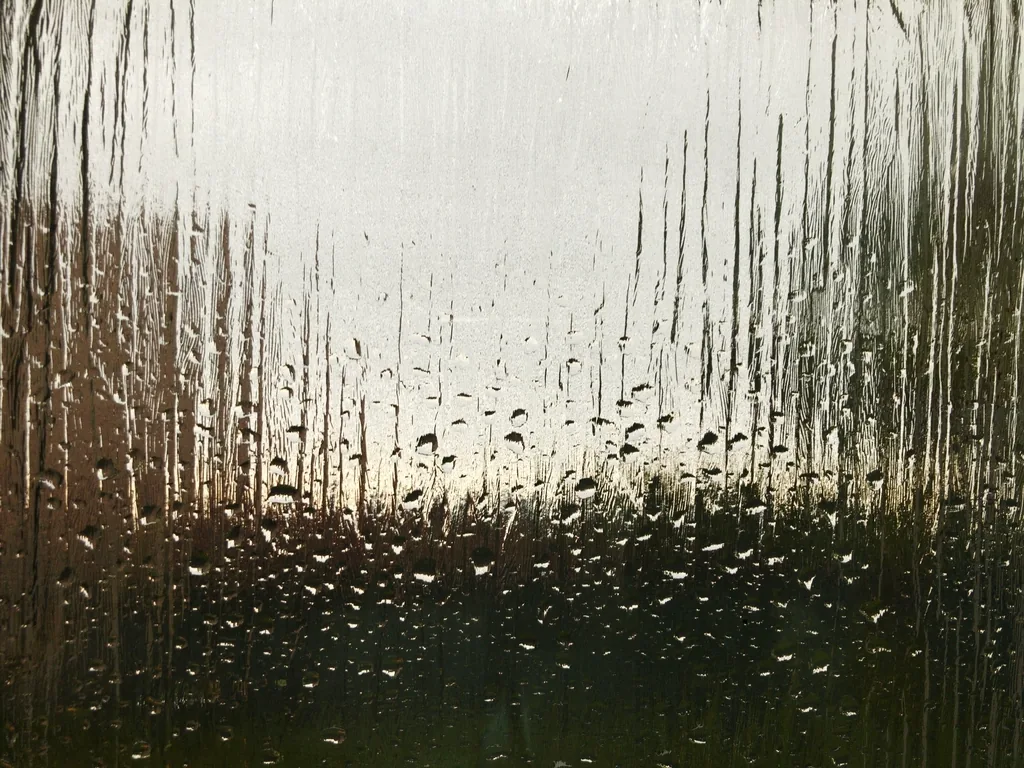
Cloudy shower glass that won't come clean
When shower glass stays hazy after a real cleaning, the surface itself has changed. How to tell corrosion from its three imposters, and what still works.
PUB. JUL 15, 2026
Permanent haze is a diagnosis of exclusion. Rule out the three imposters first:
- Imposter one — residual soap film. One strong degrease pass. If the haze moves, it was never permanent.
- Imposter two — mineral you haven't actually beaten. The compress method with real dwell time, both chemistries, in order.
- Imposter three — a dying coating. Patchy, blotchy haze on glass that once beaded water points at coating remnants, not damage.
- The wet test settles it: haze that vanishes while the glass is wet and returns as it dries is corrosion — the surface itself. No chemistry reverses it.
- Then two honest options: cerium oxide polishing (real restoration, real labor) or panel replacement, which costs less than most people fear.
Shower glass corrodes faster than any other glass in a house. The last section covers why — and how to keep the replacement panel from repeating history.
The call always sounds the same. I cleaned the shower door properly this time — the vinegar, the compress, the whole routine from your site — and it looked perfect wet. Then it dried and the haze came back. What did I miss?
Usually: nothing. The cleaning worked. Every removable thing on that glass is gone. What's left isn't on the glass at all — it's in it, a corroded layer of the surface itself, and the haze reappearing as the panel dries is the signature of exactly that. Shower glass develops this condition more than any other glass in a house, for reasons worth understanding because they decide what you do next.
But "the glass is permanently damaged" is a serious verdict, and it gets handed down wrongly all the time — I've seen replacement panels ordered for doors that needed one degreasing. So this piece runs the way any good failure analysis runs: rule out everything fixable first, confirm the diagnosis with a test that can't lie, and only then talk about the two honest options.
Why rule things out in this order
A permanent-damage verdict is a diagnosis of exclusion — you reach it by eliminating everything fixable, not by recognizing corrosion directly, because corrosion looks like several removable things until you've ruled those things out. The order the imposters come in isn't arbitrary; it runs from cheapest and most common to least, so you spend the least effort to reach the answer.
Soap film comes first because it's the single most frequent cause of "permanent" haze and the cheapest to disprove — thirty seconds and a dab of degreaser. Under-beaten mineral comes second because it's the next most common and costs only a fingernail drag to check for. Coating remnants come third because they're less common and require a specific history (someone treated the glass) to be plausible. Only when all three fail do you run the wet test, because the wet test is the one that delivers bad news, and you don't want to deliver bad news until you've exhausted the good.
This matters because the failure mode in the other direction is expensive. People who skip the elimination and jump straight to "it must be etched" order replacement panels for glass that needed one alkaline pass. The whole discipline of this piece is refusing to reach the permanent verdict until the fixable explanations are genuinely gone — because the fixable explanations are more common than the permanent one, and they're cheap to test for. Run the ladder of imposters in order, and you'll either fix the problem for the price of a cleaning or arrive at a corrosion diagnosis you can actually trust.
Imposter one — the film you haven't removed
The most common "permanent" haze is a thin, uniform soap-scum film that survived a mineral-focused cleaning. It's easy to see how: the cleaner ran the acid rungs faithfully, dissolved every deposit, and never ran an alkaline pass — and soap scum shrugs off acid completely. The result is a door that's mineral-free and still evenly dull.
The test: one strong degrease pass on a test patch — a dab of concentrated Dawn worked in with a fingertip, two minutes, hot rinse, dry it, and look. If the patch reads clearer than its surroundings, your haze is film, not damage, and the fix is the degrease rung, applied with intent, across the whole panel.
While you're at it, consider the subtler version: surfactant residue from the cleaning itself. A too-soapy mix that never got a proper final rinse leaves its own haze, which mocks you by appearing a day after the "successful" cleaning. The fix there is a 25% isopropyl alcohol wipe-down — the neutralization pass — not more cleaning product.
Imposter two — mineral you haven't actually beaten
The second imposter is buildup that outlasted an underpowered attack. Spray-and-wipe vinegar does nothing measurable against established deposits; the acid needs ten minutes of held contact, which on vertical glass means the paper-towel compress, and heavy laminate needs the alternating degrease-acid sequence, sometimes twice around. Plenty of "permanent" haze is just deposits that have never once experienced real dwell time.
The test: run the fingernail across the haze. Any catch, flake, or texture means material is still sitting on the surface — corrosion at the stage that matters here is smooth. If there's texture, go back to the complete shower glass guide and run the ladder as written, including the sulfamic rung if the vinegar rungs stall. Come back here only if the glass beats you while smooth. The same fingernail test settles the same argument on tile, porcelain and fixtures, which is why hard water stains are worth diagnosing by surface rather than by room.
Imposter three — the ghost of a coating
If the haze is patchy — blotches and zones rather than uniform frost or deposit geography — and the door ever beaded water impressively, suspect a dying hydrophobic coating. Coatings fail unevenly, high-spray zones first, and a half-degraded coating scatters light in irregular patches while confusing every diagnostic that assumes bare glass. Previous owners apply these things and don't leave notes.
The test: water behavior. Splash the panel — if some regions bead tightly while others sheet, you're looking at coating remnants. The fix is a full strip (one deliberate alkaline-plus-mild-abrasive pass, which is finally allowed because the coating is already dead), then the ladder, then a decision about recoating properly.
The real thing: corrosion
Three imposters ruled out, run the test that settles it.
The wet test. Dry the panel completely. Photograph the haze in raking light. Now wet the glass thoroughly and look again: if the haze vanishes while wet — the panel looks perfect, like the imposters never existed — and returns as it dries, the diagnosis is corrosion. Water is temporarily filling the microscopic pits and valleys of a damaged surface, matching its optics to the surrounding glass; as it evaporates, the rough texture scatters light again. Deposits don't behave this way. Films don't. Only a changed surface does.
What changed is the glass itself.¹ Soda-lime glass is durable but not inert: water leaches sodium out of the surface and leaves a soft, altered, silica-rich layer; alkaline conditions attack the silica network directly. A shower is the perfect accelerant for both — hot water speeding every reaction, alkaline soap residue on every surface, humidity holding the wet phase of the wet-dry cycle for hours, and old mineral deposits acting as little alkaline poultices that corrode the glass fastest exactly where they sat.² This is why the haze so often traces ghost rings where the worst spots used to be, and why a door can be chemically spotless and optically ruined at once.
If you want the full science and the broader diagnostic, Easton's etching piece is the parent reference. And to be precise about a neighboring condition: haze between the panes of an insulated unit is a different failure entirely — a dead seal, not a dead surface — though shower enclosures, being single-pane tempered, don't get that one.
Grading the damage before you commit
Once the wet test confirms corrosion, the next question decides everything about what you do: how deep is it? The answer sorts you cleanly toward polishing, replacement, or living with it, and you can grade it yourself with two senses.
Look at it under different light. Corrosion that only shows up in raking light — hold a flashlight flat against the dry glass — or against a dark background, and disappears under normal front lighting, is at the shallow end. The altered layer is thin, scattering light only at grazing angles. This is the grade that polishing can genuinely fix, because the amount of glass that has to come off is small.
Feel it with a fingernail. Drag a nail across the hazy area, lightly. Corrosion you cannot feel at all — glass-smooth, with the haze living entirely in the optics — is shallow and polishable. Corrosion you can feel as texture, roughness, or distinct pitting has gone deep enough that removing it means removing a meaningful thickness of glass, which is past the point where hand or even machine polishing is economical. Frosted bands you can feel are effectively permanent by any home method.
Check how much of the panel is affected. A door with light haze in one zone — usually the bottom third, where deposits sat longest — is a very different project from one that's uniformly frosted across its whole face. Localized shallow corrosion is a plausible afternoon with cerium oxide. Whole-panel corrosion, even if it's shallow, is enough square footage that the labor math tips toward simply buying a new panel.
Grade honestly before you start, because the most common regret in this whole category is spending a full weekend polishing a panel that was always going to need replacing, discovering at hour four that the texture won't come out, and paying for the replacement anyway. Ten minutes of grading up front tells you which project you actually have.
What still works: option one, polishing
Corroded glass can be restored, in the narrow, physical sense of the word: remove the altered surface layer, and the undamaged glass beneath scatters no light. The tool is cerium oxide — the optician's polishing compound — as a wet slurry on a felt pad, worked across the surface until a micron or so of glass, and the damage with it, is gone.³
Honest expectations, because this is where internet optimism goes to die. Light corrosion — haze visible only in raking light or against dark backgrounds, glass-smooth under a fingernail — polishes out, at a real labor cost: fifteen to thirty minutes per square foot by hand, faster with a machine and the discipline to keep the pad wet, the speed low, and the tool moving, because localized heat on tempered glass is how panels explode. Moderate corrosion — visible haze in normal light — is machine territory and patience territory, and a full door becomes an afternoon. Anything you can feel — pitting, texture, frosted bands — is beyond economic hand restoration; the layer that must come off is too thick.
And a hard line: some professional restoration chemistries dissolve etching with hydrofluoric-acid relatives. They work. They are also a genuine medical hazard with delayed, severe consequences from skin exposure, and they do not belong in a home bathroom under any framing.⁴ If your damage is bad enough to tempt that route, it's bad enough for option two.
Option two: the replacement math
For a standard framed door, a replacement tempered panel — the glass alone, into your existing frame — is a few hundred dollars installed in most markets, often less than a professional polishing visit and always less than people braced for. Frameless enclosures run higher because the glass is thicker and the hardware fussier, but even there, one panel is a fraction of the enclosure's original cost. Get the quote before you spend a weekend polishing; the math genuinely surprises people, in the good direction.
One practical warning if you go the replacement route: shower glass is tempered, and tempered glass cannot be cut or drilled after manufacture — it shatters into gravel if you try. That means a replacement panel has to be ordered to exact dimensions, with any holes for hinges or handles specified up front, from the measurements of the opening or the old panel. You can't buy an oversized panel and trim it to fit the way you might with ordinary glass. Measure carefully, or have the glass shop template the opening, because a tempered panel ordered a quarter-inch wrong is simply scrap. This is also why you can't polish your way through a hole-placement problem or shave a binding edge — with tempered glass, the dimensions are fixed at the factory and the only fix for wrong dimensions is a new panel.
If you do replace: order the panel and read the coatings piece before it arrives, because the day it's installed is the one day its surface will ever be factory-clean — the best coating-application conditions it will ever see.
Making the verdict stick
Whichever option you take, you now own a clear panel and the exact conditions that ruined the last one. Corrosion is slow — years, not months — which means prevention barely has to try to win. The daily squeegee habit removes the water before it can cycle; the fan clears the humidity that extends every wet phase; prompt deposit removal takes away the alkaline poultices that concentrate the attack; and in genuinely hostile water, a maintained coating takes the chemistry on itself as a renewable, sacrificial layer.
The economics of prevention versus cure
It's worth putting numbers next to the habit, because the case for thirty daily seconds is overwhelming once you see what the alternative costs.
The cure for corrosion is either an afternoon of miserable cerium-oxide polishing that only works on light damage, or a few-hundred-dollar replacement panel that only postpones the problem if the conditions that caused it don't change. Both are real costs — money, or a weekend, or both — and neither is a one-time payment, because a replacement panel installed into the same hostile conditions simply starts the same slow clock again. Cure, in other words, is expensive and temporary.
Prevention is thirty seconds a day with a squeegee that costs less than a lunch, plus a fan you already own, plus the occasional deposit removal you'd be doing anyway. And because corrosion is slow — it takes years of unbroken wet-dry cycling to develop — prevention barely has to be perfect to win. You can skip the squeegee on travel weeks, forget the fan occasionally, and still stay far ahead of a process that needs sustained daily attack to make headway. The margin is enormous and it runs entirely in the careful household's favor.
This asymmetry is the whole argument. A process that takes years to damage the glass is trivially outrun by a habit that takes seconds to interrupt it. The people who end up polishing panels or ordering replacements are almost never people who tried prevention and found it insufficient; they're people who never knew the glass was on a clock at all. Once you know — and if you've read this far, you know — the maintenance is close to free and the damage is close to optional.
The door that went cloudy did it invisibly, one shower at a time, over years nobody was watching. The replacement gets watched. That's the entire difference.
Notes
- The mechanism, compressed. Soda-lime glass is a silica network with sodium and calcium ions packed into it. Water attacks it two ways: ion exchange, where hydrogen ions swap in for sodium and leave a soft, hydrated, silica-rich layer at the surface; and network hydrolysis, where hydroxide ions cut the silicon-oxygen bonds themselves. The first dominates below pH 9, the second above it. A shower supplies both regimes daily — near-neutral hot water for the exchange, alkaline soap residue for the hydrolysis — plus the wet-dry cycling that concentrates leached ions into an increasingly alkaline film as droplets evaporate. The frosted texture you see is that altered layer scattering light.
- Why the shower specifically: reaction rates roughly double per ten degrees Celsius, and shower glass runs 30–40 degrees warmer than a window whenever it's in use. Soap and shampoo residues are alkaline. Humidity keeps the surface in the wet phase of the wet-dry cycle for hours after each use. And established mineral deposits make it worse — a deposit holds moisture against the glass and buffers it alkaline, so the glass corrodes fastest exactly where the deposits sat longest. This is why a door can come chemically clean and reveal ghost rings of haze exactly where the worst spots used to be.
- Cerium oxide practical notes: the slurry works by a combined mechanical-chemical action unique to glass polishing — it's the same compound optical shops use. By hand with a felt block, expect roughly 15–30 minutes per square foot for light haze, which is honest and miserable arithmetic for a full panel. With a drill or polisher, keep the pad wet, the speed low, and the tool moving: a dry pad on one spot builds heat fast, and localized heat on tempered glass is how panels shatter in people's hands. Deep etching — texture you can feel with a fingernail — is beyond what surface polishing can economically remove.
- A category warning that belongs in every piece on this subject: some professional 'glass restoration' products remove etching chemically using hydrofluoric acid or ammonium bifluoride. These work by dissolving the glass surface — controlled damage to erase uncontrolled damage — and HF exposure is a medical emergency with delayed symptoms. They have legitimate uses in trained hands with proper protective equipment. They have no place in a home bathroom, full stop.
Sources
- Corning Museum of Glass, 'Glass Disease: Crizzling and Surface Alteration,' conservation notes.
- GANA Glass Informational Bulletin, Proper Procedures for Cleaning Architectural Glass Products, 01-0300
- NIOSH, Skin Notation Profiles: Hydrogen Fluoride / Hydrofluoric Acid (HF), DHHS (NIOSH) Publication 2011-137 — NIOSH assigns HF the notation SK: SYS (FATAL)-DIR (COR): skin contact can be life-threatening, causing severe corrosion and acute systemic toxicity, and the systemic effect can follow dermal exposure alone
Jan Davenport
Editorial team contributor covering the Midwest and Great Lakes beat. Articles bylined by Jan are researched and reviewed in collaboration with the Giordano Inc. editorial team and informed by interviews with practicing window-washing operators in the region, plus published trade and small-business operations references.