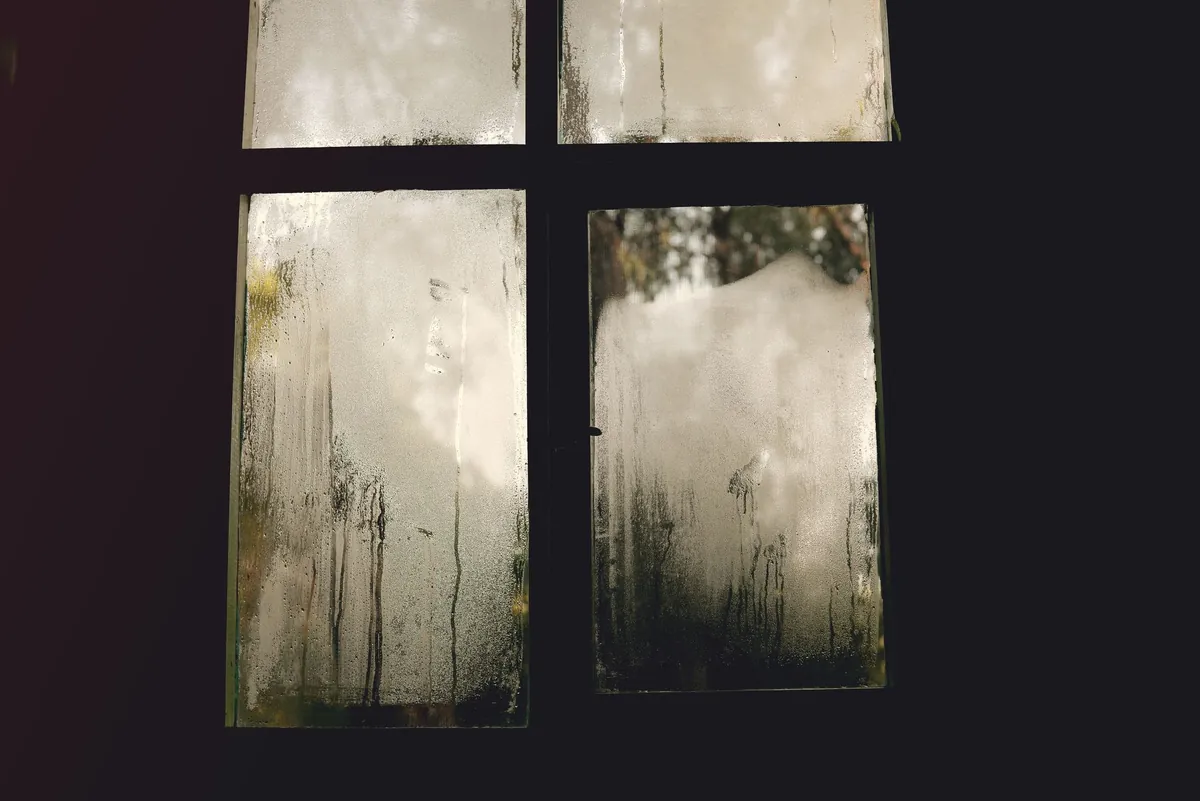
Foggy windows that won't clear: the failed-seal diagnosis no one wants to hear
When the haze is between the panes, no cleaner on earth will touch it. Here's the materials chemistry of why your double-pane window has failed, what the failure actually is, and the four options you have — including the two everyone forgets to ask about.
PUB. APR 19, 2026
If you have haze, fog, or visible moisture *between* the panes of a double-pane window, here is the unwelcome truth:
- The window has failed. The hermetic seal is breached and the desiccant is saturated.
- No cleaner will ever fix it. The damage is on the inside surface of the glass, in a sealed cavity you cannot reach.
- The four real options are: replace the IGU, replace the whole window, attempt defogging (controversial), or do nothing.
- Defogging companies exist and the technology works — but it does not restore the original insulating properties.
The single most common misdiagnosis I see is the homeowner who assumes 'foggy window' is a cleaning problem. It is not. It is a manufactured-component failure. Knowing which kind of failure you have determines what you should do about it.
There is a particular phone call I get every few months, usually from a homeowner who has been quietly seething about the same window for two years. The call always starts the same way. I've cleaned this thing inside and out fifty times. It will not come clean. There is something between the panes. Is there a way to get in there?
There is not. There is also nothing you have done wrong. Your window has failed.
This is the article I write so that the next caller can figure that out before they buy three more bottles of cleaner. The diagnosis is straightforward once you understand the materials chemistry, and the materials chemistry is genuinely interesting — at least to me, which is admittedly a low bar.
The thing inside your window is not a window
A modern double-pane window is, in glass-industry vocabulary, an insulated glass unit, or IGU. The full IGU consists of two — sometimes three — glass panes, separated by a perimeter spacer bar, with a sealed cavity between them. The spacer is typically aluminum, stainless steel, or a thermally improved composite, and it is filled with a desiccant material (usually a molecular sieve or silica gel).1 The cavity itself contains either dry air or, more commonly in modern construction, an inert gas — argon at atmospheric pressure, occasionally krypton in higher-performance units.
The cavity is sealed by two layers of sealant applied during manufacture. The inner layer, called the primary seal, is almost always polyisobutylene (PIB), a synthetic rubber selected specifically because it is essentially impermeable to water vapor and to argon.2 The outer layer, called the secondary seal, is typically silicone or polyurethane, and its job is structural rather than barrier — it holds the assembly together against thermal cycling, wind load, and the slow movement of the building.
This entire arrangement has one purpose: to maintain a hermetically dry, gas-filled cavity between two pieces of glass. That cavity is what makes a double-pane window thermally efficient. The R-value improvement over single-pane glass — typically R-2 versus R-1, or roughly double — comes almost entirely from the trapped gas, not from the glass itself.
When the seal fails, three things happen, in this order:
- The argon (or krypton) leaks out, replaced by ambient air.
- Humid ambient air begins to enter the cavity.
- The desiccant absorbs the incoming moisture — until it can't.
That third step is when you, the homeowner, notice. Up until the desiccant is saturated, the seal can be slowly leaking for months or years and you'd never see anything. This is a different failure from the one people mean when they say windows leak when it rains — that water is running through the frame assembly, not into the sealed cavity — and the two get quoted as the same job constantly. The desiccant is doing its job. Once it tips into saturation, the next humid day pushes more moisture into the cavity than the desiccant can hold, and you see condensation. Or haze. Or, in the worst cases, a permanent watermark deposited on the inside surfaces of the glass.
What the haze actually is
It depends on how long the seal has been failing.
Stage one: intermittent fog. Early-stage seal failure presents as fog that comes and goes. You'll see it on cold mornings — interior moisture has been entering the cavity but the desiccant is still partially functional. The cavity dew point fluctuates with the temperature differential between interior and exterior. Some days the window is clear. Cold mornings, it fogs up. This is the most salvageable stage, and it is also the easiest stage to ignore.
Stage two: persistent fog or haze. The desiccant is fully saturated. Moisture is now in the cavity at all times in either liquid or vapor form. The window will appear hazy in nearly all conditions, sometimes worse in mornings or after rain. You can usually see condensation droplets at the bottom edge of the cavity if you look closely.
Stage three: cloudy residue / coating degradation. This is the irreversible one. If your IGU contains a low-emissivity (low-E) coating — and almost all IGUs manufactured after 2010 do — the coating is silver-based and chemically vulnerable to moisture. Sustained moisture exposure causes the silver layer to oxidize. The result is a milky, cloudy residue on the interior surface of the inner pane that does not move, does not condense and re-evaporate, and is not removable.3 At this point the IGU is not just thermally compromised; the optical clarity of the unit is permanently damaged.
I have seen all three stages in homes where the homeowner believed they had a cleaning problem. None of these are cleaning problems.
How to confirm the diagnosis in 30 seconds
There is a simple test that distinguishes between-pane fog from surface fog. It eliminates the diagnostic ambiguity in essentially every case.
Take a rubbing alcohol pad or a cloth dampened with isopropyl alcohol. Wipe the outside of the glass vigorously over the foggy area. Wait for it to evaporate. If the fog is gone, the haze was on the outside surface — your problem is dirt or surface residue, and Mara's article on streak diagnosis is where you should be.4
If it isn't gone, repeat on the inside of the glass. Same test. If the haze disappears, the fog was on the interior surface — likely interior humidity condensing on a cold pane, which indicates a humidity issue, not a seal failure. That is the better outcome of the two, and it has a fix: how much indoor humidity your windows will tolerate is a published number that falls as the outdoor temperature does, and sweating glass usually means you are over it.
If the haze remains visible from both sides after both wipes, the moisture is between the panes. Your IGU has failed. There is no other diagnosis.
A second confirming sign, if you want it: try to find the corner where the fog is worst. Failed seals almost always present worse along one specific edge or corner — typically the edge that has been exposed to the most water (the bottom of the unit, generally) or the edge that experiences the most thermal stress (the south or west elevation, in the Northern Hemisphere). Even fogging across the entire pane is unusual and suggests very advanced failure or a manufacturing defect that compromised the entire perimeter seal at once.
Why your seal failed (the unsexy answer)
I am asked this constantly, because homeowners want to know if they did something wrong. They almost never did. IGU seal failure is, by a wide margin, a function of three boring physical realities:
1. Time. PIB primary seals, even when applied perfectly, slowly permeate water vapor at a low but nonzero rate. The desiccant's job is to absorb that vapor. The desiccant has a finite capacity. The unit's expected service life — generally cited as 15 to 25 years depending on climate and construction quality5 — is essentially the calculated point at which the desiccant runs out. After that, fogging is statistically inevitable.
2. Standing water. Anywhere water can pool against the bottom edge of an IGU is a place where the seal is being asked to function in conditions it was not really designed for. Poorly drained sills, clogged weep holes in the frame, rotted glazing tape, and ice damming all dramatically accelerate seal breakdown. If you have a cluster of failed IGUs all on the same elevation of your house, the first thing to check is the drainage pattern of that wall.
3. Thermal cycling and altitude. A sealed gas cavity expands and contracts with temperature, and the seal flexes with it. Each cycle puts stress on the seal. Houses in climates with extreme temperature swings — northern Minnesota, the high desert Southwest — will see IGU failures earlier than mild coastal climates. Altitude matters too: IGUs assembled at sea level and shipped to mountain installations experience permanent pressure differential stress. (This is why high-altitude installations sometimes require capillary tubes or breather tubes during shipping, sealed at the install site.)
If you ask me what you, the homeowner, did to cause your seal failure: probably nothing. If you have failed IGUs, your house is most likely the age it should be, located where the climate stresses windows the way it always has. The boring answer is that this is what windows do.
Your four options, ranked by what I'd actually recommend
When a customer calls and the diagnosis is confirmed seal failure, here is the menu I lay out. I have opinions about which option is right when, and unlike some of my colleagues, I will share them.
Option 1: Replace the IGU only (not the whole window)
The IGU is the glass-and-spacer assembly. It is a separate component from the window frame. In most cases, it can be replaced without replacing the entire window.
The frame stays. The sash stays. The hardware, the trim, the weatherstripping — all stay. A glazier removes the failed glass unit and installs a new IGU into the existing sash. For a standard residential double-hung or casement, expect $200–$450 per unit installed, as of 2026, with significant regional variation.
This is the right answer for the majority of seal-failure diagnoses. It is dramatically cheaper than full window replacement, the result is functionally identical to a new window from the glass outward, and any reputable glazier in your area can do the work.
The catch: the new IGU will not match the old IGUs in the rest of your house perfectly. Argon fill levels, low-E coating versions, and even glass thickness vary by manufacturer and year. Side by side, in certain light, you may notice a faint tint or reflectivity difference. Most homeowners do not notice. The few who do, notice for the rest of the window's life.
Option 2: Replace the entire window
This is the right answer when the frame itself is damaged — rotted wood, corroded aluminum, deteriorated vinyl, or warping that prevents proper sealing of a new IGU. It is also the right answer when multiple IGUs in the same window have failed, when the window is approaching the end of its expected service life on other criteria (single-glazed where the rest of the house is double, leaky frames, hardware failures), or when you are renovating anyway and updating windows is part of the plan.
Costs vary enormously by window type, frame material, and region. A standard residential vinyl replacement runs $500–$1,200 installed. Wood-clad windows triple that. Custom or historic-replication windows go higher still.
I would not recommend full window replacement for a single failed IGU on an otherwise sound window. It is a financial overreach driven by sales pressure, not by your actual problem.
Option 3: Defogging (the controversial one)
Several companies offer a service in which they drill a small hole in the failed IGU, flush the cavity with cleaner and dry air, and re-seal. The brand names vary regionally. The technology works, technically — meaning, it does remove the visible fog and restore optical clarity, at least for a while.
Here is what the technology does not do:
- It does not restore the argon or krypton fill. The cavity is now filled with ambient air, which means the unit's R-value has dropped from approximately R-2 down to about R-1.7, depending on the original construction.
- It does not restore the desiccant. The original desiccant is still saturated. Moisture entering the cavity in the future will not be absorbed.
- It does not, in cases of low-E coating degradation, repair the coating. The cloudy residue from oxidized silver remains.
I have mixed feelings about defogging. For a homeowner who simply cannot afford IGU replacement and wants to maintain visual clarity for resale or for sanity, it is not nothing. The optical fix can last several years. But anyone selling defogging as "fixing your window" is overselling it. The window's insulating function is gone permanently the moment the seal fails. Defogging restores appearances, not performance.
If you are going to defog, get specifics from the contractor in writing about what is and is not warranted. The reputable operators are forthright about the limitations.
Option 4: Do nothing
This is, surprisingly, sometimes the right answer.
If the failed IGU is in a low-priority part of the house — a basement window, a garage, a window you rarely look out of — the actual cost of failure is mostly aesthetic. The energy efficiency loss from a single failed unit in a typical home is measurable but small, on the order of a few dollars per year on the heating bill. If you do not care about the appearance, leaving the unit failed is a defensible choice. It will not get worse beyond a certain point. Once the desiccant is fully saturated and the silver coating is fully degraded, the window has reached its terminal state. It will not deteriorate further in any meaningful way.
I would not recommend this for windows in primary living spaces, for windows visible from the street (resale concerns), or for stage-one or stage-two failures where the appearance is intermittent and bothersome. But for the basement window the dog is sometimes interested in? It is a fine answer. Do not let anyone shame you for choosing it.
What you should never do
Drill a hole yourself. Inject anything yourself. Apply heat to "evaporate" the cavity moisture. Caulk over the visible seam from the outside. Use a vacuum cleaner. Use a hair dryer. Use the suction-cup contraptions sold on certain online marketplaces that promise to "fix foggy windows."
I am not exaggerating when I say I have seen attempts at every one of these, in person, at someone's house, after the fact. They do not work, and several of them turn a $300 IGU replacement into a $1,500 full-window replacement by damaging the sash, the seal, or the glass itself.
The IGU is a sealed, manufactured component. It is not user-serviceable. Treat it like the cooling system in your refrigerator: when it fails, you replace the assembly, not the gas inside.
A final word on the diagnosis you don't want
The hardest part of this article to write is the part where I tell the homeowner, who has been cleaning the same window for two years and is convinced they're missing something, that there was never anything they could have done. The window failed. They didn't fail the window.
This is information that some readers will resist, because it implies an expense they were not planning. I understand that resistance. I have given this diagnosis in person, in homes, to people who took it personally — as if the window having failed reflected poorly on them as a homeowner. It does not. The IGU industry has been quietly accepting a 15–25 year service life since the 1970s, and pretty much all of us who own old enough houses end up replacing IGUs eventually. It is no different from replacing a water heater, except that you can see the failure, which somehow makes it feel worse.
If you are reading this and you have just confirmed the diagnosis on your own window: it's genuinely fine. Get two quotes for IGU replacement from local glaziers, take the lower one if both are reputable, and the window will be functional again in about a week. That's the whole story. There is no cleaner. There never was.
Glossary terms in this piece
- Argon fill — inert gas in the IGU cavity that improves thermal performance
- Butyl migration — black streaks of PIB smearing from the spacer into the visible cavity
- Capillary intrusion — water drawn into an IGU cavity through a microscopic seal breach
- Desiccant — the molecular sieve in an IGU spacer that keeps the cavity dry
- Edge condensation — condensation along the IGU perimeter from spacer-bar conduction
- Failed seal — compromised IGU seal that lets moisture in — what 'foggy windows' actually means
- IGU — insulating glass unit — two panes, sealed cavity, desiccant, the modern window
- Polyisobutylene (PIB) — the primary butyl polymer sealing IGU perimeters; ages with heat and UV
- Spacer bar — the perimeter member that holds an IGU together and contains the desiccant
- Three-pane diagnostic — Jan's protocol: clean both exposed surfaces, see what's left between them
Footnotes
Sources
-
ASTM International, E2190 — Standard Specification for Insulating Glass Unit Performance and Evaluation — the durability test an IGU seal is certified against; failure between the panes is failure of this specification
-
Fenestration and Glazing Industry Alliance (FGIA, formerly IGMA/AAMA), industry body for insulating-glass certification and field guidance — publisher of the IGU certification programs and technical manuals referenced by fabricators
-
ASTM International, C1036 — Standard Specification for Flat Glass — the base glass specification the IGU lites are made to
-
ASTM International, Standard Test Method for Insulating Glass Unit Performance, ASTM E2190-19
-
Cardinal Glass Industries, Technical Service Bulletin CG06: LoĒ-i89® Coated Glass — the manufacturer's own care and cleaning limits for coated glass: soap solution or standard glass cleaner is fine, hydrofluoric-acid rust removers and abrasives are not, and a squeegee must have no exposed metal edge
-
Helen Sanders, Insulating Glass Seals Are Not Hermetic, USGlass, February 2024 — the trade-press piece behind the failed-seal picture here: IGU seals are permeable by design, the desiccant is what absorbs the moisture that gets in, and the unit fails when that capacity is spent — often damaging the low-E coating before visible condensation appears
-
National Fenestration Rating Council, NFRC 100: Procedure for Determining Fenestration Product U-factors, 2023 edition.
Footnotes
-
Modern IGU desiccants are typically 3A or 4A molecular sieve materials, named for the angstrom diameter of their adsorption pores. Silica gel is also used in some lower-cost units. Molecular sieves outperform silica gel on a unit-volume basis but cost more. The performance difference matters most in extreme-temperature climates. ↩
-
Polyisobutylene's exceptional vapor impermeability comes from its molecular structure: tightly packed isobutylene units with low free volume, giving it among the lowest gas-permeability coefficients of any commercial polymer. The trade-off is that PIB has poor structural strength on its own, which is why it is paired with a structural secondary seal of silicone or polyurethane. ↩
-
Low-E coatings on residential IGUs are typically a stack of thin films including a silver layer (or two, in dual-silver coatings) of approximately 10 nm thickness. Silver is selected for its near-perfect infrared reflectivity. The same property that makes it useful — low oxidation potential at room temperature in dry conditions — does not survive sustained moisture exposure. The oxidation product, silver oxide, is the cloudy residue homeowners see in advanced seal failure. ↩
-
The alcohol test works because isopropyl alcohol cuts through nearly all common surface contaminants — finger oils, surfactant residue, silicone migration, light atmospheric soiling — and evaporates without leaving residue. Anything still visible after the wipe is, by elimination, not on that surface. ↩
-
The Insulating Glass Manufacturers Alliance (IGMA) publishes service-life expectations for IGUs based on testing protocols including ASTM E2188 and ASTM E2190. Field service life closely tracks these laboratory predictions in most climates. Premature failures concentrated in specific manufacturer/year cohorts have led to several class-action settlements over the years; if your IGUs are uniformly failing well before the 15-year mark, it may be worth checking whether your installer used a unit that's part of a known recall or warranty extension. ↩
Easton Giordano
Editorial team contributor covering the Pacific Northwest and broader West Coast beat. Articles bylined by Easton are researched and reviewed in collaboration with the Giordano Inc. editorial team and informed by interviews with practicing window-washing operators in the region, plus published materials-science and trade references.