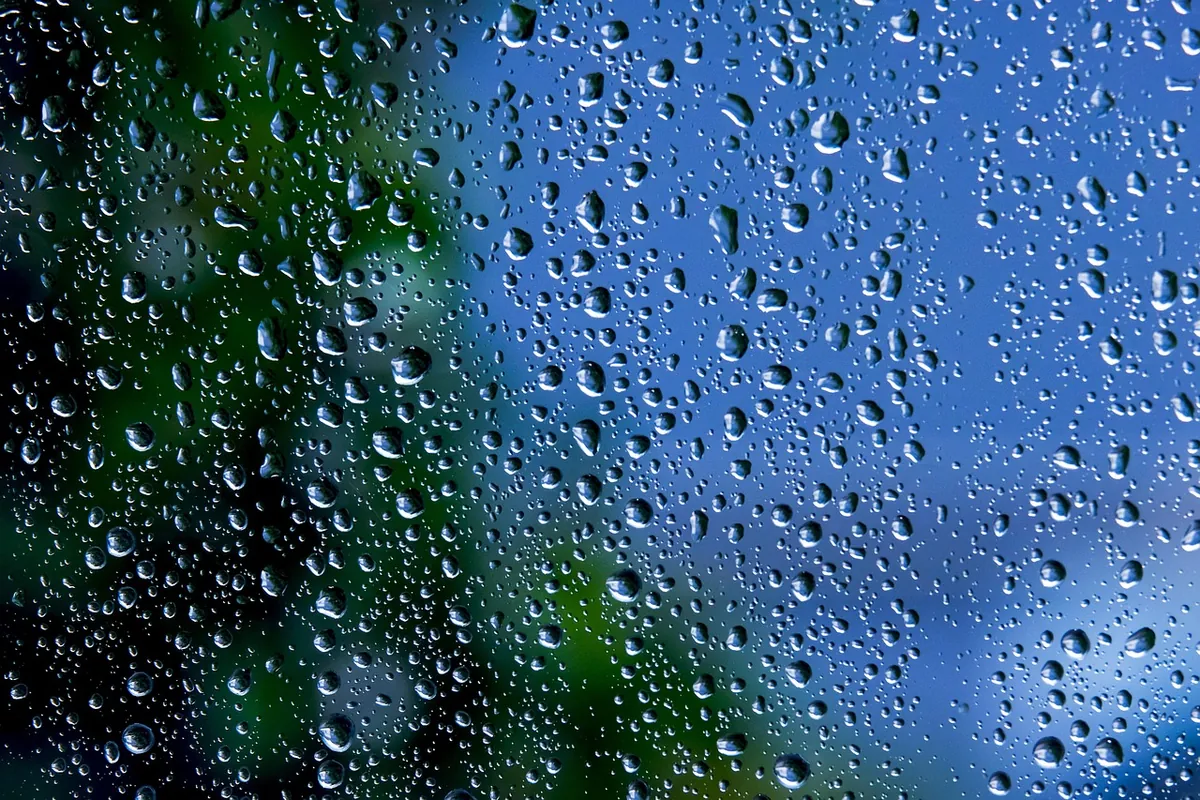
White spots on your windows after it rains? Here's what's actually happening.
Those chalky white dots that appear on your exterior glass after a storm aren't from the rain. They're from what the rain washed off your roof. Here's the diagnosis, the test, and the fix — from someone who has scrubbed thousands of them off.
PUB. APR 12, 2026
If you keep finding chalky white dots on your exterior glass after rain, here's the short version:
- It's almost never the rain itself — rain is distilled water and leaves nothing behind
- It's runoff from your roof, gutters, or upper trim carrying minerals, sealant residue, or hard well water
- Sprinkler overspray is the second most common cause — and the easiest one to fix
- The deposits are calcium carbonate or silica residue, removable with a mild acid if caught early
If they keep coming back after you clean them, the source is upstream of the glass. The fix is finding the source, not cleaning harder.
A homeowner in Bloomfield Hills called me one summer about her brand-new picture window. She'd had it installed in May. By August it looked like someone had flicked white paint at it. She'd cleaned it three times. Each time, the spots came back within a week.
I drove out, took one look at the roof, and told her what was going on in about ninety seconds.
The spots weren't from the rain. They were from her shingles.
This is the most common service call in residential window cleaning that nobody knows is a service call, because the homeowner thinks they have a window problem. They don't. They have an upstream problem, and the window is just where the evidence collects.
What rain actually deposits on glass (almost nothing)
Pure rainwater is, by chemistry, distilled water — water that has evaporated from oceans, lakes, and ground, leaving its dissolved minerals behind. By the time it falls on your roof, it has picked up some atmospheric particulates and dissolved a bit of carbon dioxide (which makes natural rain very slightly acidic, around pH 5.6),1 but the dissolved mineral content is essentially zero.
Rain hitting clean glass and evaporating leaves nothing visible behind. I've watched it happen on freshly washed test panes a thousand times. Wet glass, wet glass, wet glass — sun comes out — clean glass.
So if you have white spots after rain, the rain is not your problem. Something between the cloud and your window is contaminating the water before it touches the glass.
The four real culprits
In eleven years of running residential routes, four sources accounted for probably 95% of the "spots after rain" complaints I diagnosed. In rough order of frequency:
1. Sprinkler overspray (the easy fix)
This is the one I solved most often, and the one homeowners are least likely to suspect, because their first thought is always "the rain." But sprinklers run on the same hard water that's in your tap, and lawn-irrigation hard water is often worse than household water — many systems pull from wells, untreated.
Hard water, when sprayed onto glass and allowed to dry in the sun, deposits dissolved calcium and magnesium carbonates as the water evaporates. The result is the classic chalky white spot, which is calcium carbonate (essentially the same compound that limescale and chalk are made of).2
Here's the diagnostic test. After your next rain, look at the pattern of the spots. Real rain spots — meaning spots actually caused by rain runoff — will be evenly distributed across the whole pane and concentrated at the top. Sprinkler overspray spots will form a band, usually on the lower third of the window, sometimes only on one side, and they'll often have visible drip marks running downward from each spot. If you can see directional spray patterns, you have a sprinkler problem.
The fix is twenty minutes with a screwdriver. Adjust the heads. Cap the ones aiming at the house. If you have a system installed by someone who didn't think about glass, it's probably overdue anyway.
2. Asphalt shingle runoff (the new-roof problem)
This was my Bloomfield Hills caller's actual problem. New asphalt shingles release a fine mineral coating during the first few years of their life — mostly limestone dust and ceramic granule fines that the manufacturer applies during production. Rain washes these off the roof, down through the gutters, and onto whatever windows happen to be in the path.
The deposits look chalky-white but feel slightly gritty if you rub them with a fingertip. That texture is the tell. Pure mineral spotting from sprinklers feels smooth. Shingle runoff feels like very fine sandpaper because there are tiny ceramic particles mixed in.
This problem largely goes away after the first two to three years of a new roof's life as the loose granules wash out. There's no permanent fix while it's happening — only management. Wash the affected windows more frequently during heavy-rain seasons. If the problem is severe, a gutter cover or splash guard above the worst-affected windows can redirect the runoff.
3. Concrete, stucco, or limestone window surrounds
Anything calcium-based above your window — concrete sills, stucco walls, limestone trim, the mortar between bricks — will leach minerals when it gets wet. The water that runs off these surfaces and onto your glass is already loaded with dissolved calcium carbonate, and when it evaporates, it deposits that calcium on the glass.3
I had one customer in Royal Oak with a beautiful 1920s home and limestone window surrounds. Every rain, every single window had a chalky band of spotting in the upper few inches where runoff from the limestone hit the glass. The spotting got progressively worse going down the wall — one window's runoff would land on the limestone above the next window, dissolve more calcium, then run onto that glass with twice the mineral load.
The diagnostic for this is location. If the spots are concentrated at the top edge of the glass and gradually fade toward the bottom, and especially if the windows lower on the building have worse spotting than the ones on the top floor, you're looking at masonry runoff.
The fix here is harder. You can't change the masonry. What you can do is seal the masonry above the windows with a penetrating siloxane sealer, which dramatically reduces calcium leaching. A good masonry contractor will know what to use. The other option is a proper drip-edge above each window that catches and redirects the runoff. Both work. Both cost money.
4. Wood or composite trim with sealant or stain runoff
This one fooled me for years. I'd see a window with strange milky residue after rain — not chalky-spotted, more like a hazy film — and assume it was hard water. Then I'd clean it with vinegar. The vinegar would do nothing. I'd escalate to CLR. Still nothing. The film just sat there, laughing at me.
What I eventually figured out — and this took embarrassingly long — is that some wood trim sealants and stains release oils, surfactants, or polymer fines during their first year, and those wash down onto the glass. They're not minerals. Acids don't touch them because they aren't acidic problems. You need a degreaser or a mild solvent.4
If your windows have this filmy, slightly oily-looking residue after rain, especially on a house with new wood trim or a recently restained deck or pergola above the windows, try a small test patch with isopropyl alcohol. If the haze comes off cleanly with alcohol but not with vinegar, you've found your culprit.
The diagnostic flow chart in my head
When I'd pull up to a house and the homeowner said "spots after rain," here's the question sequence I'd run, usually within the first thirty seconds:
- Where are the spots concentrated? Top of the glass, bottom, even? (Top → masonry/roof. Bottom → sprinklers. Even → atmospheric, rare.)
- Is there directional drip pattern? (Yes → sprinklers, almost certainly.)
- What's directly above the window? (Limestone, concrete, new shingles, fresh wood trim, gutters that overflow?)
- How old is the house, and how old is the roof or trim? (New construction or a recent replacement is a huge clue.)
- Do the spots feel chalky-smooth or chalky-gritty? (Smooth → minerals only, sprinklers or masonry. Gritty → shingle runoff.)
- Is there a screen in front of that window? (If it hasn't been washed in a few years, the rain is rinsing whatever the window screen has been collecting straight down the pane — pollen, road dust, and on a truck route, soot.)
Nine times out of ten, that sequence pointed at one cause. The tenth time was usually something weird — a leaky AC condensate line dripping onto a kitchen window, that kind of thing. If the water is arriving from inside the wall rather than off a sill, that is a drainage problem, and why windows leak when it rains is the one to read instead.
How to actually clean the spots off
Once you know what's causing them, removal is the easy part — provided you catch them within a few weeks. Mineral deposits on glass are removable with mild acid right up until the point where they start to chemically bond with the silica in the glass, at which point you have a much bigger problem (etching, which I'm covering in Article 012, and which is not removable with cleaners).
The standard residential approach, in escalating order:
Step 1: White vinegar at full strength. Soak a microfiber cloth in 5% distilled white vinegar, lay it on the spotted area, and wait five to ten minutes. The acetic acid dissolves calcium carbonate effectively at this concentration.5 Wipe and rinse. For light, recent spotting, this is often all you need.
Step 2: Bar Keepers Friend. If vinegar doesn't fully remove it, the spots are probably older or have started bonding to the glass. Bar Keepers Friend (the powder, not the cream) contains oxalic acid, which is a stronger acid than vinegar and is also a chelator — it grabs onto calcium ions and pulls them away from the glass surface. Make a thin paste, apply with a soft cloth, scrub gently, rinse thoroughly. I've used this on approximately ten thousand windows. It works.
Step 3: CLR or commercial calcium remover. For badly neglected windows where the spotting has been there for months, CLR (which is a blend of lactic and gluconic acids plus surfactants) is the next step up.6 Follow the label exactly. Do not use it on glass with stone trim — see Mara's article on the vinegar question for why.
Step 4: Razor blade on heavy spots. This is a pro trick that homeowners can do safely with care. A new, sharp single-edge razor blade held at a 30-degree angle to the glass will lift hardened mineral deposits without scratching the glass — provided the blade is genuinely sharp and the glass is genuinely flat tempered or annealed. I'll write a full piece on this technique soon. For now: don't try this on tinted, low-E, or laminated glass, and don't use a dull blade.
If none of the above touches the spots, the deposits have probably etched into the silica matrix of the glass itself. At that point, you're looking at professional glass restoration (which involves ceric oxide compound polishing) or replacement. There's no DIY fix for true etching. The good news is that real etching is uncommon under three years of exposure. The bad news is that it accelerates dramatically once started.
What I tell every customer about prevention
After the spots are gone, the question is always: how do we keep them from coming back?
The honest answer depends on which culprit you found:
- Sprinklers: Adjust the heads. This is permanent. The spots stop forever. (I'd estimate 30% of homes I serviced had sprinkler heads aimed at the house.)
- New shingles: Wait it out. Wash the affected windows quarterly during the first two years.
- Masonry runoff: Seal the masonry, install drip edges, or commit to washing the affected windows monthly. Pick one.
- Wood trim: Wait for the trim to fully cure (one to two years), then it largely stops on its own.
The thing I want every homeowner to internalize is that the windows are not the problem. The windows are downstream of the problem. If you find yourself cleaning the same spots in the same place month after month, stop looking at the glass and look up. The answer is almost always above the window, not on it.
I'd love to tell you something more clever, but eleven years on the trucks taught me that "look up" is the actual diagnostic protocol. The Bloomfield Hills woman with the painted-looking window? Two years later her shingles had stabilized. Her spots stopped. She still calls me every spring to wash her windows. They look great.
Glossary terms in this piece
- AC condensate — air-conditioner drip pattern with biofilm; an upstream-source problem
- Efflorescence — white crystalline deposit migrating out of brick and concrete
- Lime drip — vertical white tracks from concrete sills above; first-year construction issue
- Look-up rule — Jan's diagnostic principle: when a window has a problem, the answer is rarely on the glass
- Sprinkler mineral spray — dotted hard-water pattern from sprinkler arc grazing a building
- White spots after rain — the chalky deposit pattern after rain dries; mineral re-deposit, not new dirt
Footnotes
Sources
-
U.S. Geological Survey, Hardness of Water — hardness bands (soft <60 mg/L to very hard >180 mg/L) used throughout this piece
-
U.S. Geological Survey, Map of Water Hardness in the United States — the regional pattern behind "where the white spots are worst"
-
U.S. Environmental Protection Agency, Secondary Drinking Water Standards: Guidance for Nuisance Chemicals — the 500 mg/L total-dissolved-solids secondary standard; hardness is a nuisance parameter, not a health one
-
Cardinal Glass Industries, Technical Service Bulletin CG06: LoĒ-i89® Coated Glass — the manufacturer's own care and cleaning limits for coated glass: soap solution or standard glass cleaner is fine, hydrofluoric-acid rust removers and abrasives are not, and a squeegee must have no exposed metal edge
-
U.S. Geological Survey, Water Hardness Map of the Contiguous United States, 2020 update
-
Natural Stone Institute (formerly the Marble Institute of America), Care & Cleaning of Natural Stone — hard-water spotting on the stone around the window: acids dull calcareous stone, and the Institute's own remedy for water spots and rings is dry 0000 steel wool rather than an acid
-
Jelmar LLC, CLR Calcium Lime Rust Remover, Safety Data Sheet, rev. 2024.
Footnotes
-
Natural, unpolluted rainwater has a baseline pH of approximately 5.6 due to dissolved atmospheric CO₂ forming carbonic acid. "Acid rain" refers to rain with significantly lower pH (typically below 5.0) caused by sulfur dioxide and nitrogen oxide pollution. Even acid rain does not deposit visible minerals on glass — the acidity affects different surfaces (limestone, marble, untreated metals). ↩
-
Hard water deposits on glass are predominantly calcium carbonate (CaCO₃) and magnesium carbonate (MgCO₃), the same compounds that form limescale in kettles and shower doors. Iron-rich water sources can also deposit reddish iron oxides, which respond to different cleaning chemistry (oxalic acid works particularly well). ↩
-
The same chemistry behind cave stalactites — calcium carbonate dissolved by slightly acidic rainwater, then redeposited where the water evaporates. Old buildings with limestone or concrete elements above windows essentially function as small, slow stalactite-makers, with your windows as the deposition surface. ↩
-
Manufacturer-recommended cleaners for glass adjacent to fresh stained wood or new sealants typically specify a non-acidic, non-alkaline pH-neutral cleaner with a small percentage of isopropyl alcohol for cutting oily films. Ettore's Squeegee Off and Glass Gleam-3 both work well for this. ↩
-
Distilled white vinegar at standard grocery-store strength (5% acetic acid) effectively dissolves fresh calcium carbonate deposits but is too weak to remove deposits older than a few months. "Cleaning vinegar" sold at hardware stores is approximately 6%, which is meaningfully stronger for this purpose. ↩
-
CLR's actual chemistry, per the manufacturer SDS, is a blend of lactic acid, gluconic acid, sulfamic acid, and nonionic surfactants. It is significantly more aggressive than vinegar and should not be used on natural stone, terrazzo, or unsealed grout under any circumstances. ↩
Jan Davenport
Editorial team contributor covering the Midwest and Great Lakes beat. Articles bylined by Jan are researched and reviewed in collaboration with the Giordano Inc. editorial team and informed by interviews with practicing window-washing operators in the region, plus published trade and small-business operations references.