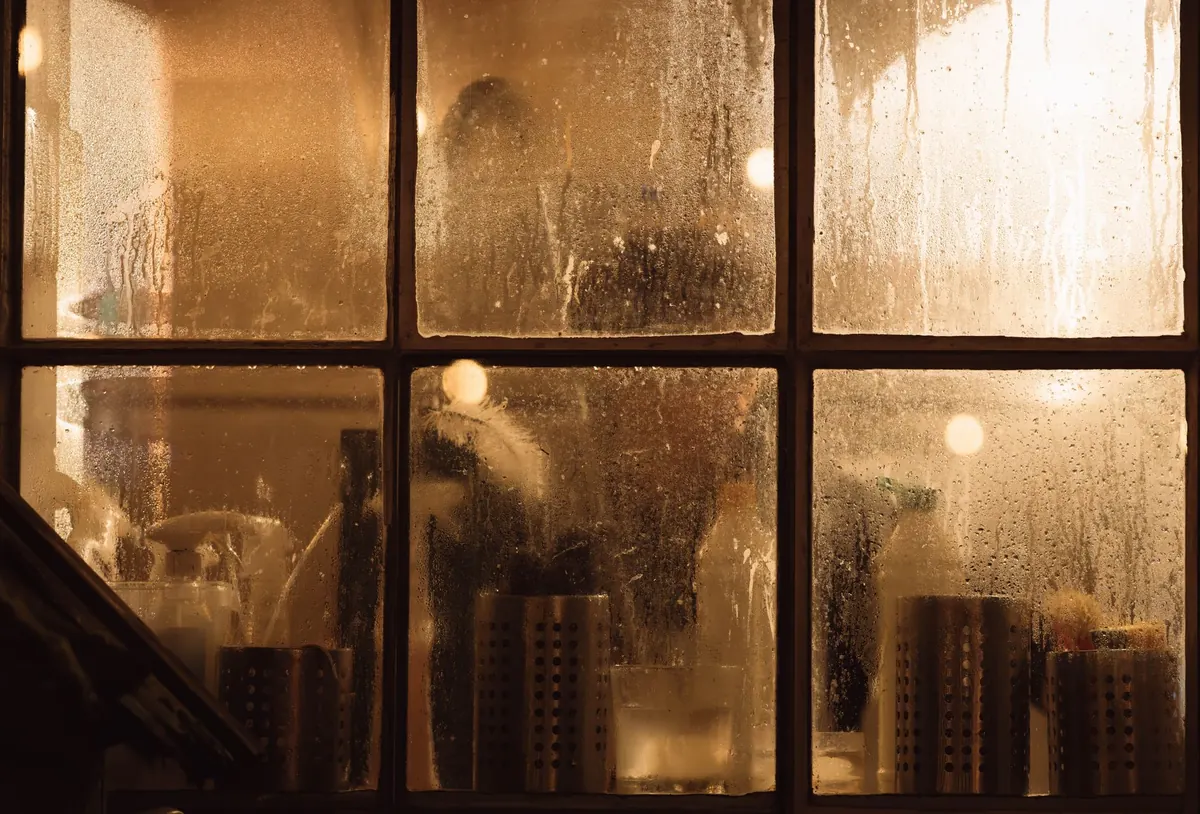
Why windows sweat on the inside
Water on the room side of your glass is almost never a window fault. It's your house saying its humidity is too high for the weather — and there is a number.
PUB. JUL 16, 2026
Wipe it. Which side the water is on tells you everything, and only one of the three answers is a broken window:
- Room side, wipes off: condensation. Your indoor humidity is too high for how cold it is outside. The window is the messenger.
- Between the panes, won't wipe: the seal has failed. That's the foggy window piece, and no cleaning reaches it.
- Outside surface: dew. This is good news — it means your glass is staying cold, which is what an efficient window is supposed to do.
- There's a number. At 70°F indoors: 35% RH at 20°F outside, 25% at 0°F, 15% at −20°F. Above the line you get water. A $15 hygrometer ends the argument.
- New windows don't cause condensation — they reveal it. The old drafty ones were ventilating your house for free. You sealed the leak and the moisture stayed.
Chase the moisture, not the glass. The water on the pane is a reading, and cleaning a thermometer doesn't lower a fever.
Every January, reliably, the same call. A house in Roseville or Highland Park, windows running with water by breakfast, a puddle on the sill, and a homeowner who has arrived at one of two conclusions: the windows are defective, or the windows are dirty.
Both are wrong, and the second one is the reason we're writing this on a window-cleaning site. There is no cleaning method that fixes this. There is no product. The glass is spotless and the glass is soaking wet, and those two facts have nothing to do with each other.
Your window is not broken. It's reporting.
First: wipe it
Before any theory, the one test that sorts this into three completely different problems. Put a finger on the water.
It wipes off, and it's on the room side. That's condensation, and it's this article. The moisture is coming from inside your house.
It won't wipe, because it's between the panes. The seal on the insulating glass unit has failed and the space that used to be dry argon is now breathing damp outdoor air. That's a different piece — the foggy window one — and the honest summary is that nothing you can buy reaches the inside of a sealed unit, whatever the internet is currently selling. While you're there, the permanent fog myth deals with the etching that gets confused for it.
It's on the outside surface, in the morning, and it burns off. That's dew, and it is good news. We'll come back to why, because nearly everybody who sees it thinks it's a fault.
Three locations. Three unrelated causes. One of them is a broken window and it isn't the common one.
The physics, briefly, because it makes the fix obvious
Warm air holds more water than cold air — roughly twice as much for every 20°F you go up.¹ Relative humidity is the percentage of that ceiling you're currently using, which is why the same water content can read 60% in a cold room and 30% in a warm one without a single molecule moving.
Dew point is the temperature where the air runs out of ceiling and has to put water down.
Your glass is the coldest surface in the room. It's a thin conductive sheet with January on the other side, and it is supposed to be cold on the outside face — that's insulation working. When the room-side glass surface falls below the room's dew point, the film of air touching it gets chilled past saturation and dumps its excess onto the pane.
That's the whole mechanism. It's a cold soda can in July, mounted in your wall. The can isn't defective and neither is your window.
That chilled film of air also has weight. It gets denser than the room around it, falls, and crosses your ankles — which is why the same cold pane is what makes a window feel drafty on a night when nothing is actually getting in. If you have wet glass and a cold current at the floor, you are looking at one cause with two symptoms, not two problems.
Which means there are exactly three levers: lower the indoor humidity, raise the glass surface temperature, or move air across the glass so the boundary layer never sits still long enough to saturate. Everything below is one of those three.
There is a number, and you can look it up
This is the part that ends most arguments, because condensation feels subjective and isn't.
At an indoor temperature of 70°F, manufacturers publish recommended maximum indoor relative humidity against outdoor temperature. Kolbe's homeowner guide gives it as cleanly as anyone:²
| Outdoor air temperature | Max indoor RH |
|---|---|
| +20°F | 35% |
| +10°F | 30% |
| 0°F | 25% |
| −10°F | 20% |
| −20°F | 15% |
Cardinal Glass puts 35–40% as appropriate at 20°F and above. ENERGY STAR advises 30–40% for colder climates generally. They disagree slightly because the real variable is your glass surface temperature, not the outdoor air — but the shape is identical in every source, and the shape is the point: the colder it gets outside, the lower your indoor humidity has to go. Not stay. Go.
That's the thing people miss. A humidifier set to a comfortable 40% in November is set to a wet, dripping, mold-growing 40% at −15°F in January, and nobody touched the dial. The dial was fine. The weather moved.
Buy a hygrometer. Fifteen dollars, digital, accurate to two or three percent, and most smart thermostats already display the number if you go looking. Until you have it, everyone in the argument is guessing. With it, this stops being a matter of opinion in about four seconds.
Why it starts at the bottom edge
Look at where the water actually is. Almost always: a band along the bottom, worst in the corners, with the middle of the pane clear.
That's not random, and it's not a defect.³ The perimeter of an insulating glass unit is colder than the center, because the spacer bar holding the two panes apart conducts heat around the gas fill and short-circuits the insulation for the first inch. Old aluminum spacers do this enthusiastically. "Warm-edge" spacers — foam, stainless, structural polymer — exist specifically to fight it, and they work. Then add that cold air is denser and slides down the glass to pool at the bottom, and that the sash shelters the corners from any air movement at all, and the signature draws itself.
So: water at the perimeter with a clear center is condensation doing exactly what physics requires. Water uniformly across the whole pane means your humidity is well over the line. Fog between the panes that doesn't wipe is the seal, and a different article.
If you're shopping windows, this is what the NFRC's Condensation Resistance number is for — a 0–100 scale where higher resists better, and where a conventional argon-filled double-glazed unit lands somewhere in the high 40s to low 50s. Manufacturers don't always advertise it. Ask.
Your new windows didn't cause this
Here is the most common and most unfair conclusion in this whole subject.
A homeowner replaces forty-year-old windows. The next winter, the new ones sweat like they never did before. Obvious verdict: the new windows are worse. There's often a phone call to the installer, sometimes a lawyer.
The new windows are almost always innocent, and the mechanism is genuinely counterintuitive: the old windows were ventilating your house. They leaked. Cold, bone-dry outdoor air came in around every sash and every stop, all winter, continuously, and dry air is the entire product a dehumidifier sells. Your old house was being aggressively dehumidified for free by a defect you were paying to heat.
Then you sealed it. The moisture your family generates — and it's a lot; we'll get to the inventory — now has nowhere to go, indoor RH climbs several points, and it climbs past the line in that table. The new window, which has a genuinely warmer room-side surface than the thing it replaced, condenses anyway, because the air in front of it got wetter faster than the glass got warmer.
The windows didn't create moisture. They stopped the free ventilation that was hiding it. The condensation is new information about a house that was always this wet.
This is also why the fix, in a tight house, is ventilation — the thing the leak was doing, done deliberately and with the heat recovered, instead of accidentally and expensively.
Exterior condensation is a compliment
Briefly, because it generates its own alarmed phone calls: dew on the outside of a new window on a clear autumn morning means the outer pane got cold overnight by radiating to the sky, which means your house's heat is not leaking out through the glass to warm it.
That is the low-E coating and the gas fill doing precisely their job. An old single-pane never does this, because it's being warmed from inside all night. Exterior dew is a receipt. It burns off by nine.
Where the water is coming from
The inventory, roughly by volume, for an ordinary household:
- People. Breathing and perspiration put out a few pints per person per day. A family of four is a small fountain.
- Showers and cooking. The big spikes. A ten-minute shower and an uncovered pasta pot each release more moisture in minutes than the rest of the day combined.
- Unvented or badly vented appliances. A dryer venting into the house — through a lint trap "kit," or through a duct that's fallen off in the crawlspace — is the single largest source we find, and it is startlingly common.
- The basement or crawlspace. Bare soil under a house evaporates water into it continuously. A vapor barrier is one afternoon and frequently solves the whole problem upstairs.
- The humidifier. Set once, in autumn, and never revisited.
- Plants, aquariums, firewood stacked indoors — real, though smaller.
- New construction and renovation. A first winter in a new or heavily renovated house runs wetter than every winter after it, because the building is still giving up its own water.⁴
The fix, in order of what's cheapest and most likely
- Measure. Hygrometer. Compare to the table. If you're under the line and still sweating, your glass is colder than average — skip to step 5.
- Turn the humidifier down, or off, and see what happens over a week. In a modern tight house it's frequently unnecessary all winter.
- Vent the moisture at its source. Bath fan that actually runs for twenty minutes after the shower, not two. Range hood that goes outside rather than through a charcoal filter and back into the kitchen. Dryer duct verified — go look at the outdoor end while it's running.
- Cover the dirt. Poly vapor barrier over any exposed crawlspace soil.
- Move air across the glass. Open the blinds during the day; closed coverings trap a cold, still layer against the pane and reliably make condensation worse overnight. Pull furniture off the sill. Leave interior doors open. This is free and it works.
- Ventilate deliberately. In a genuinely tight house, an HRV or ERV is the real answer — it does what the old leaky windows did, on purpose, with the heat kept.
- Raise the glass temperature. A storm window, an interior insert, or eventually better glazing. This is the expensive lever and it's last for a reason.
Two things not on the list. A dehumidifier running against a humidifier is a pair of appliances arguing while you pay both; turn one off before you buy the other. And cleaning the glass does nothing at all, which is the only reason a window-cleaning site needs to say so out loud.
When it actually is the window
Everything above argues that the house is the problem. Intellectual honesty requires the other branch, because sometimes it isn't, and there's a clean way to tell.
Run the test on the whole house at once. You have one indoor humidity, shared by every room on the same floor. So if the air is uniform and one window sweats while its neighbours stay dry, the difference is not the air — it's that window's glass surface temperature. That's a real finding, and it's worth chasing.
Look for a reason. A single-glazed or failed unit among double-glazed neighbours will always go first. So will a window with an aluminum frame and no thermal break, which conducts cold straight through to the interior surface regardless of how good the glass is. So will one sitting in a poorly insulated rough opening, where the gap around the frame was never properly filled and cold air is circulating in the wall cavity right behind the trim — and that one usually shows a matching cold streak on the wall below, which you can find with a hand on a January morning.
A bathroom or kitchen window that sweats when nothing else does is not this. That's local humidity, not local cold, and the answer is the exhaust fan.
Uniform condensation across every window in the house, on the other hand, is your humidity, full stop, and no window purchase fixes it. This matters financially: people replace windows to solve condensation and then discover the new ones sweat too, having spent five figures to move the problem three percent. If every window in the house is wet, the windows are not the variable.
The ice case
Below about −10°F the water on the glass stops being water. It freezes where it lands, and the bottom two inches of the pane grow a genuine sheet of ice, sometimes thick enough to scrape.
This alarms people more than it should. In climate zone 7, at −20°F, most houses will show some ice at the very bottom of the glass, and that's true of good windows in well-run houses — at that temperature the edge-of-glass surface is simply below freezing, and there is no indoor humidity low enough to be comfortable and also stay under the line. Fifteen percent is already dry enough to crack furniture and give everyone nosebleeds.
The thing to watch isn't the ice. It's where it goes when it melts. Ice sits on the glass all day at −20°F and then, on the first afternoon above freezing, releases all at once — into the window track, the sill, and the wall below, in a volume no single condensation event ever delivers. That's the mechanism behind most "my window leaked in March" calls in this part of the country. The window didn't leak. February came off the glass.
So: keep the track clear so the meltwater has somewhere to go, wipe the sill on the thaw days, and don't panic about a rime at the bottom edge in a genuine cold snap. Do panic, mildly, about ice halfway up the pane — that means the humidity is far over the line and has been for weeks.
What it wrecks while you decide
Condensation isn't just unsightly, and this is why it's worth acting on rather than wiping.
The water runs down the pane and collects in the window sill track — the same trough that's supposed to be draining rain, now being fed from the inside all winter. It sits there against the frame, and it keeps the paint or the finish wet for months. Wood sash swells, then the finish fails, then the wood goes. Vinyl and aluminum don't rot, but the water still pools and still feeds mold in the corners, because there's plenty of organic dust in a track to feed on. Sustained indoor RH above roughly 60% grows mold on any surface that will hold it, which is most of them.
And the CDC's guidance on mold is unromantic and correct: control the moisture or it comes back. Which is this article's whole argument, aimed at a different symptom.
Wipe the glass in the morning if you like — it's not nothing, it keeps the water out of the track. But wiping is triage. The number on the hygrometer is the diagnosis, and it's the only thing on this page that will still be true next January.
Notes
- The physics in one paragraph. Air holds water vapor, and how much it can hold rises steeply with temperature — roughly doubling every 20°F in the range houses live in. Relative humidity is a percentage of that ceiling, not an absolute quantity, which is the source of nearly all the confusion here. Dew point is the temperature at which a given parcel of air hits 100% of its ceiling and has to give up water. Your room air has one dew point everywhere in the room. Your window glass is the coldest surface in that room, because it's a thin conductive sheet with winter on the other side. When the glass surface sits below the room's dew point, the thin layer of air touching it is cooled past saturation and deposits its excess onto the glass. Nothing about the glass causes this — a cold soda can does exactly the same thing in July. The glass is simply the coldest thing available.
- On the table, and its honest limits. The figures come from published manufacturer guidance for an indoor temperature of 70°F, and they're a starting point rather than a law: Kolbe's homeowner guide lists 35% at +20°F outdoor, 30% at +10°F, 25% at 0°F, 20% at −10°F and 15% at −20°F. Cardinal Glass puts 35–40% as appropriate at 20°F and above; ENERGY STAR advises 30–40% in colder climates. They differ a little because the real variable isn't outdoor air temperature at all — it's your glass surface temperature, which depends on the glazing, the coating, the gas fill, the spacer, the frame, and whether the wind is blowing. Wind chill matters to a window the way it matters to skin: one Canadian guidance chart recommends 30% RH at −12°C still, and 20% at the same temperature with a 20 km/h wind. Treat the table as the shape of the relationship, then trust your own hygrometer and your own glass.
- Why the bottom edge and corners go first. The center of an insulating glass unit is the warmest part of the room-side surface; the perimeter is colder, because the spacer bar joining the two panes conducts heat around the gas fill and short-circuits the insulation for the inch or so nearest the edge. Traditional aluminum spacers are very good conductors and very bad for this; 'warm-edge' spacers — stainless, foam, or structural polymer — were developed specifically to reduce that bridge, and they measurably raise edge-of-glass temperature. Add that cold air is denser and pools at the bottom of the pane, and that the sash blocks air movement in the corners, and you get the standard signature: a band of water at the bottom edge, worst in the two corners, clear in the middle. That pattern is condensation behaving exactly as designed. It is not a defect, and it is not the seal — a failed seal fogs between the panes and doesn't wipe.
- The first-winter exception. A newly built or heavily renovated house carries an enormous amount of construction water: concrete, mortar, wet-applied plaster and drywall compound, framing lumber, and paint all release moisture for months as they cure. It is entirely normal for a first winter to run wetter than every winter after it, and for windows to sweat in a house that will never sweat again. The correct response is ventilation and patience, not a diagnosis. The same applies at smaller scale after any big wet job — a re-plastered room, a new tile floor, a basement slab. If the condensation started the same season as the construction, wait one more before you conclude anything about the windows.
Sources
- Kolbe Windows & Doors, A Homeowner's Guide to Understanding Humidity and Condensation (2024) — recommended indoor RH by outdoor temperature at 70°F indoors.
- Cardinal Glass Industries, Technical Service Bulletin CG06: LoĒ-i89® Coated Glass — the manufacturer's own care and cleaning limits for coated glass: soap solution or standard glass cleaner is fine, hydrofluoric-acid rust removers and abrasives are not, and a squeegee must have no exposed metal edge
- National Fenestration Rating Council, Energy Performance Label — Condensation Resistance is one of the rated categories on the label: the higher the number, the better the product resists condensation
- AAMA, Condensation Resistance Factor (CRF) methodology for fenestration assemblies.
- ASHRAE, Standard 55 — Thermal Environmental Conditions for Human Occupancy — the standard that sets the acceptable indoor thermal and humidity envelope, and so the band condensation risk is judged against
- Centers for Disease Control and Prevention, Mold — mold grows wherever moisture persists, including around leaks at roofs, windows and pipes, so fixing the moisture is the step that stops it returning
Linnea Jorgensen
Regional contributor covering the Upper Midwest for Window Washing Guide. Coverage under this byline addresses Twin Cities residential routes, ice-dam meltwater chemistry, and lake-country cabin work, researched with the Giordano Inc. editorial team from practitioner interviews and published water-quality and trade references.