The 'Rain-X your house windows' trick is back on TikTok. It is still bad advice.
Every spring, the same hack resurfaces — spray Rain-X on your house windows and never wash them again. Every spring, I get a message from a homeowner asking me how to undo it. The chemistry is not on your side.
A friend of mine in Portland forwarded me a TikTok last weekend. A young man, charming, well-lit, holding a yellow bottle of Rain-X, explaining to his three hundred thousand followers that you can spray it on your house windows and the rain will keep them clean for you, forever, no more washing.
The video has 1.4 million likes. The comments are full of people saying they will try it this weekend.
I am writing this on Wednesday so I have a chance to reach a few of those people before they do. The hack does not work. It is, in fact, going to make their windows worse. And the worst part is that the damage is, in many cases, hard to reverse.
Let me explain what's actually happening, because the thing that makes this trick seductive is that it is almost right, in a particular way that turns out to be the wrong way.
What Rain-X actually does
Rain-X is a hydrophobic coating — a thin polymer film, primarily polysiloxane chemistry, that bonds to silica surfaces and dramatically reduces the surface energy of the glass. Water can no longer "wet" the surface (spread out into a thin sheet); instead it beads up and rolls off. That's why it works on car windshields. At highway speed, the airflow over the glass pushes the water beads off the windshield faster than wipers could clear a continuous sheet of water. You can see better through rain. It's a real chemistry-on-glass success story for the use case it was designed for.
The use case it was designed for is glass that is moving at thirty-five miles per hour or faster, in a direction that drains water by gravity, and that gets actively scrubbed by a rubber wiper blade six to fifty times per minute.
Your house windows are not moving. They have no wipers. The airflow over them is, on a calm day, zero. And that is where the hack falls apart.
What goes wrong on a stationary window
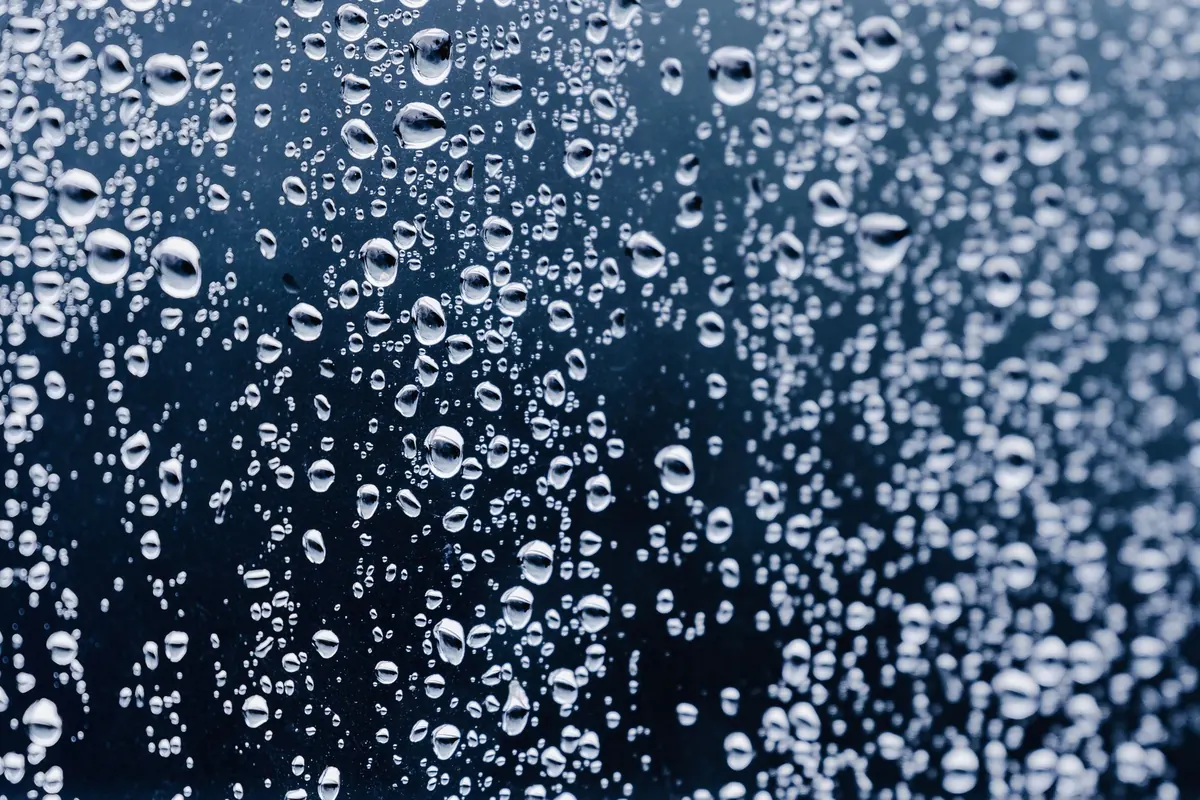
When water hits a Rain-X-coated stationary window, it does bead up. The beads are small, well-formed, and visually pleasing in the moment. But because there is no airflow and no wiper, those beads do not roll off. They sit on the glass. They evaporate in place.
Every bead is a tiny container of whatever was dissolved in the rainwater — and rainwater dissolves a lot. Atmospheric particulates, calcium-carbonate from limestone dust, pollen, NO₂ from car exhaust, sulfur compounds from industrial sources, efflorescence from any masonry uphill of your window. When the water evaporates, every dissolved solid in that bead is deposited at the bead's perimeter, in a perfect circular ring.
That is exactly the hard water spotting pattern, except it is now distributed across your entire window in a constellation of perfect rings of mineral deposit, where each ring corresponds to one rain bead.
The non-Rain-X window had the same minerals land on it. But because water spreads out across an untreated hydrophilic glass surface and forms a more or less continuous sheet, those minerals get distributed thinly enough to be relatively invisible until the next cleaning. The Rain-X window concentrates them into thousands of small, visible, ring-shaped deposits.
Within one rainstorm, the Rain-X window looks dramatically worse than the untreated window did. After three rainstorms, you cannot see through it.
And here is the real problem
The mineral rings would be bad enough on their own — they're at least removable, given some effort and the right acid. The harder problem is that the Rain-X coating is not a clear barrier between glass and dirt. It is a polymer that the dissolved minerals can become embedded in. Calcium ions from hard water, sulfur from air pollution, and tannins from pollen all interact with the polysiloxane in ways that make them very, very difficult to remove without removing the coating itself.
So you now have three layers of problem: the original glass, the Rain-X polymer film, and the mineral deposits embedded in the polymer. Cleaning the surface no longer removes the deposits because the deposits are partially under the polymer surface. To restore the window, you have to strip the Rain-X first, which requires either solvent attack (isopropyl alcohol or d-limonene, often two passes) or mechanical removal (cerium oxide polishing). Both of those are doable but they are not what someone who wanted to skip washing their windows was signing up for.
I have personally consulted on three of these jobs in the last year — homeowners who applied a hydrophobic coating to a sun-facing kitchen window and called me six weeks later saying their window was hazier than it had ever been. The fix in each case took longer than just washing the windows would have taken in the first place.
What about the "real" professional hydrophobic coatings?
The TikTok in question shows Rain-X, which is the consumer-grade product. There are professional-grade hydrophobic coatings — Diamon-Fusion, Enduroshield, ClearShield — that are sold to commercial buildings and to homeowners who pay several thousand dollars per window. These products are real. They are not snake oil. They work better than Rain-X for the same fundamental reason: tighter bond to the substrate, more uniform film, longer service life.
But they have the same problem on a stationary surface. They cause beading. Beading on a non-moving non-wiped window evaporates in place. The deposits accumulate. The professional-grade coatings have to be maintained — that's actually how the companies make money on the contract — with professional cleaning every few months that uses specific neutral products to avoid stripping the coating.
If you sign up for a professional hydrophobic coating, you are signing up for a maintenance regime, not for a one-time application that ends your relationship with window cleaning. The service contracts are explicit about this. The TikTok is not.
What actually does work for less-frequent washing
If your real goal is to wash your windows less often, the levers that actually work are:
- Better timing — pick the right season and you can stretch a wash from four weeks to ten or twelve.
- Frame care — most window haze is actually efflorescence running down from concrete or brick above the window. Sealing the masonry above does more for window cleanliness than anything you put on the glass.
- Mineral neutralization on rinse water — if you live somewhere with hard water and you do an outside wash, switch to distilled water for the final rinse. Your wash will last visibly longer because there's nothing to deposit when the water dries.
None of those are as fun as a TikTok. None of them require a yellow bottle. All of them work better than the alternative.
So please don't
Don't spray Rain-X on your house windows. Don't believe the next iteration of the same hack — because this one resurfaces every spring under a slightly different name (last year it was "ceramic coat your windows," the year before it was a "DIY Diamon-Fusion knockoff" that turned out to be a bottle of relabeled silicone). The chemistry is the same and so are the results.
If you want clean windows for less effort, the real answer is the boring one: clean less often, more thoughtfully, with the four stages of washing a window properly for the actual problem in front of you. The TikTok will not save you the time. It will cost you the time.
Easton Giordano — Editorial team contributor covering the Pacific Northwest and broader West Coast beat. Articles bylined by Easton are researched and reviewed in collaboration with the Giordano Inc. editorial team and informed by interviews with practicing window-washing operators in the region, plus published materials-science and trade references.