Window Washing in Phoenix
Phoenix hardness runs 158 to 344 mg/L depending on which of five plants serves the address, with dissolved solids above the 500 mg/L guideline throughout.
Phoenix water is hard to extremely hard depending on which treatment plant serves the address, and its dissolved solids run high everywhere, so tap water spots glass as it dries and a deionised or distilled final rinse is worth it on dark or sunny panes. March to June, September and November are the workable months. Heat shrinks the working day to a morning, and quotes carry that constraint: a single-story exterior runs $320 to $540.
What the water means for the glass
Phoenix publishes 158 to 344 mg/L, which the city also states as 9.2 to 20.1 grains per gallon. The low end is ordinary hard water that a careful tap rinse and fast squeegee can survive; the high end demands a deionised or distilled final pass on anything dark, south-facing or valuable. Because the figure is set by which of five plants feeds an address, the honest approach is to test the response of the glass rather than assume a citywide number — the same method can be adequate in one district and inadequate four miles away.
Phoenix tap water, by the numbers
| Hardness | 158–344 mg/L as CaCO₃ 9.2 to 20.1 grains per gallon, printed by the city alongside the mg/L figures, as published by City of Phoenix Water Services Department. |
|---|---|
| pH | 7.3–8.3 |
| Alkalinity | 115–234 mg/L as CaCO₃ |
| Iron | 0–0.635 mg/L |
| Sodium | 88–198 mg/L |
| Total dissolved solids | 560–686 mg/L |
| Disinfectant | free chlorine |
| Source and treatment | In 2024 about 97-99 percent surface water, mostly snowmelt: the Salt, Verde and Colorado rivers, with some Agua Fria River water mixed with Colorado River water stored in Lake Pleasant, delivered to one of the city's five water treatment plants · Screening and presedimentation to remove plant debris and river material; coagulation, flocculation and sedimentation with a coagulant such as ferric chloride; filtration; then disinfection with a small quantity of chlorine, plus fluoride · No softening step. |
Not in the report: corrosion index, manganese and chloride.
SOURCE · City of Phoenix 2024 Water Quality Report, '2024 Aesthetic Water Quality Analysis from Distribution System & Secondary Drinking Water Guidelines' table, with the disinfectant-residual table and the water treatment process section (phoenix.gov) · How we source these numbers
When a wash holds
What sets the cleaning clock
Three loads stack here on different clocks. Mineral deposit is continuous and worst where irrigation reaches the glass. Dust peaks with the monsoon between mid-June and the end of September, when outflow winds drive fine desert particulate onto every windward elevation in minutes. Landscaping pollen runs spring and autumn in the irrigated older districts. The shortest-lived wash of the year is one taken the afternoon before a haboob; the most durable is a still, clear stretch in January.
ARIZONA SEASON BY SEASON →What's specific to Phoenix
Phoenix is a city where the published water figure is a range and the decisive number is a temperature. The 2024 Water Quality Report gives hardness as 158 to 344 mg/L, or 9.2 to 20.1 grains per gallon, across five treatment plants drawing Salt, Verde and Colorado river water — a span that crosses from hard into very hard depending on which plant serves the address. In the same table the city records distribution-system water between 57 and 95 degrees Fahrenheit. That upper figure governs method more than hardness does: water near 95 degrees landing on glass that has been in the sun for hours evaporates faster than it can be cleared, and leaves the whole dissolved load behind. Total dissolved solids of 560 to 686 mg/L and sodium of 88 to 198 mg/L mean there is more in that droplet than calcium. The practical consequence is scheduling. Work shaded elevations, work early, and keep the glass wet from first contact to final pass rather than trusting any product to buy back the time.
Phoenix does not publish a hardness number, it publishes a spread. The city's 2024 Water Quality Report gives total hardness as 158 to 344 mg/L, printed in the same row as 9.2 to 20.1 grains per gallon. Five treatment plants feed the network and which one serves a given address moves the figure inside that band.
That spread straddles a boundary. At 148 the supply is hard; at 288 it is well into very hard. A rinse routine calibrated at one end of the range will visibly underperform at the other, which is the reason a single citywide rule about whether tap water is good enough to finish with cannot be written honestly.
The supply is river water with a trace of well water. In 2023 roughly 97 to 99 percent of it began as snowpack and arrived as surface water — Salt and Verde river water through the SRP canal network, Colorado River water through the Central Arizona Project aqueduct, with Agua Fria water blended in where it is stored at Lake Pleasant. About two percent came from around twenty city wells.
The most operationally useful figure in that report is not hardness. It is temperature: the city measured water in the distribution system between 57 and 95 degrees Fahrenheit over the year. Tap water arriving at the top of that range is not rinse water in any useful sense.
Ninety-five degree water meeting glass that has been in direct sun since morning evaporates faster than a squeegee can clear it, and every dissolved solid it carried stays on the pane. Most summer streaking here is that mechanism rather than a bad product, and the fix is the hour of the day, not the bottle.
Dissolved solids ran 368 to 626 mg/L against a 500 mg/L secondary guideline, and sodium ran 59 to 144 mg/L. Hardness minerals are only part of what a drying droplet leaves behind, which is why glass here can haze even where the hardness reading sits at the low end of the published band.
Algae blooming in the SRP canals in late summer and autumn are the city's own named cause of the musty odour some customers report. The algae are removed in treatment and activated carbon is dosed for the lingering smell, but the seasonal organic load is a reminder that canal-fed supply changes character through the year.
How old the glass is
- Before 1940 · 2%wood sash and older glass
- 1940–1959 · 12%steel casements, early aluminium
- 1960–1979 · 28%aluminium sliders, often single-pane
- 1980–1999 · 31%double-pane units become standard
- 2000–2009 · 16%vinyl frames, low-E spreading
- 2010 or later · 12%low-E common: gentle cleaners only
The city, by neighborhood
What window cleaning costs in Phoenix
Heat compresses the productive day, so a Phoenix crew sells a morning rather than a full shift, and summer quotes carry that constraint whether or not it is itemised. Storey height and lift access dominate downtown and along Camelback. In the flood-irrigated districts frequency does the work: glass that is regularly wetted by irrigation needs more visits than pane count alone would suggest, and a quote built on square footage will understate the year.
Doing it yourself
Single-storey stock in the outer subdivisions is reasonable homeowner work provided it is done before about nine in the morning in summer, which is the part most people skip. Anything above one storey on the Camelback corridor, and any large fixed pane in full afternoon sun, is worth hiring out — not for the height alone but because the working window is narrow enough that an unpractised pass will dry mid-stroke. Downtown commercial frontage is contracted access work and is not a homeowner proposition at any skill level.
OPEN COST ESTIMATOR →2025 annual mean at the North Phoenix monitor, 601 E Butler DR ,Phoenix, 2.6 km south-east of the city (EPA site 04-013-1004).
Largest air release: Honeywell Engines Systems & Services, 111 S 34TH ST MS: 158 HSE (transportation equipment), inside the city limits, 33,759 lb in 2024.
Phoenix's water code requires customers to keep pipes, faucets and sprinklers in good repair to prevent waste. Its drought procedure starts with a Stage 1 Water Alert, which relies on public education and voluntary cuts; only from Stage 2 can the Director make drought-plan limits mandatory.
Phoenix City Code §37-27: waste of water · Phoenix City Code §37-126: Stage 1 Water Alert · Phoenix City Code §37-127: Stage 2 Water Warning · checked September 2026
Phoenix City Code bars releasing anything that is not entirely stormwater into a public right-of-way, retention basin or storm drain. The listed exceptions include lawn watering, washing your own car at home, dechlorinated pool water and street wash water; washing windows or buildings is not on the list.
Phoenix City Code §32C-103: prohibited and permitted stormwater practices · checked September 2026
Any building permit affecting the exterior of a property on Phoenix's Historic Property Register, non-historic buildings in historic districts included, needs a Certificate of No Effect or a Certificate of Appropriateness. Minor work that clearly fits the General Design Guidelines can get a Certificate of No Effect over the counter from staff; other changes need the fuller Certificate of Appropriateness.
City of Phoenix Historic Preservation Office, approvals and guidelines · checked September 2026
What actually shows up on Phoenix glass
Fine red-tan dust deposited during haboobs and convective storms. Hygroscopic — it pulls moisture from the air and re-bonds to glass overnight, producing the characteristic morning-after streak pattern.
Palo verde produces a fine yellow pollen for about three weeks in April. Creosote bushes contribute resinous aerosol after rain. Neither responds well to plain water; both want a surfactant pass.
Phoenix, answered
How hard is the water in Phoenix, Arizona?+
Phoenix publishes 158 to 344 mg/L, which the city also states as 9.2 to 20.1 grains per gallon. The low end is ordinary hard water that a careful tap rinse and fast squeegee can survive; the high end demands a deionised or distilled final pass on anything dark, south-facing or valuable.
How much does window cleaning cost in Phoenix?+
Residential window cleaning in Phoenix typically runs $11–16 per pane or $320–540 for a standard single-story exterior. Heat compresses the productive day, so a Phoenix crew sells a morning rather than a full shift, and summer quotes carry that constraint whether or not it is itemised.
When is the best time of year to clean windows in Phoenix?+
Phoenix's drier, frost-free months are March to June, September and November, by NOAA's 1991–2020 normals for the Phoenix Deer Valley Municipal Airport station. The calendar on this page marks March (after the February 14 bloom) and September (after smoke season). A frost night comes in about half of winters, near December 25. Normal highs reach 90°F in May to September.
Can I rinse windows with Phoenix tap water?+
Not as the final rinse: City of Phoenix Water Services Department publishes dissolved solids of 560–686 mg/L, enough to spot as it dries, so finish with pure water. Its iron, up to 0.635 mg/L, is at the staining level, and acid cleaners will not lift that film. It draws on about 97-99 percent surface water, mostly snowmelt: the Salt, Verde and Colorado rivers.
Why do my windows look dirty so quickly in Phoenix?+
In Phoenix the dominant residue patterns include published hardness spanning 158–344 mg/l (9.2–20.1 grains), set by which of five plants serves the address and dissolved solids of 560–686 mg/l, above the 500 mg/l secondary guideline across the whole range. Three loads stack here on different clocks. Mineral deposit is continuous and worst where irrigation reaches the glass.
Do I need a professional to clean my windows in Phoenix?+
Single-storey stock in the outer subdivisions is reasonable homeowner work provided it is done before about nine in the morning in summer, which is the part most people skip.
What sets Downtown Phoenix apart for window cleaning in Phoenix?+
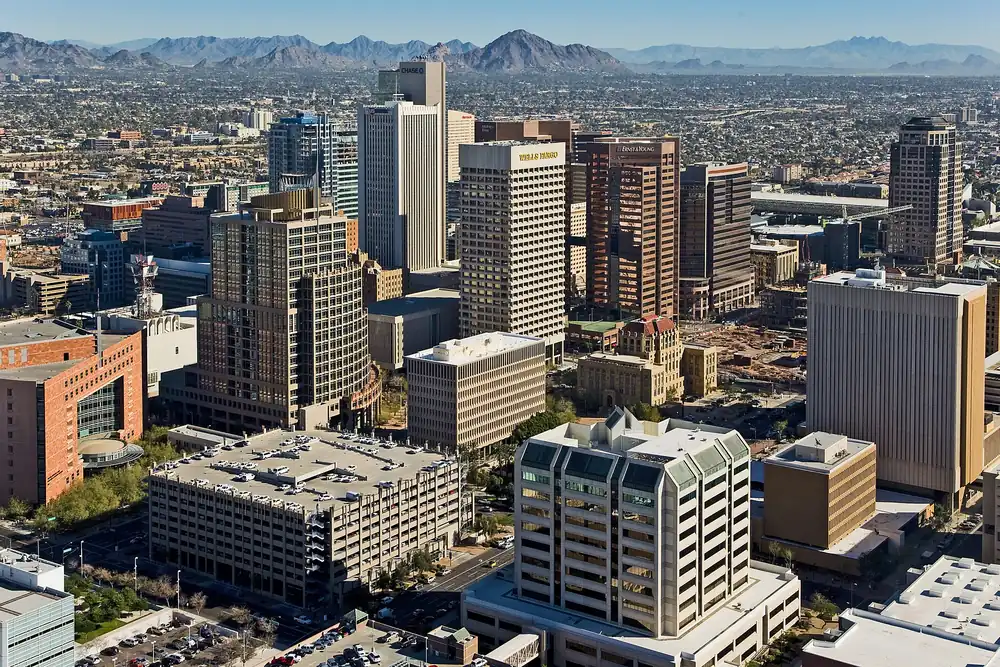
Mid- and high-rise commercial frontage on contracted schedules, with a thin band of surviving early twentieth-century low-rise around the edges. Rope and lift access sets the price here far more than pane count does. Encanto-Palmcroft and Arcadia have their own housing stock and glazing as well.
Other cities we cover in Arizona
Nearby cities in neighboring states
Just over the Arizona line