Window Washing in Los Angeles
Los Angeles water runs 93 to 275 mg/L hard, salt aerosol reaches three to five miles inland, and wildfire ash lands from September to November.
Los Angeles water runs from moderately hard to very hard depending on the source blend serving an address, so a tap-water rinse that dries clean in one neighborhood can spot badly in another. Salt spray near the coast and wildfire ash inland are the recurring messes, and May to October is the dependable window for a wash. Access and scale set the number here: a single-story exterior runs about $350 to $600, and large fixed glazing on the Westside costs more.
What the water means for the glass
There is no single Los Angeles hardness and the utility does not pretend otherwise. At the soft end of its published range the supply barely marks glass; at the top it is very hard and will spot anything left to dry. Which one an address gets depends on the source blend serving that area, and that blend shifts with drought — so the right question here is not how hard the water is but which water is arriving this year.
Los Angeles tap water, by the numbers
Figures by zone, as reported.
| Hardness | 93–275 mg/L as CaCO₃ Published by Water Quality Area; San Fernando Valley and Western Los Angeles average 8.6 grains per gallon (147 mg/L), range 5.4 to 16.1 grains (93 to 275 mg/L). |
|---|---|
| pH | 6.9–9 |
| Alkalinity | 92–132 mg/L as CaCO₃ |
| Sodium | 34.6–117 mg/L |
| Chloride | 29–116 mg/L |
| Total dissolved solids | 215–690 mg/L |
| Disinfectant | ozone + chloramine |
| Source and treatment | Los Angeles Aqueduct Eastern Sierra snowmelt, purchased Metropolitan Water District supply blending Colorado River and State Water Project water, and local San Fernando, Central and Sylmar basin groundwater · Pre-ozonation, coagulation, flocculation, rapid mix, microscreening and rapid sand filtration, UV/peroxide advanced oxidation, granular activated carbon and packed-tower aeration on groundwater, chlorination and fluoridation, with chloramines as the residual and an orthophosphate inhibitor · No softening step. |
Not in the report: corrosion index, iron and manganese.
SOURCE · LADWP 2024 Drinking Water Quality Report, Tables II and III, six source columns — LA Aqueduct Filtration Plant, Northern and Southern Combined Wells, and the MWD Weymouth, Diemer and Jensen plants, with the LADWP hardness-by-Water-Quality-Area FAQ · How we source these numbers
When a wash holds
What sets the cleaning clock
Three cycles overlap in this city and none of them is the supply. Coastal frontage runs continuously on salt; the basins run on traffic and inversion particulate; and the whole region resets when ash season arrives in autumn. A single citywide interval serves none of them, and the autumn fire window overrides whatever was planned.
CALIFORNIA SEASON BY SEASON →What's specific to Los Angeles
LADWP publishes hardness by Water Quality Area rather than citywide: San Fernando Valley and Western Los Angeles average 8.6 grains per gallon (147 mg/L) across a range of 5.4 to 16.1 grains (93 to 275 mg/L). That three-fold spread inside one area is the fact to plan around, because it tracks which of three sources is dominant that month. Beyond the tap it is coastal salt, wildfire ash season, and the sheer scale of premium inventory.
LADWP does not publish one number for Los Angeles. It publishes hardness by Water Quality Area, and for the San Fernando Valley and Western Los Angeles area it gives an average of 8.6 grains per gallon, 147 mg/L, across a range of 5.4 to 16.1 grains — 93 to 275 mg/L. The low end is moderately hard and the high end is very hard, in the same service area.
The spread is a blend effect and it moves with hydrology. Los Angeles Aqueduct water is Eastern Sierra snowmelt and the softest in the system; purchased Metropolitan water mixing Colorado River and State Water Project supply is the hardest; local groundwater sits between. In dry years the imported share rises and so does the hardness at the tap.
That means a rinse policy in Los Angeles should be set per route and re-checked annually rather than set once. A crew working the Westside on aqueduct-dominant water and a crew working the harbour and eastern side on imported water are handling materially different supplies under the same utility name.
Coastal salt aerosol carries three to five miles inland on the afternoon onshore flow. West-facing glass inside that band shows visible deposition between cleanings, and the film is hygroscopic — it goes tacky in the marine layer rather than drying hard, so pressure spreads it and flooding lifts it.
Wildfire ash season runs roughly September to November and is the most consequential airborne event of the year. The ash is fine, alkaline and abrasive; it must be flooded off before any contact, because a dry pass drags it across the glass and the scratching is permanent.
The city is large enough that the airborne picture changes by basin. The coastal strip runs on salt, the valley floors trap particulate under inversions, and the foothills take the worst of the ash. Three different service intervals on one rate card is normal here.
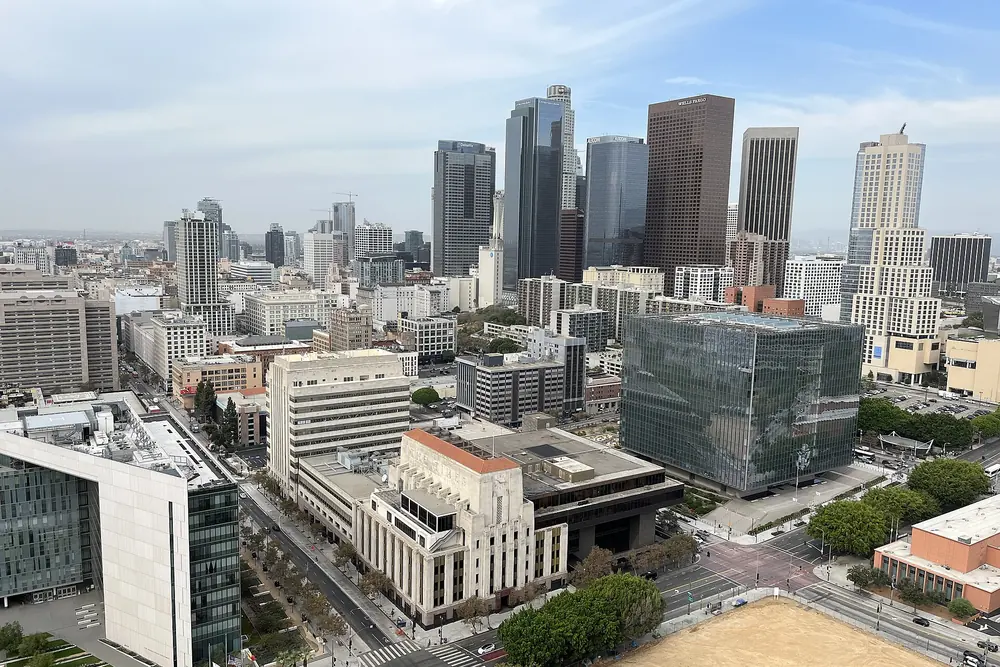
Downtown's high-rise concentration and the converted-loft stock beneath it are rope-access and suspended-platform work under California's own regulatory regime, with institutional tenants on monthly contracts. It is the ceiling of the market and a separate business from the residential book.
Mid-City and Hollywood carry 1920s Spanish-revival and bungalow stock with original wood sash in quantity, so heritage handling is routine across a large share of the housing rather than confined to a few blocks.
How old the glass is
- Before 1940 · 19%wood sash and older glass
- 1940–1959 · 25%steel casements, early aluminium
- 1960–1979 · 26%aluminium sliders, often single-pane
- 1980–1999 · 16%double-pane units become standard
- 2000–2009 · 6%vinyl frames, low-E spreading
- 2010 or later · 8%low-E common: gentle cleaners only
The city, by neighborhood
What window cleaning costs in Los Angeles
Scale and access set the number. Downtown prices on rigging, insurance and out-of-hours scheduling; the Westside prices on large fixed glazing and client expectation; coastal Venice prices on frequency because salt never stops. Ash season is the volatile element, arriving as an unplanned surge that resets the whole city's schedule at once.
Doing it yourself
On the Westside's aqueduct-dominant water and modern accessible glazing, a careful homeowner does well. Two things do not carry over. Wildfire ash must be flooded rather than wiped, and the instinct to wipe it is how glass gets permanently scratched across whole neighbourhoods in a single season. And anything downtown is regulated high-access work rather than a taller version of a house.
OPEN COST ESTIMATOR →2025 annual mean at the Los Angeles-North Main Street monitor, 1630 N Main ST, LOS Angeles, 17.7 km east of the city (EPA site 06-037-1103).
Largest air release: Tesoro LOS Angeles Refinery-Carson Operations, 24696 S Wilmington AVE (petroleum), inside the city limits, 903,406 lb in 2024.
Los Angeles is in Phase 2 of its water conservation plan: no runoff onto streets, driveways or gutters, no hosing of hard surfaces, and any hand-held hose needs a self-closing shut-off nozzle. For glass, that means a trigger nozzle and rinse water kept off the pavement.
LADWP, Water Conservation Ordinance (Phase 2 in effect) · checked September 2026
Los Angeles bars anyone from discharging, causing or contributing to the discharge of pollutants that harm people, animals, plants or fish, or that create a public nuisance, into the city storm drain system or receiving waters. Commercial activities face further limits, so cleaning runoff should be collected rather than washed to the curb.
Los Angeles Municipal Code §64.70.02: pollutant discharge control · checked September 2026
Inside a Los Angeles Historic Preservation Overlay Zone, City Planning's rule of thumb is that every exterior alteration needs HPOZ approval, even a simple repair such as replacing a pane of glass in a window that needs no building permit. Significant exterior work on a contributing building goes through a Certificate of Appropriateness.
Los Angeles City Planning, Office of Historic Resources: HPOZ FAQs · Los Angeles City Planning, HPOZ definitions: Certificate of Appropriateness · checked September 2026
What actually shows up on Los Angeles glass
The defining cleaning consideration of California in the last decade. Wildfire smoke deposits a fine carbonaceous film with embedded fine particulate that bonds to glass and requires a surfactant pass to remove. The film can deposit overnight in event-heavy years and recurs faster than normal cleaning cadences anticipate.
The Pacific coast from San Diego to Eureka sees salt aerosol year-round, heaviest during winter storm season. The Marin headlands, the San Francisco Sunset, the Big Sur coast, and the Malibu beach properties are the heaviest-deposition areas. Salt corrodes aluminum sash hardware over time.
Los Angeles, answered
How hard is the water in Los Angeles, California?+
Los Angeles runs on Los Angeles Department of Water and Power a mixed surface-and-groundwater blend at a published 93–275 mg/L (CaCO₃) — published by Water Quality Area; San Fernando Valley and Western Los Angeles average 8.6 grains per gallon (147 mg/L), range 5.4 to 16.1 grains (93 to 275 mg/L).
How much does window cleaning cost in Los Angeles?+
Residential window cleaning in Los Angeles typically runs $12–18 per pane or $350–600 for a standard single-story exterior. Scale and access set the number. Downtown prices on rigging, insurance and out-of-hours scheduling; the Westside prices on large fixed glazing and client expectation; coastal Venice prices on frequency because salt never stops.
When is the best time of year to clean windows in Los Angeles?+
Los Angeles's drier, frost-free months are May to October, by NOAA's 1991–2020 normals for the Santa Monica Municipal Airport station, where February brings the most rain. The calendar on this page marks May (after the February 8 bloom). Frost nights essentially never come here.
Can I rinse windows with Los Angeles tap water?+
Not as the final rinse: Los Angeles Department of Water and Power publishes dissolved solids of 215–690 mg/L, enough to spot as it dries, so finish with pure water. Its sodium, up to 117 mg/L, leaves a salt film that pulls moisture back, so rinse it off rather than let it dry. It draws on Los Angeles Aqueduct Eastern Sierra snowmelt.
Why do my windows look dirty so quickly in Los Angeles?+
In Los Angeles the dominant residue patterns include coastal salt aerosol three to five miles inland and wildfire ash, fine and abrasive (september–november). Three cycles overlap in this city and none of them is the supply.
Do I need a professional to clean my windows in Los Angeles?+
On the Westside's aqueduct-dominant water and modern accessible glazing, a careful homeowner does well. Two things do not carry over. Wildfire ash must be flooded rather than wiped, and the instinct to wipe it is how glass gets permanently scratched across whole neighbourhoods in a single season.
What sets Downtown LA apart for window cleaning in Los Angeles?+
High-rise commercial and converted-loft residential with institutional tenants on monthly contracts. Rigging, insurance and building coordination rather than pane count. Hollywood and Westside — Brentwood and Westwood have their own housing stock and glazing as well.
Other cities we cover in California
Nearby cities in neighboring states
Just over the California line