Window Washing in Fresno
Fresno runs on Central Valley well water, published at 87 to 150 mg/L hard with dissolved solids of 87 to 260 mg/L, and that is what spots a tap rinse.
Fresno's well water is moderately hard on average, but the published range has swung widely from year to year, so an address can land on much harder water than the average suggests. Summer heat and valley dust set the schedule: June to October is the dry season, and work goes best early in the day. Heat caps how many jobs a route can carry, and a single-story exterior runs $280 to $480.
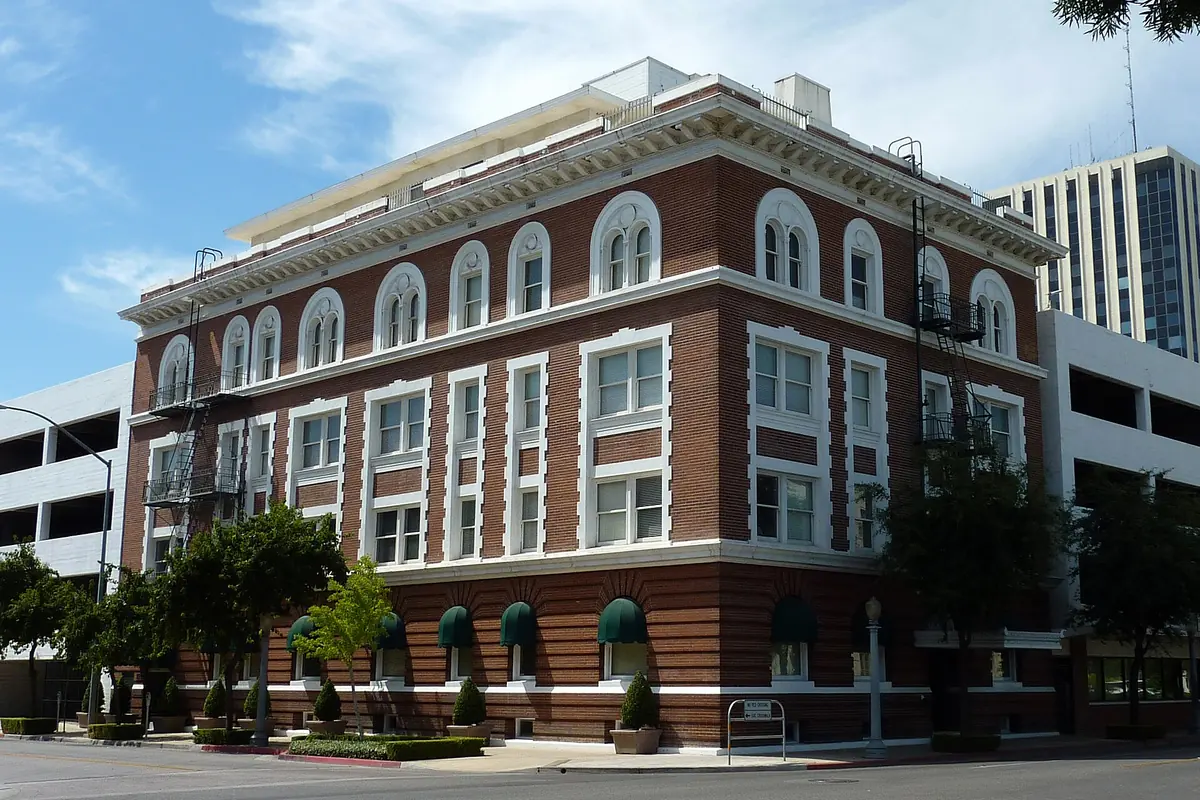
What the water means for the glass
At an average of 89.3 mg/L the supply is moderately hard and would ordinarily be unremarkable. Two things override that. The published range runs from 87 to 150 in 2025, 65 to 190 the year before and 9 to 410 across earlier years, so an individual address can be far from the average; and summer evaporation is fast enough that even modest mineral content marks glass, because the water dries before it can be removed.
Fresno tap water, by the numbers
| Hardness | 87–150 mg/L as CaCO₃ Hard on average — 129.0 mg/L in the 2025 report; earlier report years give averages of 89.3 (5.2 grains), 108 (6.3 grains) and 121 with system ranges reaching 9 to 410, as published by City of Fresno Department of Public Utilities. |
|---|---|
| Iron | 0.014 mg/L |
| Manganese | 0.0005 mg/L |
| Sodium | 27 mg/L (range 26–29) |
| Chloride | 10 mg/L (range 2.6–16) |
| Total dissolved solids | 186.8 mg/L (range 87–260) |
| Disinfectant | ozone + chlorine |
| Source and treatment | Surface water with a large groundwater well field, per the EPA SDWIS federal record · Pre-ozonation, coagulation, flocculation, rapid mix, pre pH adjustment, sedimentation and rapid sand filtration, greensand filtration for iron and manganese, granular activated carbon, packed-tower aeration, ion exchange, adsorptive media and blending for inorganics, chlorination and fluoridation, with orthophosphate and polyphosphate inhibitors and sequestration · No softening step. |
Not in the report: pH, alkalinity and corrosion index.
SOURCE · City of Fresno 2025 Annual Water Quality Report, secondary-standards table, with the EPA SDWIS federal treatment record, PWS CA1010007 · How we source these numbers
When a wash holds
What sets the cleaning clock
Two opposite seasons drive the calendar. From late summer through October, agricultural dust reloads windward elevations within days; in winter, tule fog slows dry-down and mildew becomes the problem instead. Between them, spring is the only stretch where an ordinary interval behaves predictably.
CALIFORNIA SEASON BY SEASON →What's specific to Fresno
Fresno publishes total hardness at an average of 129.0 mg/L in its 2025 report — hard on the USGS scale — across an 87 to 150 range, after 89.3 across 65 to 190 the year before, and earlier report years record a system range of 9 to 410. That spread is the point: roughly 260 wells feed a 115-square-mile service area alongside three surface plants, so the well serving an address decides the water. Central Valley dust and extreme summer evaporation, not mineral load, define the operating reality.
The city's 2025 report gives total hardness as an average of 129.0 mg/L, ranging 87 to 150; the 2024 edition averaged 89.3 across 65 to 190. Earlier editions record averages of 108 (6.3 grains) and 121, with system ranges of 9 to 410 and 30 to 380. That is moderately hard on average and anything from very soft to very hard depending on the source.
The reason is scale: the Department of Public Utilities operates roughly 260 wells across a 115-square-mile service area, plus three surface water treatment facilities. With that many independent groundwater sources, a citywide average describes an abstraction rather than any particular tap, and the spread between wells is far larger than the year-to-year movement.
The surface side is a different supply entirely. Water comes from Millerton and Pine Flat lakes in the foothills east of the city, delivered through Fresno Irrigation District canals and treated at the northeast plant (30 MGD), the T-3 facility in east Fresno (4 MGD) and the southeast plant (54 MGD). Surface-served areas sit at the soft end of the published range.
The report flags hardness as something customers specifically ask about, noting that sodium and total hardness are unregulated but that many customers are interested. Sodium is published alongside at 14 mg/L averaging, range 9.1 to 26, with total dissolved solids averaging 175.9 across a 130 to 340 range.
Extreme summer evaporation is the dominant operational fact here, and it compounds whatever mineral is present. In July and August water flashes off the pane before a squeegee finishes the pass, so even moderately hard water spots — which is why filtered or deionised rinse earns its keep on premium work in this city despite an average that would not require it elsewhere.
Central Valley agricultural dust runs from late summer through October and is the heaviest airborne load this city's glass carries. It is fine, dry silt, and the windward elevation of a property catches a visible film between cleanings while the sheltered side stays comparatively clean.
Tule fog in winter inverts the problem. Dry-down that is impossibly fast in August becomes impossibly slow in December and January, so the same building needs opposite technique at opposite ends of the year — work the shade in summer and the open hours in winter.
The city has a documented history of discoloured-water complaints in northeast Fresno tied to distribution chemistry rather than source quality, which means customers here sometimes arrive with strong existing views about their water. Knowing the published figures is worth more in this market than in most.
How old the glass is
- Before 1940 · 6%wood sash and older glass
- 1940–1959 · 15%steel casements, early aluminium
- 1960–1979 · 28%aluminium sliders, often single-pane
- 1980–1999 · 27%double-pane units become standard
- 2000–2009 · 13%vinyl frames, low-E spreading
- 2010 or later · 10%low-E common: gentle cleaners only
The city, by neighborhood
What window cleaning costs in Fresno
Heat sets the working day and therefore the cost — the productive window in high summer is the early morning, which caps how many jobs a route carries. Dust season drives frequency rather than rate. Filtered rinse is a real line item in summer and largely unnecessary in winter, which is an unusual seasonal split to build into a rate card.
Doing it yourself
Moderately hard water is forgiving in principle, and in the cooler months a careful homeowner does well. Summer is the trap — in July heat the pane dries faster than anyone can work it, and the spotting that follows looks like poor technique when it is physics. The practical professional advantages here are timing the work to the hour and carrying a filtered rinse for the months when nothing else finishes clean.
OPEN COST ESTIMATOR →2025 annual mean at the Fresno - Garland monitor, 3727 N First ST, Fresno, 1.8 km east of the city (EPA site 06-019-0011).
Largest air release: Modern Welding Co of California, 4141 N Brawley AVE (fabricated metals), inside the city limits, 4,100 lb in 2024.
Fresno bans rinsing sidewalks, driveways, patios and other paved areas with a hose, and a hose used for a quick vehicle rinse needs a shut-off nozzle and must not send water onto walkways, roadways or structures. Outdoor watering follows the city's Outdoor Water Use Schedule, and uses such as solar panel cleaning can get a short-term exemption from it.
Fresno Municipal Code §6-520: water conservation · checked September 2026
Fresno prohibits any illicit discharge to its storm drain system, allowing only a listed set of clean flows, such as potable water, lawn watering, occasional non-commercial car washing and municipal street washing, when they are managed so no pollutants are present. Commercial wash water carrying soap or cleaner is not on that list and has to be kept out of the drains.
Fresno Municipal Code §6-709: prohibition of illicit discharges · checked September 2026
It is unlawful to alter, remodel, restore or otherwise change any property in a Fresno historic district without first getting a city permit, a Design Review Committee review and written approval from the Historic Preservation Commission. The commission regulates exterior alterations visible from a public right-of-way on historic resources and in historic districts.
Fresno Municipal Code §12-1618: historic district permit review process · Fresno Municipal Code §12-1606: duties and powers of the commission · checked September 2026
What actually shows up on Fresno glass
Private wells in the Central Valley pump from aquifers that have been concentrating dissolved minerals through decades of irrigation drawdown. Nitrate and arsenic are public-health concerns in specific sub-basins; the same water that produces the public-health flag also produces the heaviest hard-water deposits. Mild on the city side, brutal on the well side, often within the same county.
Fresno, answered
How hard is the water in Fresno, California?+
Fresno runs on City of Fresno Department of Public Utilities a mixed surface-and-groundwater blend at a published 87–150 mg/L (CaCO₃), averaging 129 — hard on average — 129.0 mg/L in the 2025 report; earlier report years give averages of 89.3 (5.2 grains), 108 (6.3 grains) and 121 with system ranges reaching 9 to 410.
How much does window cleaning cost in Fresno?+
Residential window cleaning in Fresno typically runs $9–14 per pane or $280–480 for a standard single-story exterior. Heat sets the working day and therefore the cost — the productive window in high summer is the early morning, which caps how many jobs a route carries.
When is the best time of year to clean windows in Fresno?+
Fresno's drier, frost-free months are June to October, by NOAA's 1991–2020 normals for the Fresno Yosemite International Airport station, where February brings the most rain. The calendar on this page marks June (after the February 28 bloom), September (after smoke season) and October (before frost). Frost nights usually run from December 14 to January 14.
Can I rinse windows with Fresno tap water?+
Yes, if the rinse is squeegeed off before it dries: City of Fresno Department of Public Utilities publishes dissolved solids of 186.8 mg/L, between this site's two dissolved-solids flags. Water left to dry leaves mineral scale; fresh spots lift with a mild acid. It draws on surface water with a large groundwater well field.
Why do my windows look dirty so quickly in Fresno?+
In Fresno the dominant residue patterns include central valley well water. Two opposite seasons drive the calendar. From late summer through October, agricultural dust reloads windward elevations within days; in winter, tule fog slows dry-down and mildew becomes the problem instead. Between them, spring is the only stretch where an ordinary interval behaves predictably.
Do I need a professional to clean my windows in Fresno?+
Moderately hard water is forgiving in principle, and in the cooler months a careful homeowner does well. Summer is the trap — in July heat the pane dries faster than anyone can work it, and the spotting that follows looks like poor technique when it is physics.
What sets Tower District apart for window cleaning in Fresno?+
Pre-1940 commercial corridor and adjacent residential; original wood sashes and storefront glass. Old Fig Garden and Bullard / River Park have their own housing stock and glazing as well.
Other cities we cover in California
Nearby cities in neighboring states
Just over the California line