Window Washing in San Jose
San Jose's published hardness runs from 77 to 440 mg/L depending on source, with dissolved solids up to 520 mg/L and heavy eucalyptus and oak pollen.
San Jose's water depends on the source: imported surface water is moderately hard and forgiving, while valley groundwater is extremely hard and will spot, etch and stain anything left wet. Eucalyptus and oak pollen add a heavy spring film, and May to October is the dependable window. Treated rinse water is a real cost on the groundwater side and hardly needed on the surface side, so ask which supply you are on before comparing quotes of $350 to $600 for a single-story exterior.
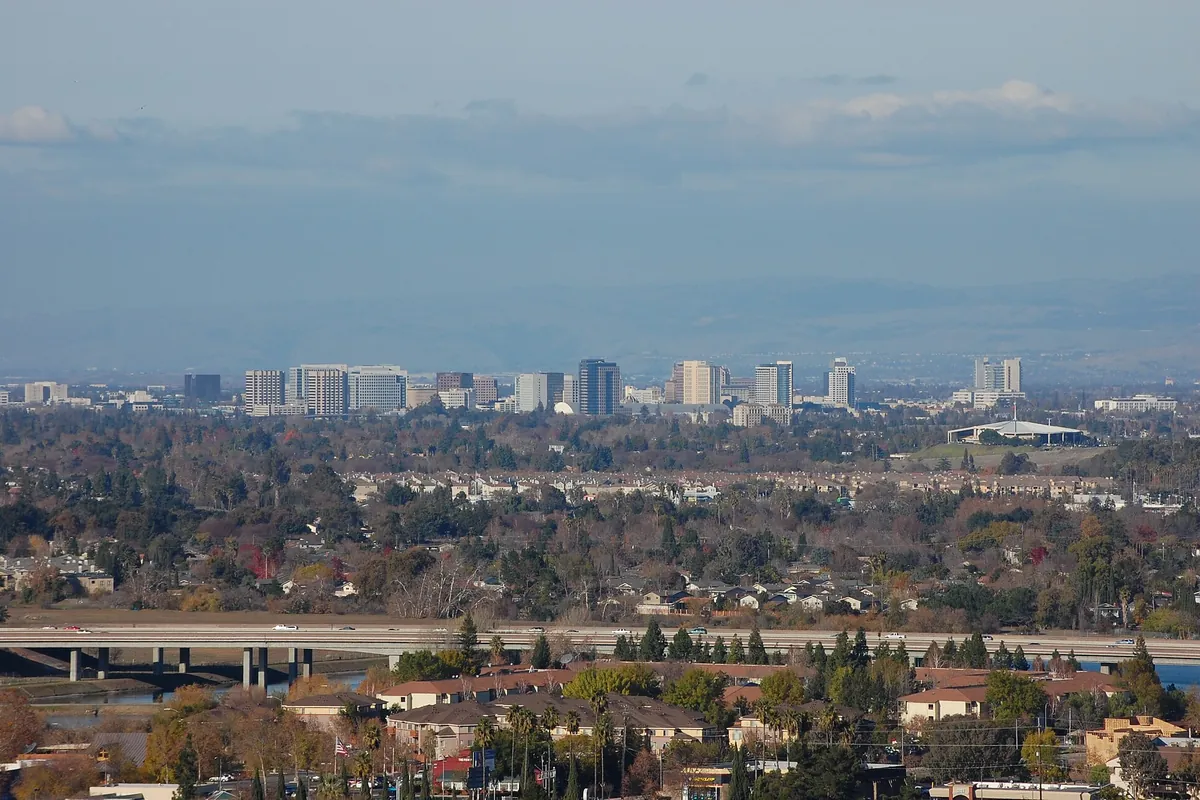
What the water means for the glass
There is no single San Jose hardness and the utility does not offer one. On imported surface water the supply is moderately hard and forgiving; on valley-floor groundwater it reaches 26 grains and will mark anything left to dry, etch anything under repeated overspray, and stain aluminium frame channels. The source, not the address, is the variable that matters.
San Jose tap water, by the numbers
Figures by source, as reported.
| Hardness | 77–440 mg/L as CaCO₃ Published by source water type — groundwater 11 to 26 grains per gallon (very hard), imported surface water 4 to 9, third source 5 to 12; the utility's own stated threshold for hard is 120 ppm or 7 grains. |
|---|---|
| Manganese | 0.009 mg/L |
| Sodium | 14–56 mg/L |
| Chloride | 20–67 mg/L |
| Total dissolved solids | 156–520 mg/L |
| Disinfectant | chloramine |
| Source and treatment | Valley-floor groundwater wells and imported surface water delivered through Valley Water, published by the utility as separate source-water types · Rapid mix, flocculation, rapid sand filtration, chlorination with chloramines as the residual, and an orthophosphate corrosion inhibitor · No softening step. |
Not in the report: pH, alkalinity, corrosion index and iron.
SOURCE · San Jose Water 2025 Consumer Confidence Report, PWS CA4310011 and CA4310018, secondary-standards table by source water type — mountain surface, groundwater and Valley Water surface · How we source these numbers
When a wash holds
What sets the cleaning clock
Interval is set by source on one axis and canopy on the other. Groundwater-served properties need a materially shorter mineral cycle than surface-served ones on identical glazing, and the March-to-April eucalyptus and oak overlap adds an organic spike across all of them that no rinse policy prevents.
CALIFORNIA SEASON BY SEASON →What's specific to San Jose
San Jose Water publishes hardness by source water type, not citywide, and the spread is enormous: valley-floor groundwater at 183 to 440 mg/L (11 to 26 grains, very hard), imported surface water at 77 to 153 (4 to 9 grains), and a third blended source at 84 to 198. The utility's own threshold for hard is 120 ppm. Which source serves an address decides the method entirely. The tech-corridor commercial footprint and Silicon Valley premium inventory set the pricing.
San Jose Water publishes a table of hardness by source water type rather than one city figure: groundwater at 183 to 440 mg/L (11 to 26 grains per gallon), imported surface water at 77 to 153 (4 to 9 grains), and a third source at 84 to 198 (5 to 12). That is a nearly six-fold span inside one service area, and the utility states its own threshold — water is hard above 120 ppm or 7 grains.
Most of the valley floor is on groundwater, which is the very hard end. Imported surface water has had far less contact with mineral-rich geology and carries a fraction of the load. A crew that establishes a rinse policy on one side of the service area and carries it to the other will get a different result for reasons that have nothing to do with technique.
At the groundwater end this is among the hardest supplies on this site — 26 grains is comparable to the worst of Arizona and Texas. Deionised or filtered final rinse is not a premium on that side of the city; it is the only way to finish a dark pane cleanly, and irrigation overspray at that concentration etches rather than spots.
Because the split follows the source rather than the neighbourhood boundary, the practical approach here is to establish hardness per route empirically — watch how the glass dries on the first job in an area and set the method from that, rather than from a citywide number that describes nobody.
Decades of tech manufacturing have left a documented groundwater contamination legacy in the Santa Clara Valley. It does not change cleaning method, but it is why the local water conversation is unusually well informed and why customers here ask more specific questions than in most markets.
Eucalyptus and oak pollen overlap in March and April and both stick aggressively. Eucalyptus in particular sheds an oily resinous residue that a pure-water rinse passes straight over — a presoak and surfactant pass is faster than any amount of scraping.
The tech-corridor commercial book concentrates around campus refresh cycles and pulls quarterly contracts at scale. It is modern low- and mid-rise curtain wall rather than high-rise, which keeps access straightforward but puts the work on formal procurement.
Cambrian Park and the mid-century ranch stock carry original aluminium-frame single-pane glazing in quantity. Aluminium frames pit and stain where very hard water sits in the channel, so frame condition is part of the assessment here in a way it is not on newer stock.
How old the glass is
- Before 1940 · 5%wood sash and older glass
- 1940–1959 · 13%steel casements, early aluminium
- 1960–1979 · 42%aluminium sliders, often single-pane
- 1980–1999 · 21%double-pane units become standard
- 2000–2009 · 10%vinyl frames, low-E spreading
- 2010 or later · 9%low-E common: gentle cleaners only
The city, by neighborhood
What window cleaning costs in San Jose
Rinse-water treatment is a real cost on the groundwater side of the service area and close to unnecessary on the surface side, which is an unusual split to price within one city. Above that, the tech-corridor book prices at bid on quarterly cycles, and Silicon Valley premium residential carries expectation rather than access difficulty — large accessible glazing judged closely.
Doing it yourself
On the imported-surface side, a careful homeowner does fine. On the groundwater side the same method fails, and the failure looks like bad technique when it is actually 20-plus grains drying on the pane. The genuine exclusions are eucalyptus resin, which needs a surfactant rather than effort, and overspray etching on the hard side, which is permanent by the time anyone notices.
OPEN COST ESTIMATOR →2024 annual mean at the San Jose - Jackson monitor, 158B Jackson ST, 9.2 km north-west of the city (EPA site 06-085-0005).
Largest air release: Headway Technologies Inc., 497 S. Hillview Drive (computers and electronic products), 1.8 km outside the city limits, 4,497 lb in 2024.
San José's water rules bar cleaning buildings, structures or paved surfaces with a hose that has no positive shut-off nozzle, and bar excess runoff. Valley Water's county rules likewise ban washing building exteriors with a hose lacking an automatic shut-off, so fit a trigger nozzle before washing windows.
City of San José, potable water use restrictions · Valley Water, water use restrictions for Santa Clara County · checked September 2026
San José's guide for mobile businesses, power washers included, says wash water must never drain into streets, gutters, parking lots or storm drains, and doing so breaks the city's stormwater ordinance. With the property owner's permission it can usually go down a utility sink, floor drain, mop sink or toilet, or onto landscaping or gravel if it fully soaks in before you leave.
City of San José, Mobile Businesses: Best Management Practices for power washers and mobile cleaners · checked September 2026
On a San José City Landmark or in a landmark district, changing windows is minor exterior work that needs a Historic Preservation Permit Adjustment from planning staff; in-kind repairs that leave the look unchanged need no permit. City rules say original windows on listed buildings should be replaced only if they can't be refurbished, with new ones matching the originals as closely as possible.
City of San José Planning, permits for projects with historic resources · City of San José Permit Center, Bulletin 297: window replacement requirements · checked September 2026
What actually shows up on San Jose glass
Private wells in the Central Valley pump from aquifers that have been concentrating dissolved minerals through decades of irrigation drawdown. Nitrate and arsenic are public-health concerns in specific sub-basins; the same water that produces the public-health flag also produces the heaviest hard-water deposits. Mild on the city side, brutal on the well side, often within the same county.
California live oak and the introduced eucalyptus release pollen on overlapping schedules from February through May. Eucalyptus pollen is the harder to clear — it carries a faint resinous component that does not respond fully to plain water and requires a surfactant pass.
San Jose, answered
How hard is the water in San Jose, California?+
San Jose runs on San Jose Water (imported supply via Valley Water) a mixed surface-and-groundwater blend at a published 77–440 mg/L (CaCO₃) — published by source water type — groundwater 11 to 26 grains per gallon (very hard), imported surface water 4 to 9, third source 5 to 12; the utility's own stated threshold for hard is 120 ppm or 7 grains.
How much does window cleaning cost in San Jose?+
Residential window cleaning in San Jose typically runs $12–18 per pane or $350–600 for a standard single-story exterior. Rinse-water treatment is a real cost on the groundwater side of the service area and close to unnecessary on the surface side, which is an unusual split to price within one city.
When is the best time of year to clean windows in San Jose?+
San Jose's drier, frost-free months are May to October, by NOAA's 1991–2020 normals for the San Jose station, where February brings the most rain. The calendar on this page marks May (after the February 24 bloom). A frost night comes in about half of winters, near December 22.
Can I rinse windows with San Jose tap water?+
Not as the final rinse: San Jose Water (imported supply via Valley Water) publishes dissolved solids of 156–520 mg/L, enough to spot as it dries, so finish with pure water. Water left to dry leaves mineral scale; fresh spots lift with a mild acid. It draws on Valley-floor groundwater wells and imported surface water.
Why do my windows look dirty so quickly in San Jose?+
In San Jose the dominant residue patterns include eucalyptus and oak pollen and central valley well water. Interval is set by source on one axis and canopy on the other.
Do I need a professional to clean my windows in San Jose?+
On the imported-surface side, a careful homeowner does fine. On the groundwater side the same method fails, and the failure looks like bad technique when it is actually 20-plus grains drying on the pane. The genuine exclusions are eucalyptus resin, which needs a surfactant rather than effort, and overspray etching on the hard side, which is permanent by the time anyone notices.
What sets Downtown San Jose apart for window cleaning in San Jose?+
Mid-rise commercial and converted-loft residential; SAP Center event-cycle commercial work. Willow Glen and Almaden Valley have their own housing stock and glazing as well.
Other cities we cover in California
Nearby cities in neighboring states
Just over the California line