Window Washing in Raleigh
Raleigh's water is soft at 24.7 to 25.5 mg/L, so the recurring jobs are the March to April oak and pine pollen wave and aphid honeydew under canopy.
Raleigh's water is soft, so there is very little mineral to leave behind; what decides a clean here is the canopy, from the oak and pine pollen wave of early spring to sticky aphid honeydew under the trees. April, May, September and October are the best months to wash. A house under mature oaks in Oakwood or Five Points carries a heavier load than a Brier Creek house of the same size; a single-story exterior runs $300 to $510.
What the water means for the glass
At roughly 25 mg/L there is very little dissolved mineral to deposit, so the supply itself is close to neutral in the result. What decides a Raleigh job is what the canopy puts on the glass and what the pH does to the cleaner — the water is the one variable a crew here can stop thinking about.
Raleigh tap water, by the numbers
Figures by plant, as reported.
| Hardness | 24.7–25.5 mg/L as CaCO₃ Soft — the city labels both plant figures 'Classified as Soft' in its own report, as published by City of Raleigh Public Utilities. |
|---|---|
| pH | 8.4–8.41 |
| Alkalinity | 27.6–31.3 mg/L as CaCO₃ |
| Iron | not detected |
| Manganese | not detected |
| Sodium | 22.8–24.3 mg/L |
| Chloride | 11.8–14.1 mg/L |
| Total dissolved solids | 97–102 mg/L |
| Disinfectant | ozone + chloramine |
| Source and treatment | Two surface-water plants, E.M. Johnson and D.E. Benton, each reported separately · Ozone as primary oxidant, permanganate pre-oxidation, ferric sulfate coagulation with polymer, filtration with filter-aid polymer, powdered carbon for taste, odour and organics, sodium hydroxide for pH, silicate for corrosion control, fluoride, then chlorine dosed with ammonia at roughly 3.5:1 to 3.8:1 to form chloramines · No softening step. |
Not in the report: corrosion index.
SOURCE · City of Raleigh Compliance Drinking Water Laboratory, 2025 Annual Finished Water Quality Report, Minerals / Water Quality Characteristics / plant Treatment Process Information tables for the E.M. Johnson and D.E. Benton plants (raleighnc.gov). The 2025 characteristics table carries conductivity but no TDS row, so TDS is taken from the 2021 edition of the same report (102 and 97 mg/L at EMJ and DEB). · How we source these numbers
When a wash holds
What sets the cleaning clock
Raleigh's interval is set by the tree calendar, not a mineral cycle. The March-to-April oak and pine wave is the hard reset; honeydew builds under canopy through the warm months and is worst on the glass with the best shade; and leaf-tannin staining arrives in autumn. Streets with mature oaks need materially more frequent service than open subdivisions two miles away, on the same water.
NORTH CAROLINA SEASON BY SEASON →What's specific to Raleigh
Raleigh publishes hardness at 25.5 mg/L from the E.M. Johnson plant and 24.7 from D.E. Benton, both labelled Soft in the city's own table. Mineral handling is close to a non-issue and the deionised upsell has little to argue with. The canopy does the damage instead: oak pollen in spring, then tannin, leaf litter and aphid honeydew, that last one a sticky sugar film routinely mistaken for dirt and unaffected by a pure-water rinse. Downtown offers genuine high-rise work, rare in the state outside Charlotte.
Raleigh runs two treatment plants and publishes a figure for each: 25.5 mg/L at E.M. Johnson and 24.7 at D.E. Benton, 1.49 and 1.44 grains per gallon, both classed Soft in the city's own table. The two agree closely enough that the address does not change the method — which is worth stating, because a two-plant utility is exactly where a citywide figure usually breaks down.
The city also publishes a Home Brewer's Corner table, hardness alongside calcium at 6.01 mg/L, magnesium 2.50, sodium 33.0, alkalinity 27.8 and sulfate 46.7. A utility publishing its water chemistry for brewers is publishing it for anyone whose trade depends on what is dissolved in the supply, and it is the most precise source a cleaning crew will find for this city.
Finished pH runs about 8.4 at both plants, which matters more here than the hardness does. Alkaline water sits on the same side of the scale as an alkaline detergent instead of tempering it, so an aggressive cleaner has nothing pulling against it — dilute further than the label suggests and rinse sooner than instinct says.
Raleigh is called the City of Oaks for good reason, and the canopy is the operational reality. Oak pollen in spring overlays the regional pine wave, and through the rest of the year the same canopy drops tannin-bearing leaf litter, aphid honeydew and insect debris onto glass beneath it.
Aphid honeydew under heavy canopy is a specific and frequently misdiagnosed problem. It is a sticky sugar film, not mineral and not dirt, and it needs a surfactant — a pure-water rinse passes straight over it and the customer sees no improvement.
Piedmont red clay is iron-rich and splatters onto lower panes and sills from beds and unpaved edges. Left through repeated wet-dry cycles it stains rather than washes, and lifting it needs an acid or oxalic step.
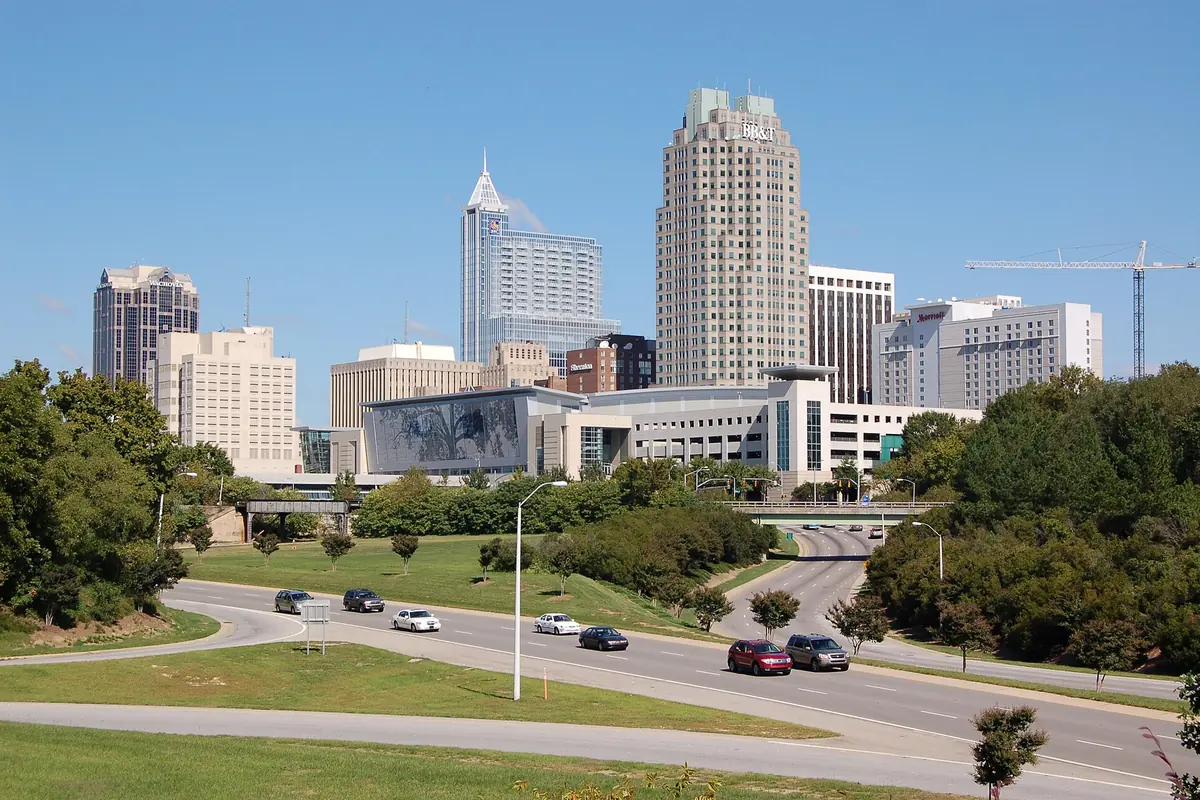
Downtown Raleigh has real high-rise glazing, which almost no other North Carolina market outside Charlotte offers. That work is a different business — rope access or powered platform, specific insurance, and scheduling around building operations — and it is where the ceiling on revenue in this market sits.
Research Triangle Park and state government together give Raleigh an institutional book far larger than its retail sector. Both procure formally on annual or multi-year cycles, so winning here depends on bid timing and documentation rather than on responsiveness.
How old the glass is
- Before 1940 · 3%wood sash and older glass
- 1940–1959 · 5%steel casements, early aluminium
- 1960–1979 · 16%aluminium sliders, often single-pane
- 1980–1999 · 32%double-pane units become standard
- 2000–2009 · 24%vinyl frames, low-E spreading
- 2010 or later · 21%low-E common: gentle cleaners only
The city, by neighborhood
What window cleaning costs in Raleigh
Canopy density is the real driver on Raleigh residential work — an Oakwood or Five Points house under mature oaks carries a genuinely heavier load than a Brier Creek house of the same size, and pricing them alike loses money on one of them. Above that sit downtown high-rise access and the institutional book, where Research Triangle Park and state procurement run on formal annual cycles and the number is set at bid time rather than at the door.
Doing it yourself
On soft water and accessible glazing a careful homeowner gets most of the way in Raleigh, and the honest version of the pitch admits it. What defeats them is honeydew, which needs a surfactant and a dwell rather than effort, and which is the step people skip before concluding the glass cannot be cleaned. Downtown's high-rise elevations are the other exclusion — rope-access or platform work with its own insurance and building coordination, a different trade rather than a harder version of the same one.
OPEN COST ESTIMATOR →2025 annual mean at the Millbrook School monitor, 3801 Spring Forest RD., 6.6 km north-east of the city (EPA site 37-183-0014).
Largest air release: Ajinomoto Health & Nutrition N.A. Inc., 4020 Ajinomoto DR (chemicals), inside the city limits, 82,111 lb in 2024.
Raleigh's everyday mandatory water rules cover restaurants and hotels, not hoses; limits on outdoor use come only through the Stage 1 to 3 restrictions the City Council adopts during shortages. The city recommends odd/even-day irrigation and running hose-end sprinklers only from 6 to 10 in the morning and evening.
Raleigh City Code §8-2175: mandatory water use restrictions · Raleigh City Code §8-2176: voluntary water use measures · checked September 2026
Raleigh bars anyone from letting any substance other than stormwater reach a stormwater conveyance or state waters, directly or by leaving it on land where it is likely to get there, apart from listed low-impact flows such as potable water and residential or non-profit vehicle washing. Commercial wash water carrying soap or cleaner is not on that list.
Raleigh City Code §13-5007: non-stormwater discharge controls · checked September 2026
Any exterior change to a property in a Raleigh General Historic Overlay District, to regulated zones of a Streetside Historic Overlay District, or to a Raleigh Historic Landmark needs a Certificate of Appropriateness before work begins, whatever other permits apply. Many projects are approved by staff as Minor Work; larger ones go to the Raleigh Historic Development Commission's COA Committee as Major Work.
City of Raleigh, Certificate of Appropriateness (COA) · checked September 2026
What actually shows up on Raleigh glass
The Triangle and eastern Piedmont parent rock weathers to a more iron-bearing clay than the Atlanta Piedmont. Lower-sash splatter on intown stock needs oxalic rather than citric to lift cleanly. A citric-only protocol leaves a faint orange ghost stain.
Loblolly and shortleaf pine pollen blankets south-facing exposures for two to three weeks each spring. Same handling as Atlanta: wet only, never scrape, light alkaline wash to lift the film.
Tropical-storm and hurricane events drop salt-loaded rain, wind-driven leaves and small debris, and occasionally roof granules across glass in the eastern half of the state. Post-event cleaning wave runs for two to four weeks after a major landfall.
Raleigh, answered
How hard is the water in Raleigh, North Carolina?+
Raleigh runs on City of Raleigh Public Utilities lake or reservoir surface water at a published 24.7–25.5 mg/L (CaCO₃) — soft — the city labels both plant figures 'Classified as Soft' in its own report. At roughly 25 mg/L there is very little dissolved mineral to deposit, so the supply itself is close to neutral in the result.
How much does window cleaning cost in Raleigh?+
Residential window cleaning in Raleigh typically runs $10–15 per pane or $300–510 for a standard single-story exterior. Canopy density is the real driver on Raleigh residential work — an Oakwood or Five Points house under mature oaks carries a genuinely heavier load than a Brier Creek house of the same size, and pricing them alike loses money on one of them.
When is the best time of year to clean windows in Raleigh?+
Raleigh's drier, frost-free months are April and May and September and October, by NOAA's 1991–2020 normals for the Raleigh Durham International Airport station, where July brings the most rain. The calendar on this page marks April (after the March 27 bloom), September (after smoke season) and October (before frost). Frost nights usually run from November 4 to March 31.
Can I rinse windows with Raleigh tap water?+
Yes, if the rinse is squeegeed off before it dries: City of Raleigh Public Utilities publishes dissolved solids of 97–102 mg/L, between this site's two dissolved-solids flags. Iron, manganese, sodium and chloride all sit under this site's flags (highest: sodium up to 24.3 mg/L). It draws on two surface-water plants, E.M. Johnson and D.E. Benton, each reported separately.
Why do my windows look dirty so quickly in Raleigh?+
In Raleigh the dominant residue patterns include oak and pine pollen wave (march–april) and aphid honeydew film under mature canopy. Raleigh's interval is set by the tree calendar, not a mineral cycle.
Do I need a professional to clean my windows in Raleigh?+
On soft water and accessible glazing a careful homeowner gets most of the way in Raleigh, and the honest version of the pitch admits it. What defeats them is honeydew, which needs a surfactant and a dwell rather than effort, and which is the step people skip before concluding the glass cannot be cleaned.
What sets Downtown Raleigh apart for window cleaning in Raleigh?+
Genuine high-rise core with modern curtain wall towers. The rope-access and lift work in the Triangle concentrates here. Oakwood and State government complex have their own housing stock and glazing as well.
Other cities we cover in North Carolina
Nearby cities in neighboring states
Just over the North Carolina line