Window Washing in North Dakota: A Three-Zone Operator's Field Notes
PUB. MAY 11, 2026
North Dakota runs as three working zones. The Red River Valley corridor (Fargo, Grand Forks, West Fargo) on Fargo Water Treatment Plant Red River and Sheyenne River-source supply with substantial seasonal organic-load variation. The central Missouri River corridor (Bismarck, Mandan, Williston) on Missouri River-source municipal supply. The western North Dakota Bakken-corridor residential and rural well-water (Williston, Watford City, Dickinson) on Fox Hills-Hell Creek aquifer and well-water supply. Rural North Dakota well-water statewide variable depending on aquifer source.
- How North Dakota Works in Practice
- The Red River Valley Fargo and Grand Forks Profile
- Bismarck and the Missouri River Corridor
- The Western North Dakota Bakken-Corridor Belt
- Cottonwood, Ash-Pollen, and the Spring Calendar
- The Long-Winter Plains Compression
- Heritage Residential Through Fargo, Grand Forks, and Bismarck
- What I Tell Crews About Working This State
Need a window cleaner in North Dakota?
We're building a local pro directory. Join the free waitlist.
By Jan Davenport, for the Midwest and Great Lakes beat at Window Washing Guide
How North Dakota Works in Practice
North Dakota is the most seasonally compressed working state in the Plains and one of the most operationally distinctive in the country. The working calendar runs at most seven to eight months — late March through early November in the eastern corridor, mid-April through mid-October in the western corridor — and the four-to-five-month winter exterior shutdown shapes every operational decision an operator makes here. The chemistry runs as three working zones with a rural-well-water overlay that introduces meaningful variance on top of the municipal pattern.
The Red River Valley corridor — Fargo, West Fargo, Grand Forks, Wahpeton, and the surrounding Cass, Grand Forks, Richland, and Traill County residential — operates on Red River and Sheyenne River-source municipal supply. Fargo and West Fargo sit at a published 120 mg/L (moderately hard), at the top edge of that band. The chemistry-handling baseline is closer to what Cal Hatcher documents for the Memphis Mississippi-River-source supply than to the rest of the Plains. Operators porting Iowa or Nebraska aquifer-source protocols into the Red River Valley residential typically run excessive citric handling on stock that does not need it. The seasonal organic-load variation — heaviest in spring snow-melt runoff and summer low-flow stretches — produces a tinted-composite residue that requires modestly extended citric dwell on the heaviest organic-load weeks.
The central Missouri River corridor — Bismarck, Mandan, Lincoln, and the surrounding Burleigh and Morton County residential — operates on Missouri River-source municipal supply. Bismarck sits at a published 132 mg/L (hard). Iron content moderate. Organic-load fraction low. Standard alkaline-soap protocol with citric finish on lower-sash mineral residue runs cleanly across the metro.
The western North Dakota Bakken corridor — Williston, Watford City, Dickinson, Stanley, and the surrounding McKenzie, Williams, Mountrail, and Stark County residential — operates on Fox Hills-Hell Creek aquifer and well-water supply, with sub-micron suspended-particulate fraction on the worst-affected systems. None of these towns is a covered city with a published figure, a gap I documented in the Nebraska state coverage. The Bakken-era industrial-residue overlay on the commercial book is operationally distinctive.
Operators serving rural residential statewide carry chemistry verification on individual properties as routine practice.
The seasonal-disruption pattern bridges all three zones. Cottonwood and ash-pollen wave April through May is the dominant statewide spring contaminant. Severe-weather and hail-storm activity from May through September drives recurring post-event cleaning surges. Spring snow-melt residue handling from mid-March through April produces a meaningful commercial-and-residential workload. The winter exterior work effectively shuts down November through March statewide because of severe cold (regularly -20 to -30°F in deep winter stretches). The commercial-interior pricing-discipline framework I cover for the broader Midwest applies with maximum force here — North Dakota operators need to build at least 35 to 40 percent of revenue from commercial interior to carry the off-season, which is meaningfully higher than the 25 percent baseline that Linnea Jorgensen documents for the Twin Cities and that I cover for the broader upper Midwest.
The Red River Valley Fargo and Grand Forks Profile
The surface-source treatment delivers cleaner mineral chemistry than most operators outside the region expect for a Plains state. Iron content is moderate but the seasonal organic-load variation is the operational wildcard — spring snow-melt runoff carries elevated organic-fraction content from the Red River drainage basin, and summer low-flow stretches concentrate the organic-fraction content during dry-cycle years.
The protocol-handling baseline is the standard alkaline-soap protocol with citric finish on lower-sash mineral residue. The organic-load handling on the heaviest weeks requires modestly extended citric dwell (60 to 90 seconds) on lower-sash residential work. The chemistry-handling is closer to what Cal Hatcher documents for the Memphis Mississippi-River-source supply than to the rest of the Plains. Operators porting Iowa or Nebraska aquifer-source protocols into the Red River Valley residential typically run excessive citric handling on stock that does not need it.
The Fargo pre-1900 Downtown commercial heritage at modest scale carries the older surviving pre-1900 commercial-grade glazing in eastern North Dakota. The Downtown Fargo NP Avenue and Broadway commercial-conversion stock operates on heritage-handling protocol. The pre-1925 Hawthorne, Roosevelt, Oak Grove, Edgewood, and South University heritage residential neighborhoods carry Craftsman, Tudor Revival, and Prairie School heritage residential at meaningful density. The North Dakota State University campus heritage stock and the surrounding pre-1925 university-district residential operate on standard heritage-handling pacing.
The Grand Forks pre-1900 Downtown commercial heritage at modest scale and the pre-1925 Reeves Drive heritage residential operate on parallel heritage-handling. The University of North Dakota campus heritage and the surrounding pre-1925 university-district residential parallel the NDSU pattern. The Grand Forks Air Force Base institutional commercial book is a smaller but coherent institutional commercial concentration.
The Fargo-metro mid-rise downtown commercial concentration drives a substantial commercial book that operates on quarterly-to-monthly maintenance scheduling. The post-2010 coated-glass IGU commercial concentration through the surrounding mixed-use corridor carries surface-sensitivity protocol that is closer to what I document for the Minneapolis post-2010 mid-rise commercial than to standard Plains regional commercial.
Suburban Fargo — West Fargo, Reile's Acres, Horace, and the surrounding post-1985 production-suburban residential — is post-1985 production-suburban dominant with substantial post-2010 luxury concentration through West Fargo and the Reile's Acres corridor. Standard protocol-handling on the production-suburban stock; selective surface-sensitivity protocol on the post-2010 luxury concentration.
Bismarck and the Missouri River Corridor
Bismarck sits at a published 132 mg/L (hard). The protocol-handling baseline is the standard alkaline-soap-with-citric-finish framework. The Bismarck pre-1900 Downtown commercial heritage at modest scale carries the older surviving pre-1900 commercial-grade glazing in central North Dakota. The Cathedral District pre-1925 heritage residential — Tudor Revival, Mediterranean Revival, and Craftsman at meaningful density — operates on standard heritage-handling pacing.
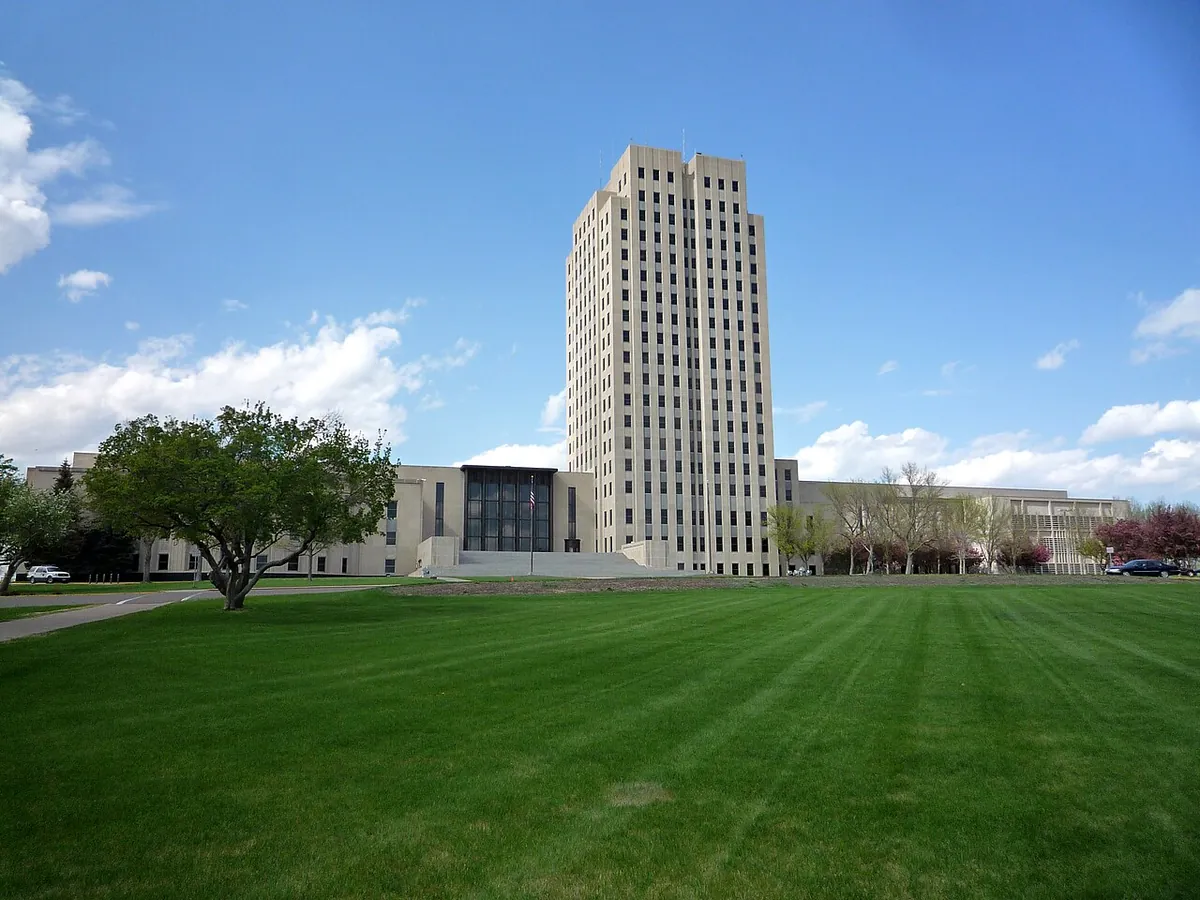
The State Capitol-district institutional commercial — the State Capitol building (the tallest building in North Dakota, completed 1934 in Art Deco style with substantial original glazing) plus the surrounding government-district commercial — operates on institutional-procurement-grade handling. The Capitol building original glazing is operationally distinctive in the state and requires conservation-grade pacing on the surviving original stock.
Mandan operates on Mandan Water Missouri River-source supply that is operationally continuous with Bismarck. Pre-1925 Downtown heritage at modest density. The Bismarck-metro west-side commercial spillover drives a meaningful Mandan commercial book.
The Bismarck-metro mid-rise downtown commercial concentration is smaller than Fargo but operates on similar quarterly-to-monthly maintenance scheduling. The post-2010 coated-glass IGU commercial concentration through the surrounding government-district and mixed-use corridor carries surface-sensitivity protocol.
Suburban Bismarck — Lincoln, the Heart Butte corridor, and the surrounding post-1985 production-suburban residential — is post-1985 production-suburban dominant. Limited post-2010 luxury concentration outside of the Riverwood and surrounding bench corridor.
The central Missouri River corridor commercial book operates as a meaningful regional commercial concentration. The State Capitol institutional commercial overlay, the central North Dakota hub-city commercial concentration, and the agricultural-services commercial through the surrounding county-seat corridor produce a coherent regional commercial pattern.
The Western North Dakota Bakken-Corridor Belt
The western North Dakota Bakken corridor — Williston, Watford City, Dickinson, Stanley, Tioga, Crosby, and the surrounding McKenzie, Williams, Mountrail, Divide, and Burke County residential — operates on Fox Hills-Hell Creek aquifer and well-water supply, with sub-micron suspended-particulate fraction on the worst-affected systems. None of these towns is a covered city with a published figure. The protocol-handling for western North Dakota residential requires extended citric dwell (3 to 5 minutes) plus citric-rinse finish on most stock.
The Bakken oil-and-gas commercial concentration is the operationally distinctive commercial pattern in the western corridor. The post-2008 Bakken boom drove a substantial expansion of the western North Dakota commercial book — oil-and-gas service-corridor commercial, hospitality-and-retail commercial, and the surrounding industrial commercial concentration. The Bakken commercial book peaked through the 2014-2015 stretch, contracted through the 2016-2019 downturn, and rebuilt through the 2020s with operationally different industry-and-business mix.
The Bakken-corridor industrial residue on commercial glass is operationally distinctive. The hydrocarbon-residue-plus-drilling-mud-and-fines-residue-plus-mineral-residue composite that accumulates on facility-adjacent commercial glass requires extended alkaline-soap dwell plus citric-rinse handling. Operators working Bakken commercial without the industrial-residue protocol-handling produce streaked work on the affected stock. Local-knowledge handling — knowing which specific Bakken facility classes produce which residue fingerprints — is part of the trade-craft baseline for western North Dakota commercial operators.
Williston operates on Williston Water mixed supply with substantial post-2010 Bakken-era infrastructure pressure. The municipal water supply quality through the 2010s and into the 2020s carried recurring reliability questions — distribution-system pressure events, occasional discoloration episodes, and the post-2010 infrastructure-expansion construction overlay — that produced an operational complication. Most working Williston operators carry distilled-water backup as routine practice.
The Williston pre-1925 Downtown heritage at limited density was substantially obscured by the post-2008 Bakken-era expansion. The original downtown commercial heritage stock survives but the surrounding pre-1925 residential was thinned through the Bakken-era teardown-and-rebuild pattern. The post-2010 production-residential dominant housing stock through Williston and Watford City operates as standard production-residential cleaning.
Dickinson operates on Dickinson Water aquifer supply. Pre-1925 Downtown heritage at modest density. Dickinson State University campus heritage. The Bakken-corridor commercial concentration is smaller in Dickinson than in Williston but operationally similar.
Cottonwood, Ash-Pollen, and the Spring Calendar
The cottonwood and ash-pollen wave from late April through May is the dominant statewide spring contaminant and the single largest seasonal booking driver in North Dakota. The spring onset runs late by Plains standards because of the high-latitude position of the state — late April through May rather than the late-March-through-April Nebraska pattern. The pollen-wave booking surge is correspondingly compressed into a tighter window than the more-southern Plains states.
Eastern cottonwood seed-fluff in late May is operationally distinct from the pine pollen that defines the Southern spring pattern. The cottonwood seed-fluff accumulates as a fluffy white residue on screens, sash perimeter, and lower-pane surfaces. Wet-rinse handling. Screen-and-sash-perimeter cleaning takes meaningfully longer than standard spring cleaning because of the seed-fluff accumulation on the screen mesh and sash tracks.
The ash-pollen wave from late April through early May runs alongside the cottonwood pattern. The pollen deposits as a fine pale-green-and-yellow film on horizontal and east-facing vertical glass. The combined cottonwood-and-ash-pollen booking surge runs from late April through late May statewide and is the heaviest single residential-booking-pressure stretch of the year.
The spring snow-melt residue handling from mid-March through April produces a meaningful commercial-and-residential workload. The late-winter and early-spring ice-melt residue carries chloride-residue, mineral residue, and organic residue composite. The handling pattern is operationally similar to what Linnea Jorgensen documents for the Twin Cities ice-dam meltwater — percarbonate-citric ladder protocol on the worst-affected lower-pane commercial and street-level retail.
The pre-pollen-wave spring cleaning book then bridges into the late-spring booking calendar that runs through Memorial Day and into the early-summer production window. The June stretch is the cleanest production window in North Dakota statewide before the summer thunderstorm-cycle disruption begins.
The Long-Winter Plains Compression
North Dakota operates on the most seasonally compressed working calendar of any state I cover. The winter exterior work effectively shuts down November through March statewide. Deep-winter cold — regularly -20 to -30°F in extended stretches through January and February, with occasional drops below -40°F in the worst winter weeks — makes most exterior work impossible for four to five months. The Plains compression pattern is operationally more extreme than what Linnea Jorgensen documents for Minnesota.
The commercial-interior work statewide is off-season backbone for all operators. The pricing-discipline framework I cover for the broader Midwest applies with maximum force here. North Dakota operators need to build at least 35 to 40 percent of revenue from commercial interior to carry the off-season, which is meaningfully higher than the 25 percent baseline that Linnea Jorgensen documents for the Twin Cities. Operators who do not build that commercial-interior buffer face a five-month no-income stretch that the business cannot survive without external income support.
The road-salt residue on lower-pane commercial and street-level retail glass through the long winter is a meaningful commercial-cleaning workload from November through April. The chloride-residue requires wet-rinse-first protocol on commercial-grade glazing, with light citric finish on the worst-affected stock. Operators with substantial commercial-retail books carry the winter cleaning workload as the core off-season production stream.
The pre-snow residential rush from September through October is the most concentrated single-window residential booking surge of the year. The early winter onset compresses the pre-winter close-out cleaning workload into a six-to-eight-week stretch rather than the longer pre-winter window that more-southern Plains states get. Operators serving the residential book extend operating hours through this stretch to capture the pre-winter close-out cleaning workload.
The Bakken-corridor commercial operates on a slightly compressed winter pattern compared to the residential. Bakken oil-and-gas facility commercial cleaning continues through the winter on the facilities that maintain year-round operations, with the cleaning crew and equipment-and-chemistry handling adapted for cold-weather working conditions. The cold-weather alkaline-soap and citric-rinse handling on facility commercial requires substantially modified working protocols — solution warming, faster squeegee work to outrun the freeze-on-contact problem, and ladder-and-pole working modifications for the extreme cold. Operators working winter Bakken commercial typically run a separate winter-commercial crew with the specialized equipment and the cold-weather protocol training.
Heritage Residential Through Fargo, Grand Forks, and Bismarck
North Dakota carries one of the more limited heritage residential concentrations in the Plains states. The principal heritage corridors — Fargo, Grand Forks, Bismarck, and the small-town pre-1925 heritage corridors through Jamestown, Devils Lake, Valley City, Wahpeton, and the surrounding county-seat towns — operate on standard heritage-handling rather than conservation-grade heritage-handling on most properties.
The Fargo pre-1925 Hawthorne, Roosevelt, Oak Grove, Edgewood, and South University heritage residential is the deepest concentration in eastern North Dakota. Pre-1900 single-family Victorian and pre-1925 Craftsman, Tudor Revival, and Prairie School residential at meaningful density. Original-glass survival rates are moderate. The heritage-handling baseline is conservative pacing, hand-finish only on the most-preserved properties.
The Grand Forks pre-1925 Reeves Drive and the surrounding University Park heritage residential carries pre-1925 Prairie School and Craftsman residential at modest density. The 1997 Red River Valley flood substantially affected the Grand Forks pre-1925 residential stock — meaningful portions of the original housing were affected by the flood, and the post-1997 rebuild-and-restoration pattern produced a mixed heritage-handling book.
The Bismarck pre-1925 Cathedral District heritage residential carries Tudor Revival, Mediterranean Revival, and Craftsman residential at meaningful density. The State Capitol building original 1934 glazing is operationally distinctive in the state and requires conservation-grade pacing on the surviving original stock.
The small-town North Dakota heritage corridors through Jamestown, Devils Lake, Valley City, Wahpeton, Mayville, Carrington, Rugby, and the surrounding county-seat towns carry pre-1925 small-town heritage residential at modest density. The pre-1925 small-town commercial heritage through the downtown corridors carries the more-substantial heritage handling. Operators serving the small-town residential typically work the heritage book as part of the standard regional pattern rather than as a specialty book.
The rural North Dakota residential is overwhelmingly post-1950 modest-scale farmhouse-and-ranch construction with limited heritage stock. The Cherry County and Sandhills-equivalent ranching residential — through the western North Dakota grazing-and-grain corridor — is post-1925 modest-scale with no meaningful heritage stock.
What I Tell Crews About Working This State
A few things any operator running North Dakota should internalize:
The chemistry is genuinely three-zone with a rural-well-water overlay. Crews moving between these markets need to make the chemistry adjustment. The Red River Valley protocol does not port into Williston.
Fargo sits at a published 120 mg/L, at the top edge of the moderately hard band. Operators porting Iowa or Nebraska aquifer-source protocols into Fargo or Grand Forks residential typically run excessive citric handling on stock that does not need it. The seasonal organic-load variation requires modestly extended citric dwell on the heaviest weeks (spring snow-melt runoff and summer low-flow stretches).
The Bakken-corridor industrial residue on western North Dakota commercial requires extended alkaline-soap dwell plus citric-rinse handling. Local-knowledge handling — knowing which specific Bakken facility classes produce which residue fingerprints — is part of the trade-craft baseline. The Williston municipal water supply reliability requires distilled-water backup as routine practice.
The cottonwood and ash-pollen wave from late April through May is compressed into a tighter window than the more-southern Plains states because of the late spring onset. The pre-pollen-wave spring snow-melt residue handling from mid-March through April produces a meaningful commercial-and-residential workload. Build the screen-cleaning surcharge into the May residential pricing structure.
The winter exterior work effectively shuts down November through March statewide. Commercial interior work is off-season backbone. North Dakota operators need to build at least 35 to 40 percent of revenue from commercial interior to carry the off-season, which is meaningfully higher than the 25 percent baseline that Linnea Jorgensen documents for the Twin Cities. Operators who do not build that buffer face a five-month no-income stretch that the business cannot survive.
The road-salt residue on lower-pane commercial and street-level retail glass through the long winter is a meaningful commercial-cleaning workload from November through April. Wet-rinse-first protocol on commercial-grade glazing. Operators with substantial commercial-retail books carry the winter cleaning workload as the core off-season production stream.
The pre-snow residential rush from September through October is the most concentrated single-window residential booking surge of the year. The early winter onset compresses the pre-winter close-out cleaning workload into a six-to-eight-week stretch. Extend operating hours through this stretch.
For broader Plains and Midwest context, the South Dakota, Minnesota, Nebraska, Iowa, and Wisconsin state pages cover the chemistry and seasonal frameworks that bracket North Dakota. For the operating protocols themselves, the article on the test that tells etching from deposits covers the Bakken-corridor aquifer chemistry, the article on pricing your first commercial route covers the commercial-interior off-season buffer that North Dakota operators need, and the article on the solvent ladder for sap, tar, and bugs covers the Bakken-corridor industrial-residue handling. Cross-references for technique: the four-stage method, which glass you are actually cleaning, streaks that come back overnight.
The big cities, in numbers
Fargo Water Treatment Plant Red River and Sheyenne River-source supply with substantial seasonal organic-load variation. Pre-1900 Downtown commercial heritage. Pre-1925 Hawthorne, Roosevelt heritage residential. North Dakota State University campus heritage. Mid-rise downtown commercial concentration.
Bismarck Water Missouri River-source supply. Pre-1900 Downtown commercial heritage. Pre-1925 Cathedral District heritage residential. State Capitol-district institutional commercial. Central North Dakota hub-city commercial concentration.
The 2021 Grand Forks Regional Water Treatment Plant treats Red River of the North and Red Lake River supply through parallel conventional and membrane trains. Post-1997-flood rebuilt downtown, Lake Agassiz clay plain, UND institutional base.
Buys treated water from the City of Fargo, whose plant softens hard Red River water; Sheyenne River and Lake Ashtabula are the alternates, and the Sheyenne intake sits south of West Fargo. Overwhelmingly post-2000 housing stock.
City wells in the Minot and Sundre aquifers, softened at the Minot Water Treatment Plant; NAWS will bring Missouri River water, with final Minot plant upgrades projected for 2029. 2011 Souris River flood rebuilt much of the valley-floor stock.
Williston Water mixed supply with substantial post-2010 Bakken-era infrastructure pressure. Bakken oil-and-gas commercial concentration heaviest in the state. Post-2010 boom-era production-residential dominant. Pre-1925 Downtown heritage at limited density.
Dickinson Water aquifer supply. Pre-1925 Downtown heritage at modest density. Dickinson State University campus heritage. Bakken-corridor commercial. Western North Dakota hub-city commercial.
Mandan Water Missouri River-source supply operationally continuous with Bismarck. Pre-1925 Downtown heritage at modest density. Bismarck-metro west-side commercial spillover.
Dedicated city pages in North Dakota
Each city page carries its own water profile, neighborhood breakdown, cost range, and city-specific operating notes.
Rules for high-rise and rope-access window work
North Dakota has no OSHA-approved state plan, so private window-cleaning firms here work under federal OSHA. Its rope descent rule (29 CFR 1910.27) requires anchors the building owner certifies in writing to 5,000 pounds, gear inspected at the start of every shift, a separate fall-arrest line for each worker, and no descents above 300 feet unless no safer access exists.
OSHA, State Plans: which states run their own programs · OSHA 29 CFR 1910.27: Scaffolds and rope descent systems · checked September 2026 · How we check local rules
What lands on the glass
| CONTAMINANT | SEASON | SEVERITY |
|---|---|---|
| Cottonwood and ash-pollen wave | late April through May | high statewide |
| Eastern cottonwood seed-fluff and ash-pollen produce the dominant statewide spring contaminant. Cottonwood seed-fluff in late May is operationally distinct from pine pollen. Wet-rinse handling. Heaviest residential booking-pressure stretch of the year — concentrated because of the late spring onset and the short residential season. | ||
| Spring snow-melt residue | mid-March through April | high statewide |
| Late-winter and early-spring ice-melt residue carries chloride-residue, mineral residue, and organic residue composite. Percarbonate-citric ladder protocol required on the worst-affected lower-pane commercial and street-level retail. Same handling pattern Linnea Jorgensen documents for Minnesota ice-dam meltwater. | ||
| Bakken-corridor industrial residue (western North Dakota) | year-round on western North Dakota commercial | medium-to-high on Williston, Watford City, Dickinson commercial corridor |
| Oil-and-gas commercial concentration produces a distinctive industrial-organic residue on glass — hydrocarbon residue plus drilling-mud-and-fines residue plus mineral residue composite. Extended alkaline-soap dwell plus citric-rinse on facility-adjacent commercial. Local-knowledge handling required. | ||
| Rural well-water mineral residue | year-round on rural well systems | high statewide on rural |
| Rural well-water with sub-micron suspended-particulate fraction on the worst-affected systems. Extended citric pre-treatment (4-6 minutes) plus citric-rinse finish required. Verify chemistry on individual properties. | ||
| Severe-weather and hail residue events | May through September | episodic, high after events |
| Statewide hail-storm exposure heavy. Wind-driven debris pattern, hail-impact residue, occasional structural-residue from damaged adjacent properties. Recurring post-event cleaning surge through the working season. | ||
| Winter ice-melt and road-salt residue | November through April | high on ground-floor and lower-pane commercial |
| Statewide road-salt application produces chloride-residue on lower-pane commercial and street-level retail glass through the long winter. Wet-rinse-first protocol on commercial-grade glazing. Light citric finish on the worst-affected stock. Operationally extended winter compared to most Midwest states because of the long winter. | ||
| Red River Valley organic-load residue (Fargo, Grand Forks) | spring runoff and summer low-flow stretches | medium on Red River Valley municipal-supply residential |
| Fargo and Grand Forks municipal supply carries seasonal organic-load variation — spring snow-melt runoff and summer low-flow stretches produce tinted-composite residue on Red River Valley residential. Slightly extended citric dwell handles the composite. | ||
The year, in seasons
Mid-April through May. Cottonwood and ash-pollen wave drives booking pressure. Spring snow-melt residue handling on commercial and residential. Late spring onset compresses the spring booking calendar — most of the year-round residential book runs through May and June.
June through August is the production window statewide. Hail-storm exposure heavy. Production rates manageable.
September through October is the cleanest production stretch statewide. Pre-winter residential rush concentrated September-October because of the early winter onset. First hard frost late September to early October statewide.
Exterior work effectively shuts down November through March statewide. Commercial interior work is off-season backbone — Jan Davenport pricing-discipline framework applies with maximum force (build at least 35-40 percent of revenue from commercial interior for the longest-winter Plains markets).
The articles that matter most for North Dakota
Border states with their own guides
Land-adjacent states each get their own water-and-window profile. If you're working a regional route or moving across the border, these are the natural next reads.
Common questions about window cleaning in North Dakota
How hard is the water in North Dakota?+
The four utilities we cover in North Dakota that publish hardness report 100 to 150 mg/L (as CaCO₃). The middle of those cities sits near 123 mg/L, which is hard, meaning municipal water consistently leaves visible mineral spots and requires acid-rinse protocols on long-residence glass. Each city page gives its own utility's figure.
When is the best time of year to clean windows in North Dakota?+
In North Dakota, the working operator's calendar typically favors fall — september through october is the cleanest production stretch statewide. pre-winter residential rush concentrated september-october because of the early winter onset. first hard frost late september to early october statewide. For a full seasonal breakdown, see the cleaning calendar section on this page.
How much does window cleaning cost in North Dakota?+
Residential window cleaning in North Dakota typically runs $8–18 per pane or $200–500 for a standard single-family house exterior, depending on metro pricing, story height, screen condition, and frame type. Use our cost estimator for a calibrated quote for your home.
Why do my windows look dirty so quickly in North Dakota?+
The dominant residue problem in North Dakota is cottonwood and ash-pollen wave (late April through May). Eastern cottonwood seed-fluff and ash-pollen produce the dominant statewide spring contaminant. Cottonwood seed-fluff in late May is operationally distinct from pine pollen. Wet-rinse handling. Heaviest residential booking-pressure stretch of the year — concentrated because
Do I need a professional to clean my windows in North Dakota?+
Single-story homes with accessible glazing can be cleaned by homeowners using basic squeegee technique and the right solution. Multi-story houses, post-2010 coated glass, hard-water markets, and screens-plus-tracks work usually pay for themselves with a professional. See our hiring checklist below.
What's special about cleaning windows in North Dakota's climate?+
Severe thunderstorms statewide spring through summer. Tornado activity moderate. Hail-storm exposure heavy statewide. Severe winter weather statewide November through April — blizzard events recurring, deep-winter cold (regularly -20 to -30°F). Spring snow-melt residue events. These conditions shape what a cleaner needs to know about scheduling, technique, and timing. The clean
Where can I find a window cleaner in Fargo, North Dakota?+
Fargo is the largest market in North Dakota and has the deepest concentration of professional window-cleaning services. Our "Find a Cleaner" page takes waitlist sign-ups while the local pro directory is built; meanwhile, read the Fargo section of this page for the city-specific water and cleaning context.
Jan Davenport
Editorial team contributor covering the Midwest and Great Lakes beat. Articles bylined by Jan are researched and reviewed in collaboration with the Giordano Inc. editorial team and informed by interviews with practicing window-washing operators in the region, plus published trade and small-business operations references.
READ MORE BY JAN DAVENPORT →