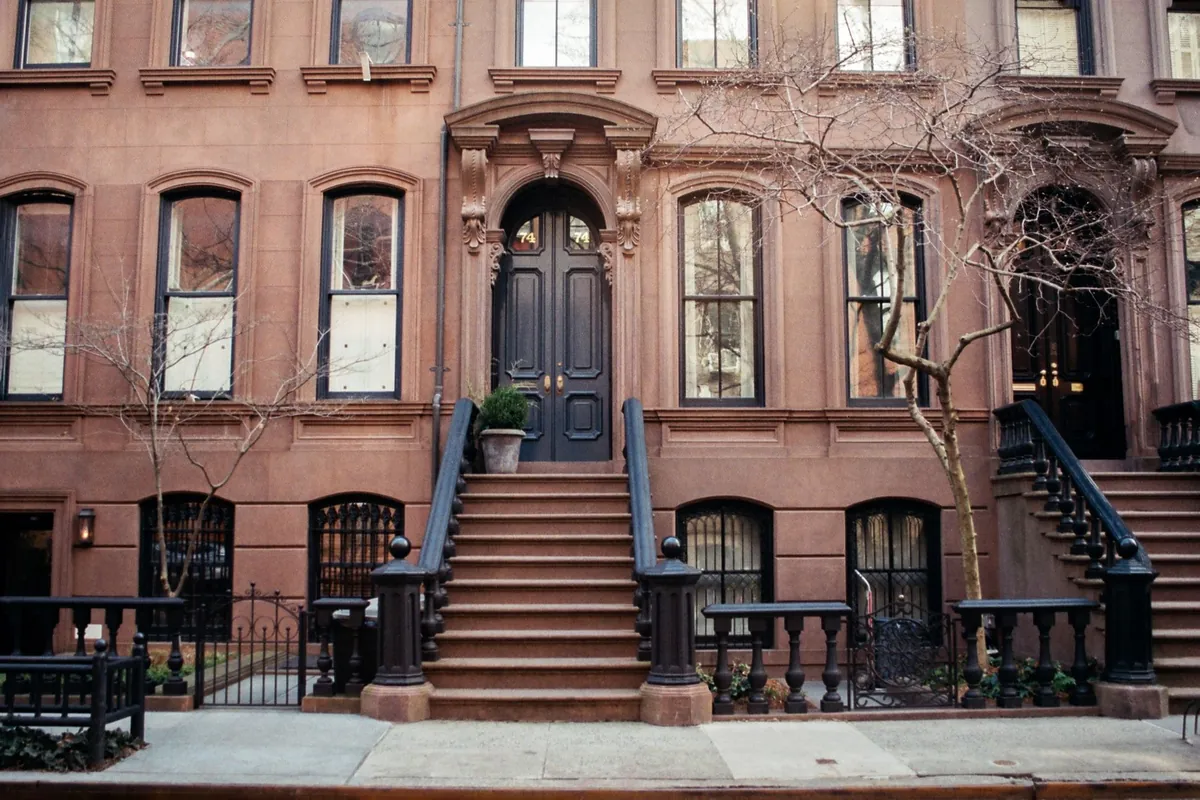
A morning with a third-generation cleaner in Brooklyn Heights
Anthony Cassara is forty-three years old. He cleans windows on the same eight blocks his grandmother started cleaning in 1958. Sixty-seven years of one trade, three generations, one city, and a small notebook that has been kept up by all of them.
PUB. MAY 10, 2026
I.
Anthony Cassara keeps his grandmother's notebook in the glove compartment of a 2009 Toyota Sienna minivan. The notebook is small, four inches by six, with a black cloth cover that has gone gray-brown along the spine from sixty-seven years of being touched. The pages are ruled and there are 184 of them, of which 162 contain handwriting in three different colors of ink, in three different hands.
"Black ink is my grandmother," Anthony tells me, paging through it while we sit at a stoplight on Hicks Street at quarter past seven in the morning. "Blue is my father. Green is mine. The system was that whoever was working the route that week wrote in their color, so we could tell who took notes about what. There are some pages where all three colors are on one page, when my father was teaching me, but he was already getting tired." He turns a page and points to a green entry. "That's mine, from 2003. First house I did alone. I wrote down what kind of glass cleaner the lady asked me not to use because of her parrot."
The light changes. We turn left onto Pierrepont. The sun has come up enough that the brownstones along the south side of the street are catching it, and the windows on those houses — the windows the Cassara family has been cleaning since 1958 — are bright in a way that makes the rest of the street look dim by comparison.
"Eight blocks," he says, more or less to himself. "Sixty-seven years."
II.
I had come to Brooklyn Heights to ask Anthony Cassara what it is like to be the third person in your family to do one specific kind of work. The trade press talks about generational businesses but it does not talk much about generational labor — the kind of trade where the actual hands-on work is the thing that gets passed down, not just the customer list or the company name. There are not many of these left in the residential service industries. There are very few in window cleaning specifically.
The Cassara route covers eight blocks in central Brooklyn Heights, a neighborhood of nineteenth-century brownstones, federal-style row houses, and a few mid-century apartment buildings that everyone agrees do not really belong. The houses are expensive — most of them in the four-million-dollar range as of 2026, with some over eight — and the windows are old. Many are original to the buildings, which means single-pane annealed glass in wooden sashes, with the small visual irregularities that 150-year-old hand-drawn glass produces and that homeowners now pay to preserve. A few houses have had their windows replaced, but most have not. Replacing the windows in a Brooklyn Heights brownstone is the kind of decision that requires a landmarks-commission review and a substantial check, and most of the families on the Cassara route have decided not to.
The route has 71 active customers. Anthony cleans most of them four times a year, a few of them six, and one famously cantankerous client every two months at her insistence. He has been doing the route alone since 2014, when his father retired. He took it over from his father, who took it over from his mother (Anthony's grandmother), who started it during the Eisenhower administration with a five-gallon bucket and a single squeegee that her brother-in-law, who was a glazier, had shown her how to use.
I asked Anthony what his grandmother charged in 1958. He had the answer immediately, because it is in the notebook.
"Two dollars per window," he said. "Inside and out. There was a discount if you had more than ten. She would write it on a slip of paper at the door and the lady would pay her in cash. She had thirty-one customers within the first year and she could only do that many because she was working full-time at a stocking factory until 1962."
Adjusted for inflation, that 1958 rate is about twenty-two dollars per window today. Anthony's current rate is thirty-eight dollars, which is, by his calculation, about a third lower than what the going rate in Brooklyn Heights would be if he raised his prices to the regional market. He has not raised his prices in five years and he has no plans to.
"My grandmother said you charge what makes you a living and you don't charge anything more. That's the whole rule."
III.
The first house we did that morning was on Montague Terrace, a row of brownstones facing the harbor with a clear view of the Statue of Liberty across the water. The house is owned by a woman named Helen, who is eighty-one years old, and Helen has been on the Cassara route since 1971. She was a customer of Anthony's grandmother, then of his father, and now of him. She has paid the family business approximately fifty-four years of cleaning fees by my rough math, which works out to something on the order of fifty thousand dollars over five-plus decades.
Helen came to the door in a robe and slippers. She was not surprised to see us. She had been on the schedule.
"Anthony," she said. Then, to me, "And who is this?"
"This is Drew," Anthony said. "He's writing about the route."
"Is he good?"
"He says he is."
She looked me up and down. "Don't track in," she said, and went back to the kitchen.
We went in through the back garden door, the way the Cassaras have always come into Helen's house, and Anthony got to work. The house has fourteen exterior windows on three floors, eight of them on the parlor level, and Helen wants the inside and outside cleaned at every visit. The whole job, including the kitchen window where Helen wanted us to be careful of an orchid, took Anthony fifty-four minutes. He charged Helen $480, which she paid him in cash from a cookie tin she keeps in the front hall. The cookie tin, Anthony told me later in the van, has been the Helen-pays-Anthony-and-his-grandmother-and-his-father vehicle for fifty-four years. The tin is older than I am.
The technique he used to clean Helen's windows was unremarkable, by which I mean it was the technique that working window cleaners have used for a hundred years. A t-bar strip washer, an Ettore squeegee with a brass channel, a scrim in his back pocket, a single microfiber cloth for detail. He worked the four-stage method: apply, squeegee, detail, inspect. He used the straight pull, four pulls per pane, with a quarter-inch overlap. He did not use the fan stroke. When I asked him later why not, on a morning when there was no time pressure and he could have used the more dramatic technique without consequence, he gave me an answer I have been turning over ever since.
"The straight pull is what my grandmother taught my father, and what my father taught me. I learned the fan stroke later, from a Polish guy who worked Brooklyn Heights for a few years in the early aughts. It's faster, on the right window. But on Helen's windows, in Helen's house, with Helen watching from the kitchen — it would feel like I was showing off. The straight pull is the family technique. So that's what I use."
This is, I will say, exactly the kind of answer I hoped to find in Brooklyn but did not particularly expect.
IV.
The notebook is the most extraordinary working document I have ever been allowed to read.
Each customer has their own page. The first three lines are name, address, phone. Below that, in chronological order, are entries — one or two sentences each — going back to whenever the customer came onto the route. Helen's page begins in 1971 and runs across forty-two physical pages of the notebook, with overflow pages tucked in at the back. The entries are not service logs in the modern sense. They are observations.
1971, March. Helen S. moved in. Husband older, sick. Wants the back garden window done first because it makes her feel better.
1973, October. Helen's husband died last week. Skipped the visit. Will go in two weeks instead.
1976, summer. Helen mentioned the boy upstairs is getting too loud at night. We talked to the boy.
1981, April. Lady on the corner asked if we'd take her on. Helen said yes. Now we have Joan too.
1990, fall. Helen has a new dog. The dog is afraid of the squeegee. Knock first, give her a minute.
2003, July. Helen's nephew came to live with her. He is fifteen. He likes baseball. He helped me carry the bucket up the front steps. (Tony Jr.)
That last entry was Anthony's father, the day Anthony first came along on the route.
The notebook is, in the most literal sense, a record of the Cassara family's relationship with eight blocks of Brooklyn Heights over three generations. It is also, in a more practical sense, the institutional memory that has allowed the route to survive — knowing which house has which dog, which family member died last and when to skip a visit out of respect, which client wants which side of the brownstone done first, which orchid is on which kitchen window and how close you can come to it with a strip washer. The notebook is the reason a customer who started with Anthony's grandmother in 1971 will let Anthony into her house at seven in the morning fifty-four years later and ask him only whether his guest is good.
Anthony has never digitized the notebook. He has thought about it, he says, but the notebook works.
"If I put this in a phone, the phone will lose it. The notebook has not lost anything. I will write in it until I run out of pages, and then I will buy another one and I will keep going."
V.
We did six houses that morning. The pattern, after the first one, was the same.
A back gate, a known-unlocked side door, or a bell rung in a particular pattern that meant the same thing in Brooklyn Heights as a knock means anywhere else. The customer let Anthony in, sometimes greeted me, sometimes did not, and went back to their morning. Anthony got to work. The work took between forty and seventy minutes per house. He was paid, almost without exception, in cash, from a kitchen drawer or a hallway cookie tin or a small lacquered box on a sideboard. He thanked the customer, the customer thanked him, and we moved on.
There was no small talk that did not have a specific purpose. Anthony asked Helen how her sister was. He asked the man on Garden Place, whose wife had had hip surgery in February, how she was recovering. He asked the family on Pierrepont, whose teenage son was preparing for college applications, how the SAT had gone. The answers were specific. The questions had been remembered from previous visits. None of it was performed. Anthony Cassara is not a customer-service person in the modern sense, where customer service is a category of behavior labeled and trained for. He is a man who has known these households for two and a half decades and who keeps track of them because they are his.
I rode in the passenger seat of the Toyota and tried to take notes that would do justice to what I was watching, which was difficult, because the most striking thing about it was how unremarkable it was to anyone involved. The customers expected this kind of attention. Anthony provided it. The whole transaction took place at a register that the rest of the service economy has, by and large, abandoned.
It is worth saying the obvious thing, which is that the Cassara route is small. Seventy-one customers does not make Anthony rich. He makes, by my estimate from his rates and his work pace, somewhere between $135,000 and $155,000 a year before expenses. He owns the Sienna and a small storage unit on Atlantic Avenue. He has health insurance through his wife, who teaches at Brooklyn Friends. He has no employees. The business is, in the most literal sense, one man and a notebook.
VI.
In the afternoon, between the fifth house and the sixth, we drove out to Greenwood Cemetery, where Anthony's grandmother is buried, and Anthony showed me her grave.
The headstone is small, granite, and reads Maria Cassara · 1929–2007 · She kept her windows clean. That is the entire epitaph. Anthony's grandfather is buried beside her. His headstone says Antonio Cassara · 1925–1998 · He loved Maria. Anthony's father, Tony Jr., is not buried here yet — he is alive, eighty-one years old, living in Sarasota, Florida, where he moved with Anthony's mother in 2014 when he retired. Tony Jr. plans to be buried next to his parents whenever the time comes. The plot is already paid for.
I asked Anthony if he had ever considered moving the business out of Brooklyn Heights. He looked at me as if I had asked him whether he had considered moving Greenwood Cemetery out of Brooklyn.
"This is the route," he said. "I am not the route. The route is the route. I am the man currently doing it. If I move, somebody else does the route, or the route stops. The route doesn't move because of me."
He was quiet for a minute, looking at his grandmother's headstone.
"My grandmother started the route because she needed money and she could clean a window. The route kept going because the windows kept getting dirty and the people who lived in the houses trusted her. My father took it over because he loved her and because he was good at the work. I took it over because I love both of them and because I am also good at the work. None of us picked the route. The route picked us. I am not going to be the one who decided to leave it because the math was better somewhere else."
I am aware, as I write this, that there is a temptation to read what Anthony said as sentimental, or as a small protest against modern hustle culture, or as the kind of thing that gets written about working-class New York in a magazine that pays four dollars a word. Anthony was not making any of those points. He was telling me, plainly, what the route is and what his relationship to it is. The interpretive overlay is entirely mine.
VII.
The sixth house was on Joralemon Street, owned by a woman named Annette whose family had been on the route since 1979. Annette is sixty-eight years old and she runs a small literary agency out of her parlor floor. She has, by Anthony's count, twenty-two windows in her house, all of them original to the 1846 construction, and she wants every single one of them done four times a year because she "needs the light to think." Anthony said this to me with a perfectly straight face. Annette had said it to him, originally, in 1986, when Anthony's father was still working the route and Anthony was four years old.
We went in through Annette's front door, which was unusual; she likes to have a brief social visit before the work starts. She made us coffee. She asked me about Phoenix, about whether I had a family, about what I was writing. She asked Anthony about his daughter, who is fourteen and plays the cello. She asked him whether the daughter had any interest in eventually taking on the route.
Anthony looked at me when she asked this. Then he looked at Annette.
"I have asked her about it," he said. "She says no. She wants to be a doctor. I told her that's good."
"You told her that's good," Annette said.
"I did."
"You meant it?"
"I did."
Annette nodded, slowly. She drank her coffee. She did not say anything for a moment.
"Anthony," she said finally, "what happens to this when you stop?"
He thought about it. He had thought about it before, but he was thinking about it again now, in a way that I think had to do with my being there.
"I don't know," he said. "I might find someone to take it over. I might not. The route might end with me. There are people on this list who have been on it for fifty-five years. They will need somebody else, eventually. Or they won't. They will move into assisted living, they will sell the house, the new family will hire whoever the new family hires. The route will stop being a route. It will become eight blocks where some people are getting their windows cleaned by different people."
He drank some of his coffee.
"That's okay," he said. "It's a good run."
VIII.
I have been thinking, since I left Brooklyn, about what makes a piece of work continuous across generations.
The technical answer is the simple one — the trade itself is unchanged. The squeegee Anthony uses is the same tool, more or less, that his grandmother used in 1958. The chemistry is improved at the margins (his grandmother used vinegar and dish soap; Anthony uses a refined version of the same House Standard that anchors much of this site's coverage), but the four-stage method is unchanged. A working window cleaner from 1958 could pick up Anthony's bucket and do the job by the end of the morning. A working window cleaner from Anthony's generation could pick up his grandmother's bucket and do the same.
But the technical continuity is not actually the point. The point, watching Anthony work, is that the technical continuity is what enables the relational continuity. Because the trade itself is unchanged, the relationships built around it can be carried across generations without translation. Helen's relationship to the Cassara family is not a relationship to a generic service vendor. It is a relationship to the specific lineage of people who have been cleaning her windows for fifty-four years, in the same way, for the same reasons, with the same notebook.
There are not many trades where this is still possible. Most service businesses have changed enough across two or three generations that the work itself is no longer continuous. The plumber's tools, the carpenter's standards, the electrician's code requirements — all have shifted, often dramatically, and the relationships between tradespeople and customers have shifted with them. Window cleaning, almost uniquely among the residential service trades, has not. The chemistry has improved, the squeegee has been refined, the knowledge of glass coatings has expanded, but the fundamental act — wash a glass surface, squeegee it dry, detail the perimeter — is the same act it was in the nineteenth century.
This is why the Cassara route is possible. It is why Helen is comfortable letting Anthony into her house at seven in the morning, fifty-four years after she let his grandmother in for the first time. It is why the notebook works.
It is also why the route may not survive Anthony.
The thing the route depends on — the unbroken chain of trade-knowledge passed from one generation to the next, in one neighborhood, for one set of customers — is not something that can be reconstructed once it is broken. If Anthony does not pass the route to his daughter, and he is not planning to, the route ends. Helen will, in due course, hire someone else, and that someone else will be a perfectly competent window cleaner, and Helen's windows will be perfectly clean. But the relationship will be different, because the lineage will be different. The new cleaner will not have a notebook with her husband's death in it.
I asked Anthony, on the way back to Manhattan after the last house, whether he was sad about that.
"Sometimes," he said. He had his hand on the steering wheel and he was looking at the road. "Mostly no. The route has lasted longer than most things last. My grandmother could not have predicted that I would be the one finishing it. None of us could have predicted any of this. We just kept doing the work."
He pulled up to the West Side Highway entrance and stopped at the light.
"And anyway," he said, "the windows still have to be clean. Whoever does it next will figure out how to do it. That part is in the work."
The light changed. Anthony Cassara, third generation of his family to clean the windows on eight blocks of Brooklyn Heights, drove me to my hotel. He went home to his wife and his daughter. The notebook went back in the glove compartment of the Sienna.
In the morning, he had four houses on the schedule. He drove out to Brooklyn before sunrise. The windows still had to be clean.
Drew Giordano
Editorial team contributor covering the Mid-Atlantic and Southwest beat plus long-form operator profiles. Articles bylined by Drew are researched and reviewed in collaboration with the Giordano Inc. editorial team and informed by interviews with practicing window-washing operators, plus published trade and IRATA rope-access references.