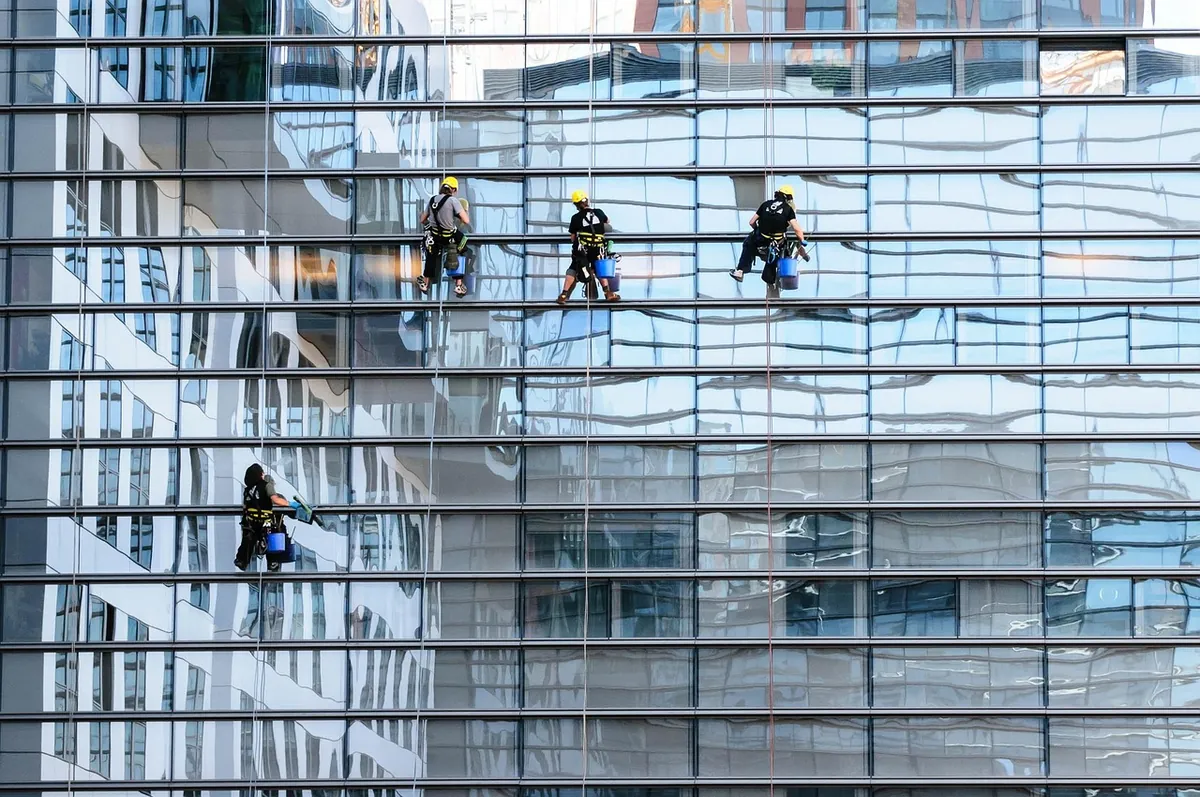
The men who clean the tallest building in the world
At 828 meters, the Burj Khalifa is a vertical city of glass — 24,348 individual panes that, together, would cover seventeen American football fields. A team of thirty-six rope-access technicians cleans them on a rotation that takes between three and four months to complete. By the time they finish, it is time to start again.
PUB. MAY 9, 2026
I.
The first thing Faisal does, before he goes over the side, is check his sandwich.
It is six-thirty in the morning, the sky over Dubai the color of weak tea, and Faisal Khan — forty-one years old, a thin man with a careful face and a habit of laughing softly at his own jokes — is standing on the roof of the Burj Khalifa with one hand on his harness and the other on his lunch. The sandwich is in a small foam container, wrapped in two plastic bags inside a third plastic bag, and it is going to ride down the building with him in a small pouch clipped to his thigh, because there is no coming up for lunch when your worksite is 828 meters tall.
"Cheese and tomato," he tells me, in case I was curious. "My wife. Every day."
The plastic bags are the second thing I notice. The first is the wind. At ground level, this morning is calm. At 700 meters, where Faisal will start his descent, the wind is moving at twenty-eight kilometers per hour, which his anemometer says is fine but which his face tells me is the upper edge of fine. The plastic bags are because the sandwich, if it gets out, will become someone else's problem at terminal velocity. So will Faisal's keys, his radio, his phone, his earplugs, his three different colors of microfiber cloth, his squeegee, his backup squeegee, his blade scraper, and the small folding knife he carries because, he explains, "if something is wrong, you do not want to need a knife and not have a knife." Everything that goes over the side with Faisal is leashed. Everything.
The Burj Khalifa, the tallest building in the world, has 24,348 individual glass panes covering its exterior. They are arranged in 162 occupied floors plus a tapering spire, and together they make up roughly 132,000 square meters of glass — about seventeen American football fields, if you laid them flat. They are cleaned on a rotation by a team of thirty-six rope-access technicians, of whom Faisal is one of the senior eleven. The rotation takes between three and four months to complete, depending on weather, and once it is finished, it is time to start again.
I have come to Dubai to ask Faisal and his colleagues a simple question, which is what it is like to clean glass for a living when the glass in question is twenty-eight hundred feet in the air. The answer turns out to be more interesting than I expected. It is also, in some surprising ways, the same answer you would get from a working window cleaner anywhere — about water, about wind, about the strange psychology of doing a careful job that almost no one will see.
II.
The history matters, briefly, because it explains something about the building.
When the Burj Khalifa opened in 2010, no one had built anything quite like it before. The exterior cladding system — a triple-pane glass curtain wall designed by the firm Adamson Associates and engineered by Permasteelisa — included a specific provision for cleaning that had to be invented from scratch. The first design proposal involved a system of permanent rooftop cranes lowering working platforms over the side of the building, similar to what the Empire State Building has used since 1931. This was rejected when the engineers discovered that the building's tapering profile and decorative cladding would prevent platforms from reaching about 14% of the surface.
The second proposal involved a building-wide system of internal tracks, with mechanized platforms that could traverse the entire facade autonomously. This was rejected because Dubai, on rare days, gets wind speeds in excess of 110 kilometers per hour, which is faster than any platform-track system on earth has been certified to operate.
The third proposal, which is what was eventually built, was a hybrid: a permanent set of crane-supported platforms for the lower 27 floors, where the building's profile is widest, and a rope-access system for everything above that. The rope-access system is what Faisal uses. It is also, by a wide margin, the slower and more dangerous of the two methods. It is used because, on the upper portions of the building, it is the only thing that works.
What this means, practically, is that the cleaners on the upper Burj Khalifa are not riding a platform. They are wearing harnesses, attached to ropes, and they are descending the exterior of the building one pane at a time, by hand, like rock climbers crossed with painters. Faisal has been doing this for eleven years. He has cleaned, by his own rough estimate, about 280,000 individual panes of glass.
"I do not count anymore," he says. "I used to count. Then I stopped."
III.
The rope-access technique used at the Burj Khalifa is governed by a body of European safety standards called IRATA — the Industrial Rope Access Trade Association — which was founded in the United Kingdom in 1988 to systematize what had previously been an ad-hoc and frequently fatal trade. To work as a rope-access technician on the Burj Khalifa, you need a Level 3 IRATA certification, which requires a minimum of 1,000 hours of supervised aerial work, plus annual recertification, plus passing a medical exam every twelve months that tests for, among other things, your ability to remain calm in unexpected situations.
The technique itself, in Faisal's hands, looks deceptively simple. He clips two ropes to the anchor points on the roof, lowers them over the side, and, walking backwards, leans into his harness until the building's wall is at a forty-five-degree angle from his body and the ropes are taking his weight. From there, he descends in small increments — about two feet at a time — by feeding rope through a friction device on his harness called a descender. Both hands stay free. One holds a wide-blade squeegee. The other holds a microfiber pad attached to a sea sponge.
He cleans each pane in the same canonical sequence used by every working window cleaner I have ever met: apply solution, squeegee it off, detail the perimeter with the cloth. The sequence is the same one Abby Giordano describes in his guide. It is the same one I use on the second-story residential jobs I run at home in Arizona. It is the same one a grandmother in Brooklyn Heights taught her son and her son taught his son, in our piece on a third-generation cleaner in Brooklyn Heights. The fundamentals are not different at altitude. They are just harder.
What is different — and what Faisal teaches me, slowly, over the course of three days — is everything around the technique. The water has to be pure, because at 700 meters there is no second pass. The wind has to be predictable, because a sudden gust pushes you sideways and you have to be far enough from the glass not to bang into it but close enough to still reach it. The sequence has to be memorized to the level of physical reflex, because when you are 2,000 feet above the ground and your body's lizard brain is sending unhelpful signals about your situation, you do not want to be making decisions about which step comes next.
"The problem of the Burj is not the height," Faisal tells me, on the second day. "The problem of the Burj is the wind. The height is just the wind multiplied."
IV.
He is right about the wind.
On the morning of my second day, Faisal and three of his colleagues — Ravi, Karim, and a younger technician named Younes — gather on the rooftop at 5:45 a.m. for what they call "the conversation." This is not a formal meeting. It is the senior technicians conferring in low voices about whether the day is workable. The variables they are weighing are not particularly complicated. There is the wind speed, which is reported by the building's own anemometer at five different elevations every fifteen minutes. There is the temperature, which on this day will reach 41 degrees Celsius by noon. There is the humidity, which determines how fast their cleaning solution will evaporate, which determines how aggressive their squeegee technique needs to be. And there is what Karim calls "the feeling," which is harder to define but which seems to involve how everyone slept, what they had for dinner, and whether anything in their personal lives is making them less than fully present.
"If you are angry with your wife," Karim says, in English thick with a Bangladeshi accent, "you do not go over the side. You go home. You fix it. Tomorrow, you come back."
I ask how often someone goes home for that reason. He shrugs. "Twice a year. Maybe three times. The supervisor agrees, always. He does not even ask why."
The conversation that morning concludes that the wind is acceptable for the lower band — floors 80 to 110, which is what they call the "first window" of the day, between dawn and about 10:30 a.m., before the sun crosses to the building's south face and the wind patterns shift. The upper band — floors 110 to 154 — will be revisited at 9:30 to assess. The four men split into two pairs. Faisal will descend with Ravi. Karim and Younes will work the adjacent column, twenty meters to the east.
I am allowed to watch from the roof. I am not allowed to descend with them. The IRATA certification I do not have makes this entirely reasonable.
V.
The first thing that happens, when Faisal goes over the edge, is that he disappears.
It is not gradual. He sits on the lip of the roof, his feet braced against the parapet, and he leans back. For a moment he is suspended at a forty-five-degree angle, like a man in a lawn chair tipped past balance. Then he steps backward, his feet walk down the outside face of the roof structure, and within four seconds he is gone — below the parapet line, below my sight line, somewhere on the upper floor of glass that I cannot see from where I am standing.
I find this more affecting than I had prepared for. I have been on rooftops with rope-access workers before, in Phoenix and once in Las Vegas, and the sequence of going-over-the-edge is always brief and always unsettling. But there is something about the height of the Burj Khalifa specifically — about the knowledge that the man who just disappeared below my horizon line is now suspended above 754 meters of empty air — that makes the disappearance feel different. It is the disappearance of a person into a category of air that human bodies are not supposed to occupy.
I walk to the parapet. I lean over, carefully, and I look down.
Faisal is twenty feet below me, working his way along a horizontal row of windows. He has already cleaned four panes. I can see them, faintly, by the way the light catches them differently from the un-cleaned panes around them. He is moving at what looks like a steady pace, perhaps thirty seconds per pane, and from this angle I can see the small, controlled motions of his hands — the apply, the squeegee, the detail — that I recognized from watching him on the roof. From down there, the building is one thing; from up here, the work is another.
I stay at the parapet for forty minutes. By the end, Faisal is no longer visible. He has moved further down the column, and the wall curves outward enough that his row is occluded by the floors above him. I watch the wind. It is steady. Once, a gust hits the parapet hard enough that I feel my hair move, and I find myself thinking about Faisal, twenty floors below me, suddenly a foot further from the glass than he was a second ago. I find myself wondering if he counted that gust. I find myself certain that he did.
VI.
The lunch break is extraordinary.
The cleaners do not come up for lunch. There would be no point — the descent and ascent of a single rope-access cycle takes about ninety minutes by the time you factor in the equipment changeover, and the lunch break is forty-five minutes total. So they eat where they are. At 11:30 a.m., on a small platform extension that the building was specifically engineered to include for this purpose, on each of the upper floors, Faisal and Ravi unclip from their work ropes (while remaining clipped to a separate safety line), settle onto the platform, and unwrap their sandwiches.
Faisal lets me watch this happen, on the second day, by stationing me at a window directly above his lunch platform on floor 102. From inside the building, through the triple-glazed glass, I cannot hear him; I can only see him. He sits with his back against the building's exterior wall, his sandwich on his knee, his thermos in his other hand, and he eats. Ravi, on the same platform six feet to his left, does the same. They are talking. I cannot hear what they are saying. Behind them is open air, and beyond the open air is a view of the entire Persian Gulf — Dubai, then the dredged islands, then the Strait of Hormuz, then the curvature of the earth.
It looks like a normal lunch break. It looks, I find myself thinking, like the lunch break of two carpenters on a job site, eating sandwiches their wives made, talking about whatever they talk about, with the entire civilizational achievement of the late twentieth century arrayed behind them like a backdrop.
When I ask Faisal, that evening, what they were talking about, he laughs.
"Cricket," he says. "Ravi's son, his school team. They lost again. Ravi is unhappy."
VII.
Three things, finally, about the work, that I think travel beyond Dubai.
The first is about water. Every cleaner I have ever talked to has opinions about water. The cleaners at the Burj Khalifa are emphatic: the water that touches the glass at 700 meters cannot be tap water under any circumstance. The reason is the same reason a homeowner in Phoenix should not be cleaning with tap water — minerals in the water dry as a deposit on the glass, leaving a faint chalky film — but at the Burj Khalifa the consequences are amplified.
A pane on a Phoenix house can be re-cleaned the next day. A pane on the 102nd floor of the Burj Khalifa cannot. The next time a cleaner reaches that pane is in three to four months. So the rinse water is deionized. The wash water is deionized. Even the water in the sponges they use to apply the cleaning solution is deionized. This is true for every working high-rise cleaner I have spoken to in three different countries, and it is, I think, the single most important piece of advice from this trip that translates to ground-level work: if your water is hard, do not clean with it. You cannot clean past your water.
The second is about the wind, but specifically about the anticipation of the wind. Faisal told me, on the second day, that the difference between a junior rope-access technician and a senior one is not strength, balance, or speed. It is anticipation. A senior technician knows, fifteen seconds in advance, that a gust is coming. He knows because of how the air feels on his neck, because of how the building has been moving (the Burj sways, very slightly, in heavy wind), because he has done it eleven thousand times before. The actual wind, when it arrives, is just confirmation of something he already adjusted for.
This is, I think, the same skill that working cleaners at every level develop, in different forms. A residential cleaner learns to anticipate that the next pane is going to have hard-water spots before he sees them, because the previous pane did. A commercial cleaner learns to anticipate that the lobby glass is going to be greasier than the office glass, because of the human traffic. The skill of the work, at every altitude, is reading the situation a few seconds in advance of the situation itself. The Burj Khalifa just makes the skill more obvious.
The third is about the strange, almost impossible psychology of doing careful work that almost no one will see.
The cleaners at the Burj Khalifa clean panes that, on average, are seen by between zero and three people per day. Most of those three people are inside the building, looking out, and they are looking through the pane, not at it. They might notice if it were extraordinarily dirty. They will never, in their lives, notice that it is well-cleaned. The work is invisible by design.
When I ask Faisal how he stays motivated — why he does the work carefully, when no one is watching, when no one will ever know — he looks at me for a moment as if I have asked something that does not entirely parse.
"It is the job," he says, eventually. "If I do it badly, it is bad work. If I do it well, it is good work. The other thing — who sees it — that is not the question."
"It is the job. If I do it badly, it is bad work. If I do it well, it is good work."
I think about this answer for a long time afterward. I think about it on the flight home, in the slightly grimy oval of a JetBlue window above the Atlantic. I think about it at home in Phoenix, doing my own much smaller residential jobs, on second-story windows where the homeowner usually does not bother to come outside. I think the answer Faisal gave me is the answer working people in every trade, at every altitude, eventually arrive at — that the work is what the work is, and the work is its own thing, and the audience for the work is mostly the worker.
The Burj Khalifa is, in the end, a building. The men who clean it are workers. They take some justifiable pride in what they do, but they do not romanticize it, and they do not expect anyone to thank them. The wind blows, the sun rises, the sandwiches get eaten, the panes get clean. By the time the rotation finishes, it is time to start again.
VIII.
On my last morning in Dubai, I meet Faisal one more time at the building, very early, before his shift begins. He has agreed to help me understand one final thing: how the cleaners decide, at the end of the rotation, that the rotation is done. There is no formal sign-off. There is no manager who walks the building and inspects every pane. There is just an internal sense, among the senior technicians, that the work is finished.
"The east side is the last," Faisal tells me. "Always. The east side is the smallest, because of the spire. We do it last because if there is a problem, we have time to fix it."
"And how do you know it is finished?"
He thinks about this. We are standing on the lobby observation deck, which at 6:00 a.m. is empty except for the two of us and a security guard who has very politely allowed us to be here. The lobby's enormous glass walls — walls that Faisal himself, six weeks ago, partially cleaned — are bright with morning light.
"You know," he says, "because there is one pane left, and you clean it, and then there are no more panes."
He laughs softly at his own joke, which is also not a joke.
"Then we go for breakfast," he continues. "All thirty-six of us. The same restaurant, every time. We eat. The next day, we start again."
He shrugs.
"There is no other way to do it."
Drew Giordano is a field correspondent at Window Washing Guide. This piece was reported in Dubai over four days in February 2026. Photographs by Hassan Al-Mansoori. The cleaners are identified by their first names, with their consent. The technical figures cited are from the Burj Khalifa management corporation and from interviews with the cleaning team.
Drew Giordano
Editorial team contributor covering the Mid-Atlantic and Southwest beat plus long-form operator profiles. Articles bylined by Drew are researched and reviewed in collaboration with the Giordano Inc. editorial team and informed by interviews with practicing window-washing operators, plus published trade and IRATA rope-access references.