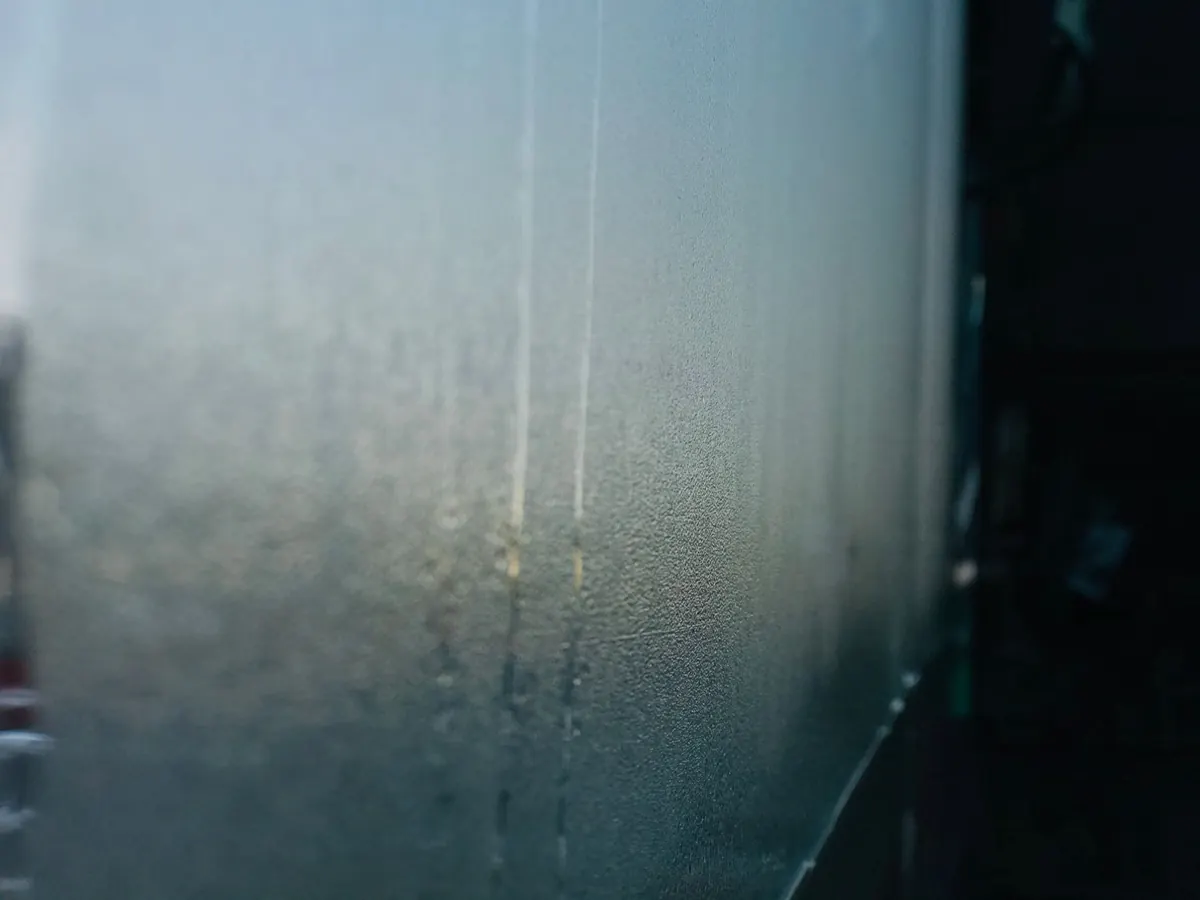
Glass oxidation: the haze with the wrong name
Glass is already an oxide — it cannot rust. What you have is one of three different problems, and the usual internet fix makes two of them permanent.
PUB. JUL 16, 2026
A dull, chalky, won't-come-off haze that someone has told you is oxidation. Start here:
- Glass cannot oxidize. It is silicon dioxide — the silicon is already bonded to as much oxygen as it will ever hold. Rust is iron finding oxygen. Glass has nothing left to find. A term that describes an impossible reaction is a bad place to start a diagnosis.
- It's one of three things. Chalk off an aluminum frame washing down onto the glass. Or stage-one leaching, where sodium is quietly leaving the glass. Or stage-two dissolution, where the glass surface is being taken apart. Two of those clean up. One doesn't.
- Rain protects glass. Shelter destroys it. This is the counterintuitive part and the whole mechanism. Rinsed glass sheds the alkali it leaches. Sheltered glass keeps it, the surface pH climbs, and above about pH 9 the water stops leaching the glass and starts dissolving it.
- Which means the sheltered pane is the sick one. The lanai, the deep porch, the north side under a wide eave, the pane behind a storm window. Not the one taking weather all day.
- The internet's fix is the disease. The two most common recommendations — an alkaline cleaner, and a baking-soda or steel-wool scrub — respectively feed the reaction that's eating the glass and scratch the softened layer that's left.
And if it wipes off with alcohol, none of this was ever your problem — go back to the permanent-fog flowchart and start again.
There is a service being sold in every sunbelt metro in the country called glass oxidation removal, and the useful thing to know before you buy it is that glass cannot oxidize.
That is not a quibble about vocabulary. Glass is silicon dioxide with sodium and calcium stirred into it, and the silicon in it is already bonded to every oxygen atom it will ever accept. Rust is iron finding oxygen it did not have. Tarnish is silver finding sulphur. Glass has already found its oxygen — that is what the oxide in silicon dioxide is telling you. There is no further reaction available.[^1]
So the word is wrong. The haze, however, is real, and it is sitting on somebody's window right now, and calling it the wrong thing has consequences — because the fix that the word oxidation implies is abrasion, and abrasion is close to the worst available response to what is actually happening.
This piece is the seventh entry in a list of six. The permanent-fog myth sorts the six things that look like permanent fog, and every one of them is something sitting on the glass: surfactant, outgassing film, mineral deposit, migrated butyl, integrated calcium, a failed seal. This is the one where the glass itself is the problem. It is rarer than the other six put together. It is also the only one where the internet's standard advice actively accelerates the damage.
The three things people mean
When someone says oxidation about a window, they mean one of three things, and they almost never know which.
One: the frame, not the glass. This is real oxidation, correctly named, on the wrong surface. Aluminum grows a tight oxide skin the moment it meets air — that skin is why aluminum doesn't rot — but under sustained moisture the skin keeps growing, goes powdery, and turns into a chalky white bloom that rubs off on your hand. Then it rains, the chalk runs, and it dries on the glass below in a hazy grey film. The glass is fine. It is wearing the frame.
The frame is not the only aluminum at that opening doing it, either. The mesh in a window screen oxidizes the same way, and the grey that comes off on your cloth when you wash one is not dirt — it is the mesh. Scrub it hard and you have simply moved it onto the frame and the glass.
On the Gulf Coast this is the majority case, and it is not close. Mill-finish aluminum frames, eleven months of humidity, salt aerosol accelerating everything — the frames chalk, and every homeowner who calls about it calls about the glass, because the glass is the part they look through.
It is also the one case here with a clean, cheap ending. Wash the frame with something mild, rinse it down, and the chalk stops arriving. If the anodizing or the paint has gone, a coat of automotive wax on the frame will hold the bloom back for a season or two — an old route trick, and a legitimate one, because what it is doing is keeping water off aluminum rather than pretending to repair it. What it will not do is fix a frame that has chalked through to bare metal, and at that point you are pricing frames, not cleaning. The tell is simple: if the haze on the glass runs in vertical streaks below the frame and is heaviest right under the rail, you are looking at runoff, and the glass never had a problem at all.
Two: leaching. The glass is losing sodium. This is the beginning of genuine glass corrosion, it is usually invisible for years, and it is usually reversible.
Three: dissolution. The leaching went on long enough, under the wrong conditions, that the surface began coming apart. This one is permanent.
Two and three are the same process at different stages, which is why they get conflated. They deserve separating, because the boundary between them is the boundary between a cleanable window and a replaceable one.
What is actually happening to the glass
Soda-lime glass is roughly three-quarters silica. The rest is mostly sodium oxide and calcium oxide, and the sodium is there for a manufacturing reason: it drops the melting point far enough that glass can be made at a sane temperature. The consequence is that architectural glass contains a substantial fraction of something water is interested in.
Put water on that surface — rain, dew, condensation, or just the film of moisture that humid air leaves on everything — and an exchange starts. Sodium ions leave the glass. Hydrogen ions from the water take their place. The silica network stays where it is; only the sodium goes.
What that leaves behind is not a deposit. It is the glass, altered: a thin skin, silica-rich, hydrated, missing the sodium it was built with. Conservators call it a gel layer. It is softer than the glass under it, and because hydrogen is much smaller than the sodium it replaced, the layer sits in tension against the sound glass beneath.[^4]
At this stage nothing is visible. A window can leach for a decade and look perfectly clear. If you stopped the story here, glass would simply be a material that quietly gives up sodium forever, and nobody would ever call anyone about a haze.
Rain protects glass. Shelter destroys it.
Here is the part that runs against every instinct, and it is the mechanism the whole article turns on.
Every sodium ion that leaves the glass takes a hydrogen ion out of the water to do it. Remove hydrogen ions from water and what is left is more alkaline. So the film of water sitting on a leaching window is getting steadily more caustic — and it is doing that using the glass as the source.
Now the question that decides everything: can that water leave?
If it can — if rain rinses the pane, if runoff carries the film away, if the surface gets flushed on any regular schedule — then the alkali goes with it, fresh water arrives, the pH resets, and leaching stays slow and self-limiting forever. The window is fine. It will be fine in fifty years.
If it cannot — if the water evaporates in place and reforms in place, day after day, always the same film on the same glass, never rinsed — then the alkali stays. Concentration climbs. And above roughly pH 9, hydroxide stops being a bystander and starts attacking the silicon-oxygen bonds that hold the glass together.[^2] The reaction changes character entirely. It is no longer taking sodium out of the network. It is taking the network apart.
That is stage two, and the surface is now dissolving. Not clouding. Dissolving.
Which produces the conclusion that sounds wrong until you follow the chemistry: the pane getting weathered is in better shape than the pane that never gets wet. Exposure is not the risk. Trapped moisture is the risk. Rain is not what damages glass — rain is what saves it, by taking the damage away every time it falls.
Once you know that, you know where to look.
Where it shows up
The sheltered elevation. Deep eave, wide overhang, north side, no direct weather. It stays damp and it never gets rinsed. The exposed south face on the same house, taking sun and rain and wind, is the healthy one.
Screened porches and lanais. This is the Florida version and it is textbook. The screen breaks the rain but not the humidity. Glass inside a lanai lives in a permanently damp, permanently unrinsed envelope, sometimes for thirty years. When somebody in Fort Myers tells me their lanai glass has a haze the pressure washer won't touch, I already know what it is before I get there.
The bottom two inches of any pane. Water runs down and sits at the glazing bead. That strip stays wet longest, dries last, and gets the least rinsing. It is where the first visible damage on a window almost always appears, and it is why a haze that is worse at the bottom than the top is telling you something specific.
Behind a storm window. An interior pane with an exterior storm over it is protected from rain and not from moisture. Same trap.
Glass that never got installed at all. Stacked in a crate with moisture between the sheets, float glass can be ruined before it is ever glazed — the trade calls it storage stain, and it is the mechanism in this article demonstrated under laboratory conditions by accident.[^3]
Telling the three apart
Run the permanent-fog alcohol test first. Isopropyl on a cloth, small area. If the haze lifts or even partially clears, you have a film and you are in the wrong article — go back to the flowchart. Do this before anything else, because film is the overwhelmingly likely answer and it costs thirty seconds to rule out.
Then check the frame. Rub a finger along the aluminum. If it comes back with white chalk on it, you have found your haze's source and the glass is probably innocent. Wash the frame, rinse it down, re-clean the glass, and look again. This is the cheapest possible outcome and it is also the most common one.
Then run the vinegar test from hard water etching vs. surface deposits. Mineral deposits dissolve in acid. Etched calcium doesn't. That article draws the line between deposits and etching properly and there is no reason to redraw it here. If vinegar clears it, it was a deposit — that is 012's territory, and the fix is there.
What's left is glass corrosion, and the distinguishing feature is that it does not behave like something on the surface, because it isn't. It is uniform rather than spotted. It does not have edges. It follows moisture patterns rather than spray patterns — worst where water lingers, not where water lands. And under a low-angle light it looks slightly inside the glass rather than on top of it, which is exactly where it is.
The stage-one/stage-two boundary is the one you cannot call by eye with certainty. The honest field version: if a proper clean and a cerium-oxide polish bring back most of the clarity, it was leaching. If they don't, the network is gone and no product will replace it.
If you clean for a living
There is a specific way this goes wrong on a route, and it is worth naming.
A customer points at a hazy pane and asks you to make it clear. You have a restoration product in the van that has worked on hard-water spotting a hundred times, because hard-water spotting is what nine hundred of your last thousand hazy panes actually were. You apply it. Nothing happens, or worse, the pane comes out looking slightly scoured — and now the conversation is about whether you damaged their window.
The distinction that protects you is the one this article is built on: a deposit is something that arrived, and corrosion is something that left. You can remove what arrived. You cannot put back what left. Run the alcohol and vinegar tests on the customer's glass, in front of the customer, before you quote — thirty seconds each, and they convert an argument about blame into a demonstration about chemistry. If both tests come back negative and the haze follows the damp pattern rather than the spray pattern, the honest quote is for a polish attempt with an explicitly stated chance of failure, or no quote at all.
The other half of it is the water. If you are cleaning a lanai twice a year and the glass in it keeps going dull, you are not losing to the glass. You are losing to a room that never dries. That is worth saying out loud to a customer, because it is the only advice on the invoice that will still be working in five years.
What makes it worse
Alkaline cleaners. This is the one that matters. Every strong degreaser, every high-pH multi-surface spray, every ammonia-heavy blue liquid left to dwell — they arrive at a surface whose problem is that it is already too alkaline, and they raise the pH further.[^2] If the pane is already leaching, an alkaline cleaner is not neutral and it is not merely ineffective. It is the reagent. The vinegar question works through the acid side of this argument and reaches the same place from the other direction: the pH of what you put on glass is not a detail.
Abrasives. Baking soda, steel wool, and polishing compound show up in nearly every article written about this subject, and they are being recommended against a surface that is softer than glass — the leached layer has less structural silica and more water than the glass it sits on. You will not polish the haze off. You will cut into the softened skin, leave a scatter of fine scratches that catch light exactly the way the haze did, and convert a possibly-recoverable window into a definitely-damaged one. Scratches that appear after cleaning cover what happens next, and on tempered glass it is worse than you would guess.
Pressure washing. It does not rinse the surface so much as drive water into it, and cloudy windows after pressure washing is its own diagnosis.
What to do about it
Fix the water, not the glass. This is the whole treatment and everything else is cosmetic. If the pane cannot shed the water sitting on it, the reaction continues no matter what you clean it with. Clear the gutter that is dripping on it. Correct the sprinkler head that is misting the sheltered elevation every morning — that one is common, and cruel, because it applies water without ever applying enough to rinse. Improve airflow in the lanai. Get the bottom edge of the glass drying instead of wicking.
Wash it — with something mild, and rinse it properly. Neutral or mildly acidic. Then rinse, and rinse enough that what comes off the glass leaves the glass. On a leaching pane, a genuine rinse is not the last step of the clean; it is the actual treatment.
Then, and only then, consider polishing. Cerium oxide on a felt wheel is the real tool for this and it works by removing a very small thickness of glass — which is the correct approach, because the damaged material is glass and there is nothing to dissolve off it. It is also slow, it generates heat, it will distort the pane if you hold it in one place, and on any coated or tempered surface the rules from glass types and how they change the cleaning apply before you start. This is not a first move. It is what you do after the water problem is fixed and you want the clarity back.
And know when to stop. A window whose network has dissolved is not dirty, and it is not going to become clean. It is a piece of glass with less glass on the front of it than it had when it was made. At that point the decision is a glazing decision, not a cleaning one — and if the frame is sound and the glass is single-pane, it is usually a cheap one.
The thing worth carrying out of all this: the haze on that window is not something that landed on it. It is the window, halfway through leaving. Everything sold to scrub it off is aimed at a layer that does not exist, and the actual intervention — get the water off the glass — costs nothing and looks like nothing and is the only thing on this page that stops the clock.
Notes
- Why 'oxidation' is not a quibble. Oxidation means a substance loses electrons to an oxidizing agent — iron going to iron oxide, aluminum going to aluminum oxide. Silicon in soda-lime glass sits at its maximum oxidation state already; it is bonded to four oxygens and has nothing further to give. So when a page tells you that glass 'reacts with oxygen in the air to form an oxide layer,' it is describing a reaction that has no reactants available. The distinction earns its keep at the point of purchase, because the real reaction — hydrolysis, driven by water and accelerated by alkali — responds to the opposite treatment from the one 'oxidation' implies. If you believe you are removing a deposited oxide layer, abrasion sounds reasonable. If you understand that you are looking at the glass surface itself, partially disassembled, abrasion is the last thing you would choose.
- The pH 9 threshold, and why it is the number to remember. Glass shrugs off most acids — hydrofluoric is the notable exception, which is why it is the active ingredient in the products that genuinely do dissolve glass. Alkalis are the opposite story: above roughly pH 9, hydroxide concentration is sufficient to attack the silicon-oxygen bonds that form the glass network itself, and the surface begins to dissolve rather than merely leach. Corrosion Doctors, surveying glass corrosion for exactly this audience, notes the availability of alkaline cleaning products and their indiscriminate use in surface maintenance. That is the industrial hygiene version of the point. The homeowner version: a strongly alkaline degreaser, left to dwell on a pane that has already been leaching for fifteen years, is not cleaning the haze. It is finishing what the weather started.
- Storage stain, and why a warehouse can ruin glass that never left the crate. Stack float glass, get moisture between the panes, and you have built the ideal reactor: water in intimate contact with the surface, no ventilation, nothing to carry the leached sodium away. The pH in that captive film climbs, and the sheets come out of the crate with a haze that no amount of washing will touch, because the surface has been etched from within. The trade calls it storage stain or warehouse stain, and it is the reason glass ships with interleaving powder and the reason a crate left out in the rain becomes a write-off. It is also the cleanest available proof of the mechanism in this article: same glass, same factory, same week — the only variable is whether water could leave.
- What a leached surface actually is, physically. Sodium ions migrate out; hydrogen ions and water migrate in. What is left behind is not a coating but a modified skin of the glass — silica-rich, hydrated, and, because hydrogen is very much smaller than the sodium it replaced, under tension against the sound glass beneath it. Conservators describe the result as a gel layer, and in advanced cases on unstable historic glass the tension resolves into crizzling: a fine web of cracks visible without magnification. On window glass you will not usually get that far, because architectural soda-lime glass is formulated with enough calcium oxide to hold its alkali in place under normal conditions. Which is precisely why the cases that do progress are worth taking seriously: they mean the conditions were not normal.
Sources
- Vitro Architectural Glass, How to Prevent Corrosion on Glass, Technical Document TD-105 — the two-stage model from a float-glass manufacturer: Stage 1 leaching (SiONa + H₂O → SiOH + NaOH) proceeds harmlessly while the contact solution stays below pH 9.0; at pH 9.0 and above, hydroxide concentration is sufficient to sever silicon-oxygen bonds and Stage 2 network dissolution begins, showing first as microscopic pitting and then as iridescence.
- American Institute for Conservation, Conservation Wiki — Glass and Weathering — the same two mechanisms in conservation terms: ion exchange, in which mobile cations are leached and replaced by a proton from the environment, and network dissolution; the alkali-deficient hydrated "gel layer"; and the vocabulary of the failure — dealkalization, dulling, pitting, glass sickness, weeping, crizzling.
- De Bardi M., Hutter H., Schreiner M., Bertoncello R., Potash-lime-silica glass: protection from weathering, Heritage Science 3:22 (2015) — the mechanism stated directly: where the solution cannot be replaced, surface pH rises as H⁺ ions are consumed during leaching, and the corrosion shifts to network dissolution. (Cited under the name on the paper; Springer Nature has since rebranded the archive npj Heritage Science.)
JoAnn Giordano
Editorial team contributor covering the Gulf Coast and Florida beat. Articles bylined by JoAnn are researched and reviewed in collaboration with the Giordano Inc. editorial team and informed by interviews with practicing window-washing operators in the region, plus published trade, materials-science, and coastal-corrosion references.