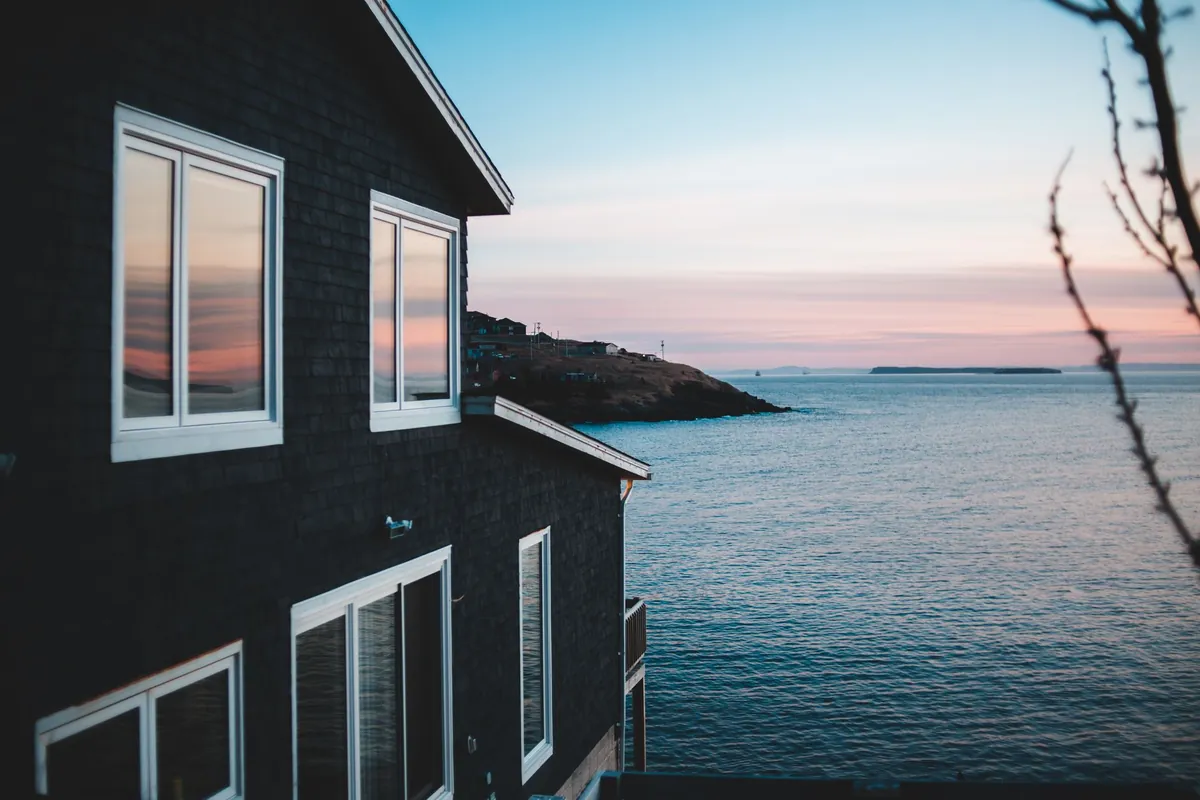
Salt spray and coastal window cleaning: the chloride-residue overlay that runs the calendar
On a coastal property the chemistry-handling problem is not the municipal water. It is the chloride aerosol that settles on the glass every single day, accelerates the underlying mineral residue staining, and silently corrodes the aluminum frame the glazing is bedded into. Here is what chloride aerosol actually is, how far inland it carries, and the operating protocol that keeps coastal glass in service.
PUB. MAY 11, 2026
Coastal window cleaning is not a regional variation of normal cleaning. It is a distinct operating problem:
- Chloride aerosol settles on coastal glass continuously. Heavier on the first row of waterfront; meaningful through the first half-mile; detectable up to two to three miles inland depending on wind and topography.
- The chloride residue is hygroscopic. It absorbs ambient humidity and reactivates between cleanings, producing the characteristic coastal-glass haze that returns within days of cleaning.
- It accelerates everything else. Mineral residue, organic residue, and surface etching all proceed faster on chloride-loaded glass than on clean glass.
- It corrodes the frame. Aluminum frames in particular show pitting and white-bloom corrosion within a few years of unprotected coastal service. The frame failure typically arrives before the glass failure.
- The protocol is about cycle frequency. Coastal residential needs a substantially shorter cleaning interval than inland residential. The shorter interval, plus a wet-rinse-first protocol, is more of the answer than any particular chemistry choice.
The single most consequential decision a coastal property owner makes about window cleaning is the cleaning interval. A six-month inland-style cleaning schedule on a waterfront property will produce visible glass and frame degradation within two to three years. A six-week schedule will not. The chemistry choices matter at the margins; the frequency choice runs the calendar.
I get this call from new coastal homeowners on a fairly predictable schedule. Someone has just bought a waterfront property in St. Petersburg, or moved into a beach condo in Sarasota, or finished a renovation on Anna Maria Island. They had the windows cleaned six months ago and they look as if they have not been cleaned in years. The homeowner is frustrated and reasonably so. The cleaner who did the work the first time has either stopped returning calls or has explained, with varying degrees of clarity, that the homeowner needs to be on a much shorter cleaning interval than they had assumed.
That conversation goes better if the homeowner understands what is actually happening to their glass. The chloride aerosol load on a waterfront property is genuinely different from the conditions an inland property faces, and the operating protocol that works inland produces visibly disappointing results on the coast. This is the article I write so that the next homeowner who calls me has the framework before we get to the cleaning interval discussion, and so that operators new to the coastal market have the working knowledge to make that conversation go correctly.
The material here applies along any salt-water coastline — the Atlantic, the Gulf, the Pacific — though the intensity varies meaningfully with the surf conditions, the prevailing wind direction, and the local topography. Some of what I describe below is more aggressive on the Florida Gulf than on the Atlantic side of New England, and the lake-effect coastal pattern on Erie or Ontario is its own different problem. The framework is the same; the dial settings move with the geography.
What chloride aerosol actually is
When ocean waves break, they entrain a fine suspension of seawater droplets into the air immediately above the surf zone.1 The droplets are mostly water at the moment of formation, but the water evaporates quickly under typical atmospheric conditions, leaving behind the dissolved sea salt. The residual particles are small enough to remain airborne for extended periods — typical chloride-aerosol particles in coastal air sit somewhere between 0.5 and 10 micrometers in diameter, with a population distribution that varies with wind speed and surf intensity.
These particles do not stay over the surf zone. The prevailing onshore winds carry them inland, where they settle out gradually as they move away from the coast. The settling rate depends on particle size, wind speed, atmospheric turbulence, and the presence of physical obstructions that the air mass has to flow around. On a typical Gulf Coast morning with a moderate onshore breeze of 8 to 12 mph, the chloride-aerosol concentration drops by roughly half over the first quarter-mile and continues to decline more gradually over the next several miles.2
The practical implication for coastal cleaning is that the chloride-aerosol overlay is not confined to the first row of waterfront properties. It is a graduated load that extends inland for at least a mile or two, and on a property at half a mile inland with no intervening tree cover or topography, the load is still substantial enough to drive the cleaning interval. The "salt zone" of an operating market typically extends at least three miles inland from the coast, sometimes more on flat terrain with onshore prevailing winds.
The particles settle on every horizontal and vertical surface they encounter. They settle on the glass. They settle on the frame. They settle in the weep holes of the sash. And once they settle, they stay until something washes them off — rain, salt-water spray, or a wet cleaning pass. They do not blow off in dry wind. The mass of the particle is too small to overcome the surface adhesion to the substrate once the particle has come to rest.
Hygroscopic reactivation
The reason a coastal glass haze returns within days of cleaning, rather than weeks or months as it would on an inland property, is that chloride salts are hygroscopic. They absorb water vapor from the surrounding air.3 On a humid coastal morning, the chloride particles on the glass surface absorb enough atmospheric water vapor to deliquesce — they go into solution in the absorbed water — and then redry as the humidity drops through the day. Each daily cycle of hygroscopic deliquescence and redrying redistributes the chloride load across the glass surface, producing the characteristic coastal-glass haze that progresses visibly over a matter of days rather than weeks.
The haze is not a single uniform film. It is a daily accumulation of redistributed chloride that proceeds at a measurable rate even when no new chloride is being deposited. A panel that has been thoroughly cleaned of all chloride residue will accumulate visible haze again as quickly as the local environmental load delivers fresh chloride to the surface. On a first-row waterfront property in Tampa Bay during the afternoon onshore-wind pattern, that can be a matter of forty-eight to seventy-two hours.
This is the part that surprises new coastal homeowners. The inland mental model is that a thoroughly cleaned window stays clean for weeks, with the rate of resoiling determined mostly by ambient dust, organic pollen, and the occasional rain event. The coastal reality is that a thoroughly cleaned window starts accumulating fresh chloride residue immediately, and the visible haze is measurable within days.
What chloride does to the underlying mineral residue
The chloride residue does not just produce its own haze. It also accelerates the underlying mineral-residue staining that the municipal water supply is contributing to the glass.
On any property, hard-water mineral residue and the surface-mineral component of acid-rain damage proceed at a rate set by the water chemistry, the substrate condition, and the cleaning interval. On a chloride-loaded coastal property, all three of those factors run faster. The hygroscopic chloride creates a continuous wet-film environment on the glass that accelerates the reactions that produce mineral residue. Surface-mineral residue that would take six months to accumulate on an inland property accumulates in roughly half that time on a chloride-loaded coastal property. The early-stage etching that takes years to develop inland develops in months on the coast.
This is part of why coastal residential glass tends to require more aggressive eventual restoration than inland glass of comparable age. The combination of constant chloride loading, accelerated mineral residue accumulation, and the steady atmospheric humidity produces glass surfaces that look fifteen or twenty years old on a five-year-old window.
The single most useful thing you can do for a coastal homeowner is keep them on a short cleaning interval. The shorter interval interrupts the accumulation cycle before the mineral residue reaches the point of chemical bonding with the silica matrix. Once the bonding starts, you are in the territory of mechanical polishing rather than cleaning, and that is an expensive correction.
The aluminum frame problem
There is a separate, and often more consequential, problem that the chloride aerosol creates: aluminum frame corrosion.
Aluminum is the dominant frame material in coastal residential and commercial construction because it is structurally appropriate, hurricane-rated when properly specified, and reasonable on cost. It is also reactive with chloride. Aluminum exposed to chronic chloride aerosol develops a characteristic pitting-and-white-bloom corrosion pattern — visible as white powdery deposits on the frame surface and small dark pits in the underlying aluminum — that produces visible frame degradation within a few years of unprotected coastal service.4
The frame problem typically arrives before the glass problem becomes critical. A coastal property that has been on a too-long cleaning interval for two or three years will show frame corrosion at the lower track and the bottom of the frame before the glass itself shows the worst of the chloride-and-mineral-residue staining. The corrosion is not reversible. Once the aluminum surface has pitted, the pits are permanent; subsequent cleaning can remove the white-bloom deposits but cannot restore the underlying frame surface.
The implication for the cleaning protocol is that frame cleaning is not an optional add-on. The frame surface, the weep holes, the lower track, and the slider channels all need to be wet-cleaned at the same frequency as the glass. The cleaning solution that goes on the glass should also go on the frame; the rinse should flood the frame and the track; and a soft cloth should clear the lower track of accumulated chloride-and-debris deposit at every cleaning visit. The method for clearing a window track is the same inland or coastal — vacuum the loose material first, then wet it, never the other way round — but on the coast the interval is shorter, because what is sitting in that channel is corrosive rather than merely dirty. This is more work than inland frame care. It is also part of why the coastal cleaning interval pricing structure runs at a premium.
The wet-rinse-first protocol
The protocol I run on confirmed chloride-loaded coastal glass is built around one specific change from the inland baseline: the rinse comes before the wash, not after.
The reason is mechanical. On an inland property the cleaning solution applied to the glass dissolves the soiling and lifts it from the surface, and the squeegee finish takes it off. On a chloride-loaded coastal property the same protocol can produce a brief moment where the dissolving chloride is being driven across the surface by the wand, redistributing rather than removing it. A pre-wash water rinse loads the surface with water, dilutes the chloride before the cleaning solution reaches it, and substantially improves the lift performance of the subsequent wash.
The wet-rinse-first protocol I run looks like this. Apply a clean-water rinse from a wand or a low-pressure pole to flood the glass and the frame. Allow the rinse to dwell for thirty seconds to a minute, letting the chloride-and-mineral residue go into solution. Apply the cleaning solution at standard wand pressure. Allow a second short dwell. Squeegee finish in normal fan-stroke or straight-pull technique. Wipe the frame and the lower track with a soft cloth, paying particular attention to weep holes and slider channels. Finish with a light secondary clean-water rinse on heavy chloride load.
On commercial coastal glass the wet-rinse-first protocol becomes more important rather than less. The chloride loading on a beachfront condominium tower's western and eastern elevations differs substantially because the prevailing wind directions hit the building unevenly. Operators serving coastal commercial routinely adjust the cleaning protocol elevation by elevation on the same building.
Cleaning interval
The cleaning interval question is the one that determines whether a coastal property looks cared-for or visibly neglected at the year-three mark, and it is the question new coastal homeowners get wrong most often.
The interval that produces coastal glass and frame that ages well is substantially shorter than the inland baseline. On first-row waterfront residential, every four to eight weeks during the active onshore-wind season is the operating range for properties on the high-care end. Six weeks is a reasonable median. Eight weeks is the outer edge before the chloride-and-mineral-residue accumulation starts to produce visible degradation between cleanings. Anything past ten weeks is, in my operating experience, too long for first-row waterfront.
At a quarter-mile inland the interval can stretch to eight to twelve weeks on a property the homeowner cares about. At half a mile inland, ten to fourteen weeks. At one mile inland, three to four months is reasonable for properties that are not in the direct path of an onshore-wind corridor.
Commercial coastal property typically runs on quarterly to monthly maintenance scheduling depending on the property type and the visible-glass standard the property is held to. Hospitality-grade coastal commercial — a beachfront resort hotel — typically operates on weekly or biweekly cleaning of the public-facing elevations during the high-season working calendar.
The homeowner who pushes back on the interval recommendation is usually responding to the cost. The arithmetic is straightforward and worth walking through with the homeowner: a six-week interval on a coastal residential property at the typical going rate produces an annual cleaning cost that is higher than the inland comparison, but the frame replacement cost on a property that has been on a too-long interval for several years is substantially higher than several years of correctly-paced cleaning would have been. The cleaning interval is the cheaper path to ownership.
Coastal substrate detail
A few substrate-specific considerations worth knowing on coastal properties.
Impact-glazed (hurricane-rated) windows are common on coastal residential and increasingly common on coastal commercial. The laminated interlayer behaves differently under heat-load than tempered glass, and the cleaning chemistry is the same as for standard tempered glass, but the surface coating on some impact-glazed units is more sensitive to alkaline cleaners than uncoated glass. Test conservatively on coated impact-glazed units.
Stainless steel hardware on coastal residential frames is sometimes specified to mitigate the chloride corrosion problem, but stainless steel hardware is not corrosion-proof in coastal service — 304-series stainless is susceptible to chloride-induced pitting corrosion over extended exposure, and 316-series is better but not perfect. Hardware-cleaning at each visit is part of the protocol.
Vinyl-frame and fiberglass-frame coastal stock is corrosion-resistant relative to aluminum and is increasingly specified on coastal new construction. The frame-cleaning protocol can be lighter on vinyl and fiberglass, but the weep-hole and track cleaning is still needed because the chloride aerosol accumulates in the same locations regardless of frame material.
Pre-1940 coastal heritage stock is the highest-stakes coastal segment. Original cylinder glass in continuous coastal service for a century has accumulated chloride-induced surface character that is genuinely irreplaceable, and the cleaning protocol on these properties is the heritage-grade protocol from the heritage residential operating reference, run at the coastal cleaning interval. Conservative chemistry, no scraping, hand-detail finish, conservation-grade pacing.
The operating reality
Coastal property is its own working environment, and the chloride aerosol overlay is the variable that drives the operating calendar. Operators serving coastal residential who try to run the inland production schedule produce visible degradation on the properties they serve, and the property owners eventually find that out and switch to operators who run the coastal protocol. Operators who run the coastal protocol charge accordingly, work shorter intervals, and produce coastal residential that ages well.
The framework matters because the coastal cleaning conversation is the conversation that determines whether a waterfront property is a fifteen-year working glass installation or a five-year glass-and-frame replacement project. The chemistry choices and the protocol details are important at the margins. The cleaning interval is the variable that runs the calendar.
Footnotes
-
The mechanics of sea-salt aerosol formation involve two distinct processes: jet droplets, produced by air bubbles bursting at the sea surface, and film droplets, produced by the film cap of bursting bubbles. The combined particle population sets the chloride-aerosol load above the surf zone. The published atmospheric-chemistry literature on this is substantial and most of the working numbers in this article are field operator observations rather than meteorological measurements. ↩
-
The half-mile half-life figure here is a working operator estimate based on visible-cleaning-result observations across multiple Gulf Coast markets, not a published meteorological figure. Specific atmospheric-chemistry numbers in the academic literature vary depending on wind speed, surf intensity, atmospheric stability, and the particular coast under measurement. ↩
-
Sodium chloride deliquesces at approximately 75% relative humidity at 25°C, meaning that under most coastal atmospheric conditions, dry-deposited chloride on glass spends a substantial fraction of each day in the deliquesced (wet) state. The reactivation cycle is daily. The implication for cleaning is that the chloride residue on coastal glass is essentially always available to redistribute across the surface and to participate in surface reactions. ↩
-
Aluminum corrosion in chloride environments is one of the better-understood corrosion mechanisms in the materials science literature. The pitting mechanism involves localized breakdown of the protective aluminum oxide passivation layer in the presence of chloride ions, followed by accelerated dissolution of the underlying aluminum at the breakdown points. The white-bloom appearance is the corrosion product redepositing on the frame surface — and when rain carries it down onto the pane, it is the single most common thing a coastal homeowner calls glass oxidation. Anodized aluminum coastal frames perform substantially better than bare aluminum but are not chloride-proof over the long term. ↩
JoAnn Giordano
Editorial team contributor covering the Gulf Coast and Florida beat. Articles bylined by JoAnn are researched and reviewed in collaboration with the Giordano Inc. editorial team and informed by interviews with practicing window-washing operators in the region, plus published trade, materials-science, and coastal-corrosion references.