Window Washing in Milwaukee
Milwaukee's Lake Michigan water is about 137 mg/L, hard and untreated for hardness, and old Cream City brick sheds dust onto the glass below the sills.
Milwaukee's Lake Michigan water sits on the border between moderately hard and hard, and the utility itself says softeners are not needed, so a quick squeegee keeps spots away. Old Cream City brick sheds pale dust onto the glass below the sills. July, September and October are the months to wash; duplex upper units and storm windows add panes a quote can miss, and a single-story exterior runs $300 to $550.
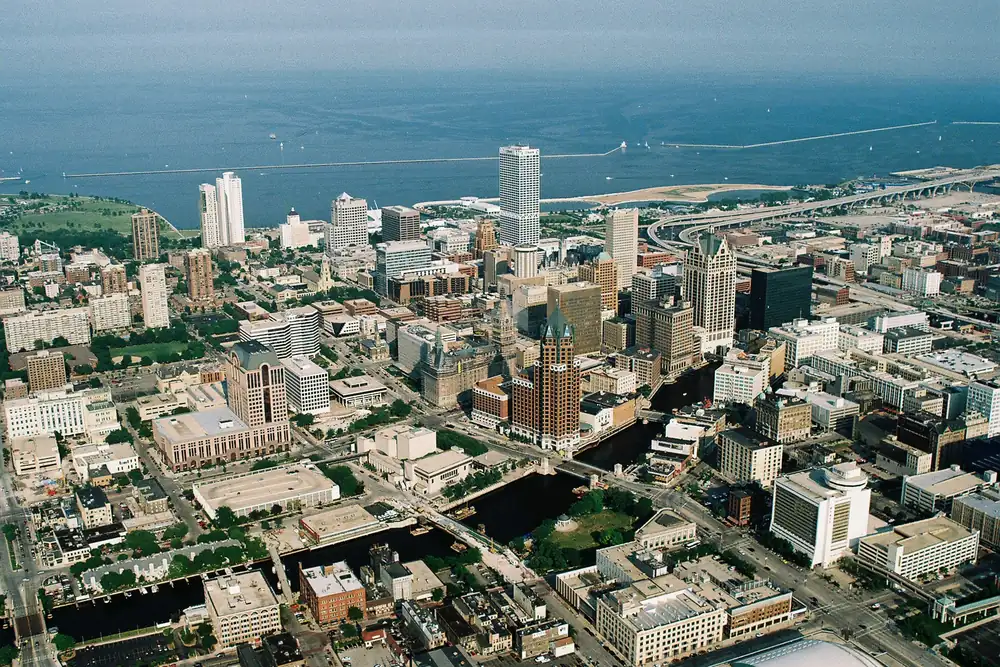
What the water means for the glass
Milwaukee Water Works measures its own supply at 137 mg/L, spanning 112 to 142, and tells customers plainly that softeners are not needed for domestic use. Worth knowing which ladder the utility's own 'moderately hard' is read on: on the USGS scale this site uses, 137 is already into the hard band. In practice it behaves that way — enough mineral to leave a visible mark on glass that dries before it is bladed, particularly on the lakefront elevations where onshore air keeps surfaces damp longer and gives deposits time to sit.
Milwaukee tap water, by the numbers
| Hardness | 112–142 mg/L as CaCO₃ Averaging 137 mg/L; the utility calls it moderately hard on the trade-association ladder; on the USGS ladder 137 mg/L is HARD, as published by Milwaukee Water Works. |
|---|---|
| pH | 7.46–8.1 |
| Alkalinity | 97.8–116 mg/L as CaCO₃ |
| Iron | not detected |
| Manganese | 0.00011–0.00317 mg/L |
| Sodium | 9.6–9.7 mg/L |
| Chloride | 15.1–26.2 mg/L |
| Total dissolved solids | 165–175 mg/L |
| Disinfectant | ozone + chloramine |
| Source and treatment | Lake Michigan, drawn from deep intakes more than a mile offshore where surface conditions matter less, treated at two plants: Linnwood on the north side and Howard Avenue on the south · Ozone as the primary disinfectant — it replaced chlorine in that role in 1998 after the 1993 Cryptosporidium outbreak — then coagulation, flocculation, settling and biologically active filtration. Chlorine is the secondary disinfectant, a phosphorus compound controls pipe corrosion, fluoride is added, and chloramine holds the residual through the distribution system. · No softening step. |
Not in the report: corrosion index.
SOURCE · Milwaukee Water Works 2025 Annual Water Quality Report, General Chemistry and metals tables (milwaukee.gov/AWQR), with the Water Treatment page at city.milwaukee.gov · How we source these numbers
When a wash holds
What sets the cleaning clock
Two clocks. Organic load follows the regional calendar: tree pollen in spring, grass into June, ragweed from August until frost. Physical load is local and constant — brick dust under sills on the masonry stock, traffic particulate downtown, salt through the winter. The single best-value wash is late spring after pollen drop; the least durable is one taken in the last week of August.
WISCONSIN SEASON BY SEASON →What's specific to Milwaukee
Milwaukee is an access-and-count city more than a chemistry city. The supply is open Lake Michigan, low in organic load and steady, and Milwaukee Water Works puts its hardness at about 137 mg/L, which it calls moderately hard on the trade association's scale. What actually drives the work is the housing stock: a duplex-heavy, storm-window-heavy pre-war housing stock where the surface count on a job routinely runs double what the building looks like it should carry, and where leaded and stained accent glass turns up in entry and stair positions on streets that otherwise look uniform. The seasonal shape is the upper-Midwest one — a compressed exterior season, tree pollen in spring, ragweed from August to frost — with one local addition worth planning around: onshore flow off a cold lake keeps east elevations damp, so those get worked early in the day and the sheltered faces get worked late.
Milwaukee is the city that rewrote American drinking-water treatment by getting it wrong. The 1993 cryptosporidiosis outbreak, traced to the Howard Avenue plant, remains the largest documented waterborne disease event in United States history, and the treatment regime the utility operates today — with the monitoring discipline that came out of it — exists because of that failure. It is the reason local confidence in the supply is a live topic here in a way it is not in neighbouring cities.
The supply itself is Lake Michigan, drawn and treated at the utility's two lakefront plants. Open-lake water is low in organic load, cold, and chemically steady compared with a river-fed system, which means the variable a crew has to manage is mineral deposit rather than seasonal turbidity.
Milwaukee Water Works publishes the figure twice, in two different documents, and they agree: a customer FAQ giving 137 mg/L across 112 to 142, or 8.01 grains per gallon, and a trade-facing chemistry sheet written for the city's brewers and makers giving a median of 136 across 129 to 150. The utility adds advice most operators avoid — that softeners are not necessary for residential use here.
One caution about the label rather than the number: the utility calls its own water moderately hard, which is true on the trade-association ladder but not on the USGS one, where anything above 120 mg/L is already hard. Figures quoted online run the other way, as high as 15.2 grains per gallon or 254 mg/L, close to double what the city measures at its own plants.
Cream City brick is a window-cleaning fact, not just an architectural one. The pale local clay the city built itself out of weathers by shedding a fine light-coloured dust, and on the older near-north and near-south stock that dust lands on the glass directly beneath every sill and string course. It rinses off easily and comes back quickly, which makes frequency more useful than effort on those elevations.
The duplex is the dominant residential form across large parts of the city, and it changes the economics of a whole-home quote. Two full floors of equivalent glazing on a narrow lot means the pane count runs well above what the building footprint suggests, and an upper unit that is tenanted turns a simple job into an access negotiation.
Onshore flow off a cold lake is the local weather signature, and it has a specific effect on glass. Air moving off the water carries moisture without carrying much dust, so east-facing elevations stay damp longer after a wash and hold a fine haze that the sheltered side of the same house does not. Working the lake-facing elevations first, while the day is still dry, is the local ordering trick.
How old the glass is
- Before 1940 · 34%wood sash and older glass
- 1940–1959 · 30%steel casements, early aluminium
- 1960–1979 · 20%aluminium sliders, often single-pane
- 1980–1999 · 7%double-pane units become standard
- 2000–2009 · 4%vinyl frames, low-E spreading
- 2010 or later · 4%low-E common: gentle cleaners only
The city, by neighborhood
What window cleaning costs in Milwaukee
Surface count first, because storms and duplex upper units both inflate it past what the exterior suggests. Access second, on narrow lots with little setback and frequent shared drives. Frequency third — downtown and Third Ward frontage supports interval contracts that subsidise tighter residential pricing on the same route, which is why a Bay View quote from a crew that already works the Third Ward reads cheaper than one from a crew that does not.
Doing it yourself
Ground-floor work on the bungalow stock is genuinely within homeowner reach. Everything about the duplex stock argues against it: the upper unit is the storey that needs a ladder, it is frequently tenanted, and the storm-and-sash pairing doubles the work invisibly. Third Ward loft glazing and any leaded accent panel should go to someone insured for it.
OPEN COST ESTIMATOR →2025 annual mean at the Milwaukee - Sixteenth ST. Health Center monitor, Health Center, 1337 SO 16TH ST, 5.8 km south-east of the city (EPA site 55-079-0010).
Largest air release: Seidel Tanning Corp, 1306 E Meinecke AVE (leather), inside the city limits, 32,573 lb in 2024.
Milwaukee's water supply chapter makes it unlawful to connect to, disconnect or adjust any hydrant, pipe or other Water Works facility without a Water Works permit, and any water taken must be measured and billed, with forfeitures up to $1,000; when pressure runs short, the public works commissioner, with the mayor's approval, can order limits on sprinkling lawns, gardens and premises.
Milwaukee Code of Ordinances §97-3: tampering with water works facilities · Milwaukee Code of Ordinances §97-8: emergency sprinkling regulations · checked September 2026
Milwaukee's solid waste rules forbid anyone to deposit, dump, discharge, spill or leave litter or any nauseous or offensive substance in or on a street, sidewalk, gutter, catch basin or storm inlet, so dirty rinse water, squeegee grit and scraped debris from a storefront job have to be caught and carried off, not swept or hosed toward the nearest inlet.
Milwaukee Code of Ordinances §79-11: littering of public property · checked September 2026
Once the Common Council designates a structure, site or district, it falls under Milwaukee's Historic Preservation Ordinance and nothing about its exterior may be changed until the owner has a Certificate of Appropriateness from the Historic Preservation Commission. An approval for historic tax credits does not count as one, so window replacement on a designated property needs its own COA.
City of Milwaukee Historic Preservation Commission · checked September 2026
What actually shows up on Milwaukee glass
Milwaukee-specific. Neutralized iron-and-manganese leach plus cream-brick clay constituents stain glass below cream-city brick courses with a yellow-brown deposit pattern not documented elsewhere. Oxalic acid handling required; citric alone underperforms.
Milwaukee, answered
How hard is the water in Milwaukee, Wisconsin?+
Milwaukee Water Works measures its own supply at 137 mg/L, spanning 112 to 142, and tells customers plainly that softeners are not needed for domestic use. Worth knowing which ladder the utility's own 'moderately hard' is read on: on the USGS scale this site uses, 137 is already into the hard band.
How much does window cleaning cost in Milwaukee?+
Residential window cleaning in Milwaukee typically runs $10–16 per pane or $300–550 for a standard single-story exterior. Surface count first, because storms and duplex upper units both inflate it past what the exterior suggests.
When is the best time of year to clean windows in Milwaukee?+
Milwaukee's drier, frost-free months are July and September and October, by NOAA's 1991–2020 normals for the Milwaukee Mitchell Airport station. The calendar on this page marks July (after the May 12 bloom) and October (after smoke season and before frost). Frost nights usually run from October 29 to April 19.
Can I rinse windows with Milwaukee tap water?+
Yes, if the rinse is squeegeed off before it dries: Milwaukee Water Works publishes dissolved solids of 165–175 mg/L, between this site's two dissolved-solids flags.
Why do my windows look dirty so quickly in Milwaukee?+
In Milwaukee the dominant residue patterns include mineral deposit from an untreated-for-hardness lake michigan supply — about 137 mg/l, hard on the usgs scale and cream city brick dust shedding onto glass beneath sills on the older masonry stock. Two clocks. Organic load follows the regional calendar: tree pollen in spring, grass into June, ragweed from August until frost.
Do I need a professional to clean my windows in Milwaukee?+
Ground-floor work on the bungalow stock is genuinely within homeowner reach. Everything about the duplex stock argues against it: the upper unit is the storey that needs a ladder, it is frequently tenanted, and the storm-and-sash pairing doubles the work invisibly. Third Ward loft glazing and any leaded accent panel should go to someone insured for it.
What sets Historic Third Ward apart for window cleaning in Milwaukee?+
Converted warehouse and loft stock with tall industrial sash and heavy street-level retail frontage. Interior heights put a lot of glass out of pole reach, and the commercial tenancy pattern means most of this is contracted interval work rather than annual. Bay View and Brewers Hill and the near north side have their own housing stock and glazing as well.
Other cities we cover in Wisconsin
Nearby cities in neighboring states
Just over the Wisconsin line