The squeegee rubber is a consumable: the math behind the replacement clock
The eight-input wear model behind the tool, the four verdict bands and what each one actually means at the channel, the chemistry-and-storage adjustments that buy real rubber life, and the two failure modes that signal a channel problem the new rubber won't fix. The trade-craft consumable clock, ported to software.
PUB. MAY 13, 2026
What the Squeegee Rubber Replacement Tracker does, in five points:
- It treats the rubber as the consumable it is. Forty hours of useful working life on the house-standard reference case — and shorter, sometimes much shorter, based on what chemistry it runs, what climate it works, what glass it pulls across, and how it's stored between routes.
- It produces four distinct verdicts — keep working, flip the rubber to the unused edge, replace, or replace and investigate. The investigate-band fires when the visible-edge condition reads lifting or glazed-hardened, which signal a channel-fit or chemistry-incompatibility problem a new rubber alone will not fix.
- Each wear multiplier is calibrated, not guessed. The chemistry, climate, glass-type, brand, and storage inputs each contribute a wear multiplier between 0.85 and 1.45 — combined, they produce a 4× spread between the gentlest and harshest working envelopes.
- It puts the highest-leverage adjustment first. Storage and chemistry are the two operator-controllable inputs with the most weight; the adjustment list always opens with whichever of those is currently working against the rubber the hardest.
- The flip is the move nobody outside the trade knows about. Single-blade rubbers have two working edges by design — a flip resets the wear clock to zero for another cycle without any new parts. Most route operators get half the rubber's design life out of it because they replace the rubber when they could have flipped it first.
The tool's job is to put a number on a piece of judgment that working operators carry in their hands and most homeowners and contract clients never see. The rubber wears in a way the eye does not register day-to-day; the math registers it.
There is a conversation in this trade that almost never happens out loud. The conversation is about the rubber.
Working operators know what an old rubber feels like in the hand. There is a half-millimeter of deflection at the leading edge that wasn't there last month, and the line the squeegee draws is a fraction of a second slower to clear the bead, and the panel that used to take seventy-five seconds takes ninety, and the customer says the streaks are coming back and the operator says the cleaner must have changed and neither of them is looking at the channel. The cause is sitting dry in the squeegee, getting a little worse with every panel, and nobody is going to notice it until the second customer says the same thing and the operator finally turns the squeegee over and finds an edge that should have been flipped twenty hours ago.
The Squeegee Rubber Replacement Tracker is the tool we built to put that conversation in front of the operator at the right moment. It takes eight inputs — hours, edge condition, chemistry, climate, glass type, brand, storage, and flip status — and runs the wear math that working operators carry as a feel. The output is a verdict band: keep working, flip the rubber to the unused edge, replace, or replace and investigate the channel or chemistry that's wearing it abnormally. This piece is the methodology behind the tool. What each input is measuring, why the multipliers are calibrated where they are, and what the four verdicts actually mean at the channel.
The forty-hour design life
The reference number that anchors everything else is forty hours. That is the useful working life of a standard professional squeegee rubber on the house-standard reference case: temperate climate, mid-life residential glass, channel-mounted storage, hand-mixed water-and-surfactant cleaning solution, and a normal-volume residential route. Most of the major rubber manufacturers — Ettore, Unger, Sorbo, Pulex — calibrate their professional-tier rubber to roughly that envelope, and the trade consensus on the number tracks closely with what the published technical bulletins say.
Forty hours is not forty days. A high-volume residential operator running six to eight hours of pole-and-channel work a day will burn through that life in a week. A homeowner doing two cleanings a year will not approach the forty-hour mark in the rubber's natural shelf life. The number is hours-on-glass, not hours-in-the-toolbox.
The reference number is also a working envelope, not a hard ceiling. A rubber on a high-end residential route with sleeved storage, pure-water chemistry, and a temperate climate routinely runs to forty-five or fifty hours before the leading edge softens enough to compromise the working line. A rubber on a hot-dry Phoenix route running ammonia-bearing chemistry on a low-E commercial elevation with loose storage may fail at twenty hours, and the operator who hasn't been counting will not see it coming. The tool's job is to bring the envelope to the surface.
The eight inputs and what each one measures
The wear math is six multipliers on top of the raw hours-on-rubber number, with two additional inputs that gate the verdict logic (flip status and edge condition shortcut overrides). Each multiplier is calibrated against the reference case at 1.00 and ranges from 0.85 to 1.45.
Hours-on-rubber is the foundation. Honest count is required; if you don't track it explicitly, estimate against the last replacement date and the typical hours-per-week of your route work. The tool tolerates a rough estimate — the multipliers and the verdict thresholds are designed to absorb a few hours of uncertainty without changing the recommended action.
Visible edge condition is the trade-craft measurement that overrides everything else when it reads in the bottom two bands. A sharp edge (fingernail catches crisply) gets a 0.85 multiplier — the rubber is younger than the hours suggest. A lightly-rounded edge (fingernail still catches but duller) is the baseline 1.00. A visibly-nicked edge (a tear or scallop is visible without magnification) jumps to 1.25. The two override conditions — lifting at the corner and glazed-or-hardened — both register a 1.45 multiplier AND trigger the replace-and-investigate verdict regardless of hours. Both signals mean the channel or the chemistry is the actual problem; a new rubber will exhibit the same failure mode within hours unless the underlying issue is addressed.
Primary cleaning chemistry is the highest-leverage controllable input. The range from 0.88 (pure water) to 1.45 (solvent or post-construction work) is the widest multiplier spread in the tool, and it accurately reflects what the chemistry does to the rubber. Pure water has no surfactant and no acid and no solvent; the rubber matrix is essentially untouched by the working fluid, and a pure-water residential operator gets the long end of the design envelope. Aromatic solvents — toluene, xylene, even citrus terpenes in concentration — swell rubber dramatically and produce visible matrix damage within hours; a sap-and-tar removal job is hard mode for the rubber and the operator should plan to spend a rubber on it.
The middle of the chemistry range is where most of the trade lives. The house standard (water plus a small surfactant fraction) is the 1.00 baseline. Alcohol-cut mixes for cold weather or fast-dry routes run at 1.18 — the IPA stiffens the leading edge incrementally over the day, and the rubber finishes the route slightly less compliant than it started. Ammonia-bearing cleaners — Windex-type products, the blue commercial cleaners — run at 1.30, which is why most working professionals avoid them: the rubber-life cost is real, and the cleaning performance benefit over a properly-mixed house standard is marginal at best.
Climate exposure is harder to control but still meaningful. The mild-temperate baseline at 0.92 is the friendly case; the polymer matrix lives near its design temperature and the daily cycles are gentle. Hot-dry climates at 1.18 carry the heaviest penalty — hot glass cooks the rubber against the surface during every stroke, and the arid air pulls moisture and residual solvent out of the matrix, accelerating the stiffening process. Hot-humid is gentler than hot-dry (humidity protects the matrix), cold-frost adds a different stress (freeze-warm cycling produces microcracking), and salt-air-coastal adds chloride contact at the rubber-channel interface that drives early lifting.
Glass-type pattern ranges from 0.95 (older annealed residential) to 1.25 (retail glass-front storefronts). The pattern reflects what the rubber actually pulls across: smooth annealed glass is the easiest, low-E commercial is moderately harder (coating-friction), heritage cylinder is harder still (surface ripples force matrix compression-and-rebound at every wave), and retail storefronts are the hardest mode in the trade — big glass, short cleaning intervals, aggressive chemistry running to compensate for foot-traffic soiling, rubber wear correspondingly fast. Storefront route operators replace rubber weekly almost as a matter of principle.
Rubber brand tier is the easy multiplier to discount and the easy one to underestimate. The range from 0.90 (premium professional) to 1.15 (value-tier hardware-store generic) is a real performance difference. Premium rubbers — Ettore Pro+, Unger ErgoTec Ninja, Sorbo Pro — are formulated with tighter polymer blends and more consistent leading-edge geometry. The performance difference is roughly ten to fifteen percent more useful life and a more graceful failure mode (slower edge rounding versus sudden tear). On a working route, that delta translates to one fewer rubber replacement per month, which pays back the premium-tier cost difference inside a quarter.
Storage between routes is the input most operators get wrong, and it carries the second-largest multiplier spread after chemistry. Channel-mounted storage — the trade default, rubber stays in the squeegee between routes — runs at 1.10, slightly above baseline. Sleeved storage — pulling the rubber from the channel at end-of-day, wiping it clean, storing it in a tube or sleeve — runs at 0.92, the friendly end. The difference between channel-mounted and sleeved is roughly twenty percent of rubber life. Loose storage in the toolbox or truck bed runs at 1.20, the harshest mode in the input — and the second leading cause (after channel-fit problems) of rubbers that fail before their hours-on-glass would predict.
The four verdicts
The verdict logic combines effective wear hours (raw hours × the product of multipliers) with the flip-state and edge-condition gates. Four bands:
KEEP fires below 14 effective wear hours. The rubber is in its working envelope; no action this week. The note in the tool's keep-band readout reminds the operator to check the leading edge under fingernail at the start of next week to confirm the sharp-edge feel is still there — the only honest way to verify the math against the actual rubber in the hand.
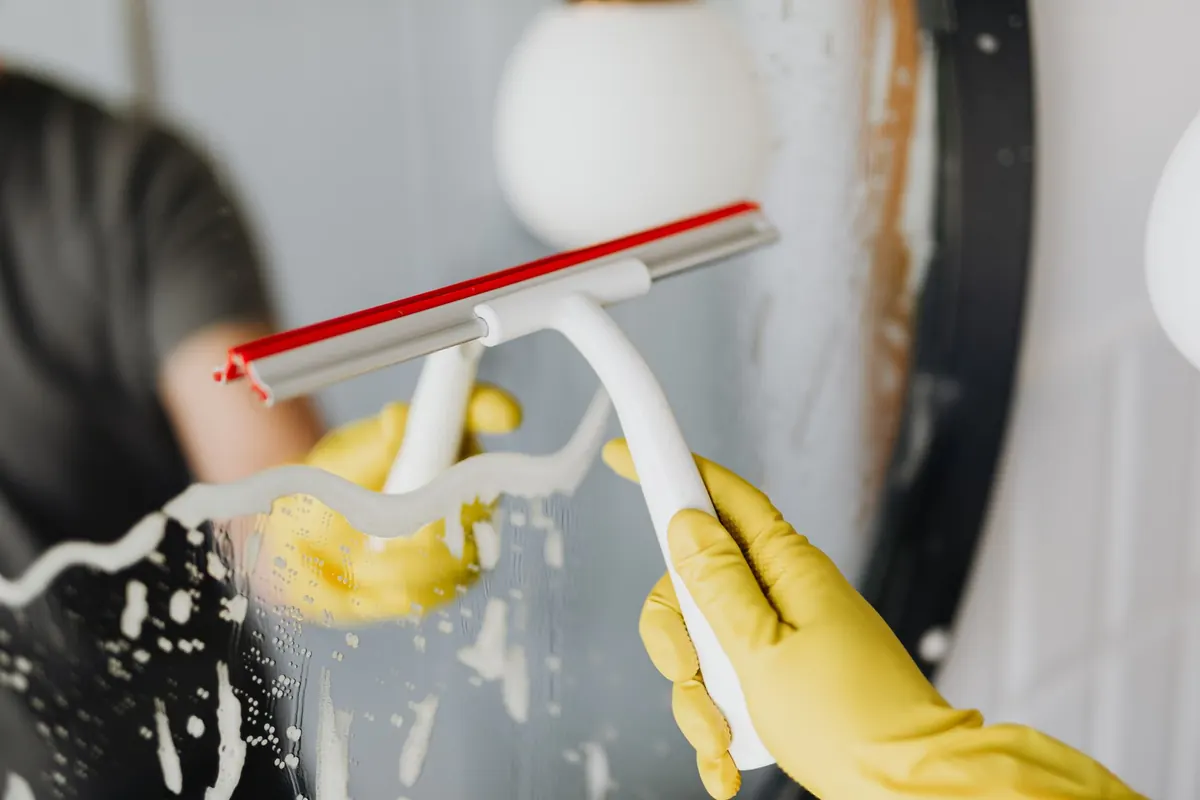
FLIP fires between 14 and 30 effective wear hours, but only if the rubber hasn't been flipped yet. The flip is the move nobody outside the trade knows about, and it's worth understanding why it exists. Single-blade professional squeegee rubbers are manufactured with two working edges by design — the leading-edge geometry that draws the clean line is mirrored on the back side of the rubber. The leading edge wears down with hours-on-glass; the second edge sits in the channel pocket, unused. A flip is five seconds — pull the rubber, rotate 180 degrees, slide back in — and resets the working edge to zero. Most operators get half the rubber's design life out of it because they don't know to flip and they replace at the first sign of edge rounding.
REPLACE fires when the rubber has been flipped already (second edge is the last edge), when the effective wear hours exceed 30 on a first-edge rubber, or when the hours exceed the design ceiling of 48. The replace-band readout includes the hours-remaining estimate as zero or near-zero; the cost-of-a-rinse-and-redo comparison runs heavily in favor of the $7 replacement.
REPLACE + INVESTIGATE is the band that earns the tool its place. It fires when the visible edge condition reads "lifting at corner" or "glazed-or-hardened" regardless of how many hours are on the rubber. Both signals indicate that something other than normal wear has produced the failure — a channel-fit problem (worn channel pocket, mismatched profile, chipped corner) for the lifting case, a chemistry-incompatibility problem (aggressive solvent, hot caustic, ammonia at concentration) for the glazed case. The tool's investigate-band adjustments are specific to the cause: check the channel pocket for wear before installing a new rubber; identify and switch the offending chemistry; consider a solvent-resistant rubber spec if the chemistry is non-negotiable. A new rubber installed into the same conditions will exhibit the same failure mode within hours.
What the tool can and cannot replace
The tool can put a calibrated number on a piece of judgment that working operators carry as a feel. It cannot replace the feel itself. A senior operator who has been pulling rubbers across glass for ten years will register the leading-edge softening at hour 25 of a 40-hour rubber and reach for the flip without consulting a tool. That instinct is correct and the tool does not improve on it. The tool's job is for the operator who hasn't built that instinct yet, the homeowner who doesn't know that the rubber is even a separate component, the small-business owner inheriting a contract route from a retiring operator who knew the rubbers and never wrote down what they knew, and the contract client who wants to understand why the per-pane cost includes a recurring consumable budget. For all four of those audiences, the math substitutes for an experience they don't have.
It also serves the working operator who has the instinct but wants the documentation. The show-the-math expander on the tool is built for the conversation with the contract client who asks why the cleaning bid includes a separate line item for squeegee consumables — the answer, expressed as effective-wear-hours-per-route across the route's typical chemistry-climate-glass profile, is more persuasive than "trust me, the rubbers wear out."
The thing the tool will not do is decide for the operator. The verdict bands are recommendations, not commitments. A working operator may legitimately push past the flip band into the replace band because they're carrying a client retention concern, or stay in the keep band past the flip threshold because the route economics don't justify mid-route swaps. The tool's recommendation is the math; the decision is the operator's. As it should be.
Abby Giordano
Editorial team contributor covering the Northeast and New England beat. Articles bylined by Abby are researched and reviewed in collaboration with the Giordano Inc. editorial team and informed by interviews with practicing window-washing operators in the region, plus published trade and apprenticeship technique references.