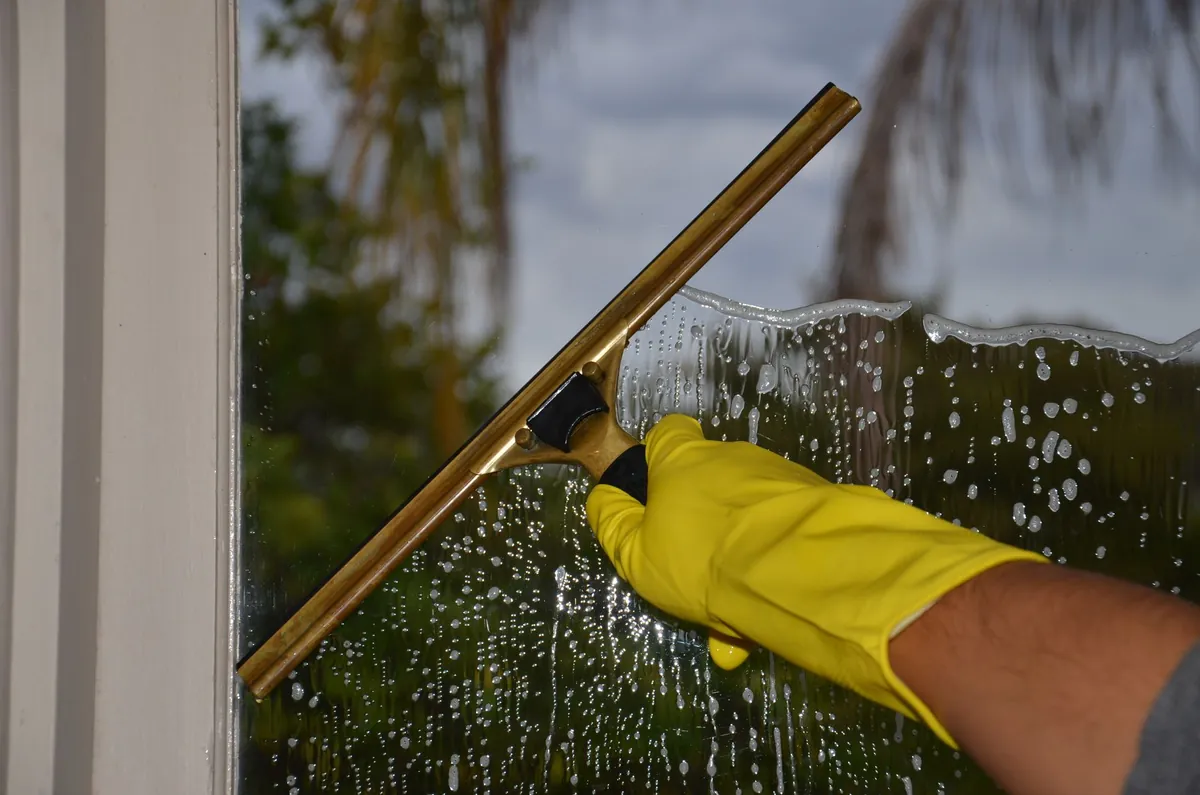
The squeegee: anatomy, technique, and the rubber problem
The single most important tool in the trade, and the one that homeowners and even some working cleaners get fundamentally wrong. A complete reference on the squeegee — handle, channel, rubber, sizes, swivels, and the technique that separates a streak-free finish from the trail of misery you used to leave on every window.
PUB. MAY 10, 2026
Five things to know before you pick up a squeegee:
- The squeegee is three parts: handle, channel, rubber. The rubber is the only part that touches glass and the only part that determines whether the window streaks.
- Rubber lasts weeks, not years. Working cleaners change rubber every two to four weeks of daily use; homeowners change it once a year and wonder why their windows streak. Change the rubber.
- The width of the channel matters less than the technique. A 14-inch channel is the residential workhorse. Bigger isn't better.
- There are three valid stroke patterns — fan, straight pull, and S-stroke — and the right one depends on the glass shape, not on which one looks coolest.
- The wipe between strokes is not optional. If you don't wipe the rubber between passes, the rubber redeposits the dirt it just removed. This is the streak.
The squeegee is one of the oldest specialized hand tools in continuous use. The basic geometry hasn't changed since the nineteen-thirties. What changes is the rubber compound, the channel tolerances, and — most of all — the user's understanding of what the tool is actually doing.
The first squeegee I bought was an Ettore Master from a hardware store on Belmont Avenue in 2014. I paid eleven dollars for it. I used the same rubber for the first six months of my career and could not understand why every window I cleaned looked worse than the windows the homeowner had cleaned themselves with paper towels and Windex. I thought I was bad at the trade. I was not bad at the trade. I was using six-month-old rubber that had been chewed down to a serrated edge by Chicago glass and Chicago grit, and I was dragging that serrated edge across glass and asking it to produce a clean line.
Nobody had told me to change the rubber. The squeegee came in a package and the rubber was already in it, and it had not occurred to me that the rubber was a consumable. This is, I have since learned, the single most common mistake homeowners make with squeegees, and it is the mistake that produces ninety percent of the streaks that get blamed on technique.
This piece is the encyclopedia entry on the squeegee, written for the homeowner who wants to understand what they're holding and the working cleaner who wants to refine what they already know. I am going to walk through the anatomy, the rubber problem, the size question, the three valid stroke patterns, and the technique details that separate a clean line from a smear. If you read one article on this site about tools, read this one.
The anatomy
A squeegee is three parts: handle, channel, rubber. Each part has a job, and the relationship between them is what determines whether the tool works.
The handle is the part you hold. It connects to the channel by way of a coupling that is either fixed (the handle and channel are one piece, common on consumer squeegees) or swiveling (the handle pivots on a ball joint mounted to the channel, standard on professional tools). The fixed handle is fine for vertical glass cleaned at arm's length. The swivel is essential the moment you start cleaning glass overhead, on a pole, or at any angle that's not perfectly perpendicular to your forearm. The swivel lets the rubber lie flat against the glass while the handle stays in your hand at whatever angle is comfortable. Once you've used a swivel handle, the fixed handle starts to feel like a tool from before the war.
The channel is the rigid metal piece that holds the rubber. It is typically aluminum (lighter, cheaper, can corrode in saltwater environments) or stainless steel (heavier, more expensive, durable). The channel has a slot machined down its length that the rubber slides into, and end caps that lock the rubber in place. The channel determines the working width of the squeegee — channels run from 4 inches (sash work, narrow panes) to 36 inches (storefront speed runs). The channel also determines how flat the rubber sits and how cleanly it pulls water; a channel with a manufacturing defect or a bent edge will leave streaks that look like a technique problem but are actually a tool problem.
There are two attachment styles for the rubber: clip-on and screw-on. Clip-on channels (Ettore Master is the dominant brand) hold the rubber with spring clips at each end. Pros: thirty-second rubber changes, you can carry spare rubbers in your pocket and swap mid-route. Cons: the clips wear out, and a worn clip lets the rubber shift under pressure, which causes intermittent streaking that's hard to diagnose. Screw-on channels (Sörbo Quicksilver is the gold-standard high-rise channel; Pulex is also good) hold the rubber with screws or set-screws. Pros: more secure, especially on a long pole or in wind. Cons: the rubber change takes a few minutes with a tool. Most working cleaners carry both styles for different situations.
The rubber is the only part of the squeegee that touches the glass. It is the part that does the actual work. It is also the part that wears out fastest, by orders of magnitude, compared to the handle and channel. The handle and channel last for years. The rubber lasts for weeks of daily use, or a few months of weekly use, or — as in my hardware-store mistake — six months of misuse before the homeowner notices that something has gone permanently wrong.
I am going to spend more time on the rubber than on anything else, because the rubber is where the trade is.
The rubber problem
A squeegee rubber is a soft natural-rubber strip, typically four to six millimeters thick, with two parallel working edges machined to a fine clean line. The rubber is held in the channel under slight tension, and when you drag the squeegee across wet glass, the leading edge of the rubber pushes the water into a head, and the trailing edge wipes the glass clean.
For this to work, three things have to be true:
- The working edge of the rubber must be sharp and uniform.
- The rubber must be supple enough to deform slightly against the glass and form a continuous seal.
- The rubber must be free of nicks, embedded grit, or built-up residue.
Each of these things degrades over time, and the degradation is irreversible. Here is what happens:
The edge dulls. Glass is harder than rubber. Every pass across glass shaves a microscopic amount of material off the rubber's working edge. Over thousands of passes, the edge transitions from a clean line to a slight curve, then to a flat, then to a serrated profile that no longer wipes cleanly. You can sometimes feel this transition by running your fingernail along the edge — fresh rubber feels sharp; worn rubber feels rounded.
The compound stiffens. Natural rubber is sensitive to UV light, ozone, and prolonged contact with cleaning chemistry. Over weeks or months, the rubber compound oxidizes and stiffens. A stiff rubber doesn't conform to the glass; it skips over fine surface variations and leaves intermittent water trails behind. Rubber that has been stored in the sun on the dashboard of a truck — and I have done this — stiffens in days rather than weeks.
The edge nicks. A single pass across a piece of grit, a chip in the glass, or the metal frame at the edge of the pane can put a small notch in the rubber edge. From that notch onward, every pass leaves a thin water trail at the position of the notch. One nick equals one streak, every time, until you change the rubber or trim past the damage.
The right answer to all three of these problems is the same: change the rubber regularly, and have a clear protocol for when. My personal protocol, which I have refined over twelve years:
- Daily commercial route work: change the rubber every 7-10 working days, or sooner if I notice streaking.
- Residential route work, mixed schedule: change every 2-3 weeks.
- Homeowner, occasional use (a few times a year): change at the start of every cleaning session. The rubber that has sat in a closet for six months has already stiffened; you cannot get a good result with it regardless of how rarely it has been used.
Rubber is cheap. Ettore Master rubber in twelve-inch lengths costs around two dollars per replacement strip in 2026. The economics of changing rubber more often than necessary are extremely favorable. The economics of not changing rubber are how my first six months looked.
The size question
Channel sizes run from 4 inches up to 36 inches in standard increments. The instinct of every new cleaner — and every new homeowner with a serious squeegee — is to buy the biggest one. More glass per stroke equals fewer strokes equals faster work. This is true in theory and in only one specific working condition.
Here is what actually determines the right channel size:
The narrowest pane width on the route or in the house. If you have any panes narrower than your channel, your channel is the wrong tool for those panes — you will have to switch to a smaller channel for the narrow work, or you will be wasting strokes by clearing only the section of channel that fits the pane. For most residential work, the narrowest panes are the small lights of a divided-light window, which run 8-12 inches wide. A channel narrower than 12 inches is rarely the right answer for residential, but a channel wider than 14 inches starts to lose its versatility on traditional architecture.
The shape of the glass. A 24-inch channel on a perfectly square 30-by-30 pane is a beautiful tool. The same 24-inch channel on a Cape Cod with French casement windows is a disaster waiting to happen. Bigger channels need bigger glass to justify themselves.
Your hand strength and forearm endurance. A 36-inch storefront channel pulls a substantial volume of water with each stroke. The forearm strength required to control it through a fan stroke, hour after hour, is real. Most working cleaners settle into a 14-to-22-inch range as their everyday channel and reserve the 24-and-up range for specific high-volume work where the throughput justifies the fatigue.
The 14-inch channel is the residential workhorse in my opinion and in the opinion of most working cleaners I respect. It clears the typical 24-by-36 double-hung pane in two strokes, fits comfortably into the narrowest standard residential pane, and produces minimal forearm fatigue across a full route day. If you are buying one squeegee for residential work, buy a 14-inch.
The three valid stroke patterns
There are three squeegee strokes that I consider professionally valid: the fan, the straight pull, and the S-stroke. Each one has its place, and the right choice depends on the glass shape and the cleaner's working position.
The fan stroke
The fan is the elegant one. The squeegee starts at the top corner, sweeps across and slightly down in an arc, comes back across in the opposite direction at a lower height, and continues in alternating arcs until the glass is clear. The arcs overlap by about two inches. The squeegee never lifts from the glass during the stroke.
The fan stroke's advantage is speed and an absence of squeegee marks — because the rubber never lifts, there is no start-and-stop transition where a thin water line might collect. The disadvantage is that the fan requires a continuous wrist rotation that takes weeks of practice to do consistently, and it does not work on glass that is so wide that you cannot reach the entire field with one continuous arc from a single body position.
The fan is the stroke I use on every standard residential pane up to about 30 inches wide. Past that, I switch to the straight pull.
For a longer treatment of when to actually deploy the fan stroke versus the alternatives, the piece on when to actually use the fan stroke Jan wrote a few weeks ago is the best practical guide I've seen.
The straight pull
The straight pull is the workhorse. The squeegee starts at the top edge of the glass, pulls straight down in a single vertical stroke, lifts at the bottom, and resets at the top for the next pull. Subsequent strokes overlap by about half an inch. The rubber is wiped on the trailing edge between every stroke.
The straight pull is the stroke I use on any pane wider than I can comfortably fan, on any pane where I'm working at full ladder extension and don't have the wrist range for a fan, and on any first pass on a heavily soiled window where the throughput of straight pulls is more important than the elegance of the fan.
The straight pull's advantage is reliability. It works in nearly every situation. The disadvantage is the wipe-and-reset between every stroke, which adds a few seconds per stroke and creates a small risk of drip lines from the bottom of one stroke into the field of the next. The fix for the drip risk is the perimeter detail towel, which catches drips before they reset onto cleaned glass.
The S-stroke
The S-stroke is the high-rise stroke. The squeegee starts at the top corner, pulls down for a few inches, sweeps across the width, pulls down a few more inches, sweeps back, and continues in a serpentine pattern down the glass. The squeegee never lifts.
The S is rarely the right stroke for residential work. It is the right stroke for wide commercial glass that is being worked from a bosun's chair or a swing stage where the cleaner cannot reposition mid-pane and needs to clear a large field with a single continuous motion. Abby uses the S-stroke on the Empire State Building lobby every Sunday. I have used it maybe a dozen times in twelve years.
I include it for completeness. If you are a homeowner reading this, the S-stroke is not the stroke you need. Learn the fan and the straight pull.
The technique details that nobody mentions
A few things I learned the hard way that no instructional video has ever explained well:
The wipe between strokes is mandatory. After every squeegee stroke, the rubber is loaded with water and the dirt that was in the water. If you start the next stroke without wiping the rubber, you redeposit that dirt onto the next strip of glass. The fix is a scrim or a clean folded microfiber kept in the non-dominant hand — wipe the rubber after each stroke, every stroke, no exceptions. The first thing I notice when I watch a homeowner squeegee a window is whether they wipe between strokes. They almost never do.
The angle of attack matters. The squeegee should be held at roughly 30 degrees to the glass — not flat against it, not at 90. Flat-against-the-glass loads too much pressure on the rubber and forces water out the sides of the channel. Too steep and the rubber doesn't deform enough to seal. The 30-degree angle is the compromise that lets the leading edge of the rubber push water cleanly while the trailing edge wipes the glass dry.
Pressure is light, not heavy. The instinct, especially with new rubber, is to press hard. The rubber doesn't need pressure. It needs contact. Light pressure across the full width of the channel, with the rubber deforming maybe one millimeter against the glass, is the correct amount. Heavy pressure deforms the rubber too far and produces what's called rubber chatter — the rubber stutters across the glass instead of gliding, and you get a series of fine parallel water lines. Once you've felt rubber chatter, you'll never forget it.
The corner detail is where the squeegee stops and the towel starts. A squeegee cannot get cleanly into a corner — there's always a thin band of water at the perimeter of the pane that the channel cannot reach. This band is what the perimeter detail towel is for. The squeegee does the field; the folded microfiber does the perimeter. Cleaners who try to squeegee into the corner produce streaks at the corner. Cleaners who detail the perimeter with a towel produce clean glass. The two-tool sequence is the trade.
A short list of squeegees worth owning
Brand recommendations age fast and I distrust them in encyclopedia entries, but a few have held up consistently enough across my twelve years that I am willing to commit them to print:
- Ettore Master: the cheap, reliable, ubiquitous American clip-on channel. The squeegee I learned on. Still a good first squeegee for a homeowner.
- Sörbo Quicksilver: the gold-standard professional channel for high-rise and demanding commercial work. Machined to tighter tolerances than anything else on the market. Abby will not use anything else.
- Pulex Tech-Trigger: my daily-driver residential squeegee. Clip-on, swivel handle, 14-inch channel, comfortable through a full route day.
- Unger ErgoTec: a solid mid-tier option. Better as a strip-washer-handle pairing than as a squeegee channel, in my experience, but both pieces are competent.
The rubber I run is Sörbo soft. The rubber I started on was Ettore. Either one, changed regularly, will outperform a premium brand left to oxidize on a shelf.
The squeegee is the central tool of the trade. It is also the tool that homeowners and beginners get most consistently wrong, and the tool that, used correctly, is the single biggest improvement a cleaner can make to their results. Buy a decent one. Change the rubber. Wipe between strokes. Learn the fan. The rest of the work — the chemistry, the diagnosis, the route economics — sits on top of competent squeegee technique.
It took me four years to get my squeegee technique to the point where I stopped thinking about it. It took me one afternoon to get it competent enough to stop streaking. The afternoon is what this article is for.
Glossary terms in this piece
- Channel — the rigid metal piece that holds the squeegee rubber
- Ettore Master — the dominant American clip-on squeegee channel; the standard first squeegee
- Fan stroke — the continuous-arc squeegee stroke, the elegant one
- Perimeter detail — the folded-microfiber pass around the edge of the pane after squeegeeing
- Pulex — Italian-American squeegee manufacturer, daily-driver residential channels
- Rubber chatter — the stuttering action of an over-pressed squeegee rubber, source of fine parallel water lines
- S-stroke — the serpentine high-rise squeegee stroke
- Scrim — the cotton wipe-cloth used between squeegee strokes; older trade term, sometimes replaced by microfiber
- Sörbo — American squeegee manufacturer, the gold-standard high-rise channel
- Straight pull — the vertical-stroke squeegee technique, the residential workhorse
- Swivel handle — the ball-jointed handle-to-channel coupling that lets the rubber lie flat at any working angle
Footnotes
Sources
- Ettore Products Company, Downloads (Professional) — the manufacturer's own brochures and sell sheets for its channels, handles and replacement rubber, which is where the house channel-and-rubber figures come from
- Sörbo Products, Channel and Rubber Compatibility Guide, manufacturer technical data, 2024.
- ASTM International, D2240 — Standard Test Method for Rubber Property—Durometer Hardness — the durometer method behind every squeegee-rubber hardness figure; the standard is explicit that it is an empirical control test and that readings taken with one type of durometer do not convert to another
Mara Whitfield
Senior editor of Window Washing Guide, covering the chemistry and foundations beat: surfactants, water hardness, and the House Standard solution recipe. Articles under this byline are researched and reviewed with the Giordano Inc. editorial team against published materials-science and trade references. Insufferable about Windex.