Why windows crack on their own
Nobody threw anything. The crack has a shape, and the shape names the cause: thermal stress, edge damage, or a nickel sulfide speck the size of a salt grain.
PUB. JUL 16, 2026
Read the crack, not the room. Four causes, four signatures, and only one of them is anybody's fault:
- Starts at the edge, perpendicular, then wanders in a lazy curve — no impact point. That's thermal stress. Sun on part of the pane, shade or A/C on the rest. Nobody did anything.
- A chip or nick at the edge with a crack running out of it. Edge damage from fabrication or install. The crack was scheduled years ago; heat or wind just called it in.
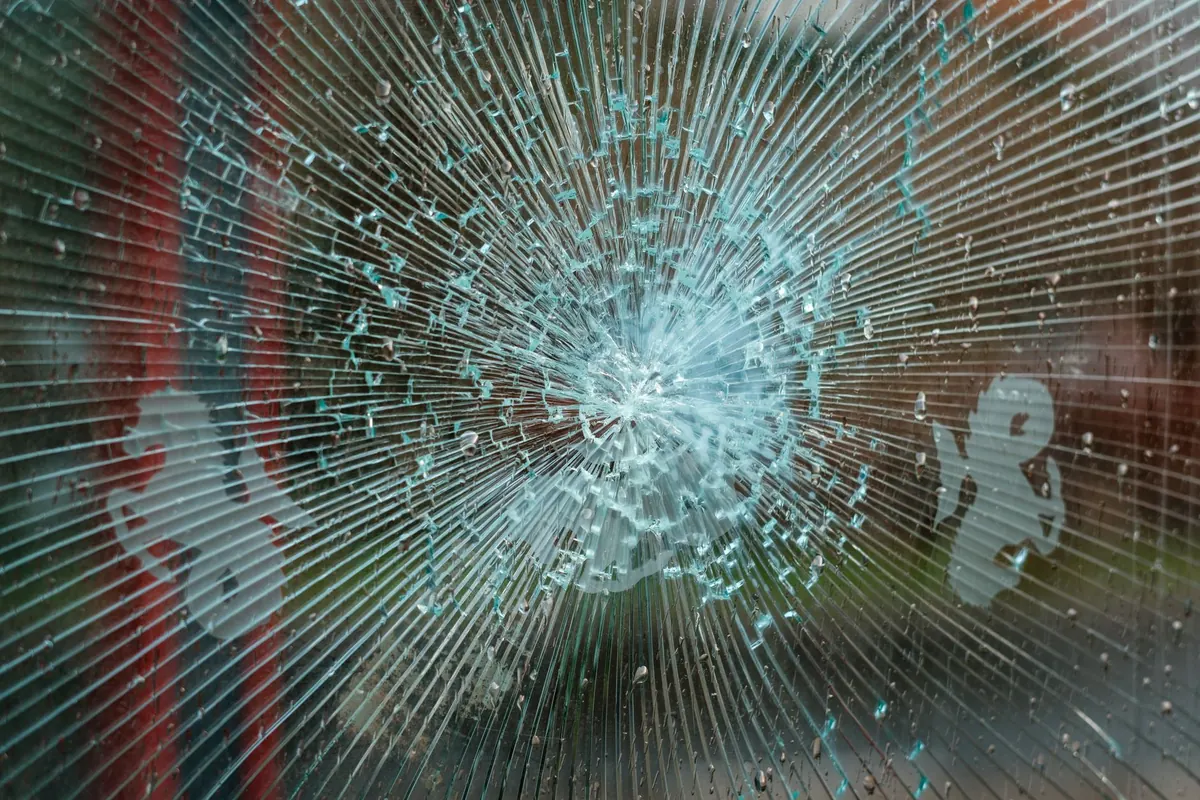
- A cone-shaped chip and cracks radiating from one point. Impact. Something hit it, even if nobody saw it — gravel, hail, a mower.
- Tempered glass that dices itself with no warning at all. Possibly nickel sulfide — a contaminant speck smaller than a salt grain, expanding for years. Annealed glass cannot do this.
- "Did the cleaner crack it?" Cold water on sun-hot glass is a real mechanism, and the trade's own bulletin says don't clean glass in direct sun. But the signature still tells you.
And the honest part nobody selling windows will lead with: a cracked pane usually can't be repaired — but the frame, the sash, and the other pane are often perfectly fine.
The call always opens the same way, and it always sounds like a confession waiting to happen:
Nobody touched it. It just cracked.
And the thing is — that's usually true. Glass cracks on its own more often than almost anyone expects, and the reason the claim sounds implausible is that we file glass under "breaks when hit," which is the one cause that comes with an obvious witness. The other three don't. They're slow, they're invisible, and two of them were decided before the window ever reached the house.
The good news is that a crack is not mute. It has a shape, the shape is diagnostic, and you can read it from your side of the room without a lab.
Read the crack, not the room
Four causes account for nearly every pane. Start at the crack's beginning — trace it back to where it's thinnest and most decisive, which is where it started.
1. It starts at the edge, dead perpendicular, then wanders. Thermal stress. The first inch or two leaves the frame square-on, like a road off a roundabout, then relaxes into a long lazy curve across the pane. There is no chip, no impact point, no origin anywhere but the edge. Usually one crack, occasionally branching late.¹
2. It starts at a visible chip or nick on the edge. Edge damage. Same physics as thermal, but with a head start — a flaw from cutting, seaming, transport or installation, sitting in the pane's highest-stress zone, waiting. The crack was effectively scheduled at the factory; the weather just picked the date.
3. A cone-shaped chip, with cracks radiating from one point. Impact. Something hit it. This is the only signature with an unambiguous origin inside the field of the glass rather than at its edge, and it usually leaves a small conical divot you can feel with a fingernail. Nobody has to have seen it happen — gravel off a mower, hail, a bird, a kid's ball two weeks ago that left a flaw which finished the job later.
4. Tempered glass that turns into a pile of dice, all at once, with no warning. Possibly nickel sulfide. This one is genuinely spectacular and genuinely nobody's fault, and it deserves the rest of this article's attention because it is the one people flatly refuse to believe.
The salt grain that breaks a window five years later
Somewhere in the float line, trace nickel — from raw material, from furnace hardware — meets sulfur and forms a crystal inside the glass. It is between about 0.003 and 0.015 of an inch across.² Pilkington's own bulletin cites inclusions as small as 0.08 mm. Photographed next to a grain of table salt, it loses.
In ordinary annealed glass, this is a non-event. Nothing happens. Ever.
Tempering changes everything about that sentence. The furnace heats the pane past 600°C, which puts the inclusion into its high-temperature crystal form. Then the quench — the blast of cold air that makes tempered glass tempered — freezes the inclusion in that form and, in the same instant, loads the pane with enormous permanent stress: compression locked into both surfaces, over a core held in tension at roughly half that magnitude. That stored stress is the whole product. It is why tempered glass is four to five times stronger than annealed, and why it dices instead of shearing into blades.
And now there's a crystal in the tensile core that is in the wrong phase and slowly wants out of it.
Over the following years — at ambient temperature, at no particular moment, with nothing happening — the inclusion converts back to its low-temperature form. The low-temperature form is bigger. It expands, inside the tension zone, until it opens a crack. The stored energy handles the rest, in about a millisecond, and the pane becomes gravel.
This can happen five years after installation. Ten. It is called spontaneous glass failure, and the trade's blunter name for it is glass cancer.
There is no way to find them. No inspection, no scan, nothing visual — the stones are smaller than the blemishes ASTM C1036 already permits in flat glass as a matter of routine. Float manufacturers fight it upstream, running raw batch material through magnetic and non-ferrous separators to keep nickel out in the first place.
The industry's actual defence is a confession dressed as a process: the Heat Soak Test, EN 14179-1.³ Tempered panes go into an oven at around 290°C for hours, deliberately provoking the phase change, so that panes carrying a lethal inclusion break in the oven instead of in the building. It costs the fabricator a sheet. It works, mostly. It is not a guarantee, and nobody claims it is.
Read that as what it is: the tempered glass industry cannot remove this defect, cannot detect it, and has instead built a furnace whose job is to kill the bad ones early. That's not a scandal — it's a reasonable engineering answer to an insoluble problem. But it does mean that "a tempered pane broke and nobody touched it" is a fully documented, entirely normal thing for a tempered pane to do, and anyone who tells a homeowner otherwise is either uninformed or protecting a warranty.
One thing this rules in, and one it rules out. If the pane is annealed — most fixed picture windows, most upper sashes away from floors and doors — nickel sulfide is not your answer. It can contain the same inclusions and it will not do this: the slow cool either halts the phase change or traps the stone before it can grow, and there's no stored tension for it to release into. Heat-strengthened glass sits in between and is dramatically rarer again, because its core tension is so much lower that a far larger stone would be needed to start anything.
So the honest triage is: dice pattern + tempered = plausible. Anything else = look elsewhere first, because the other three causes are enormously more common and every one of them leaves a mark.
First, is it even tempered?
Everything in the last section hangs on a word most homeowners have never had to check, and the triage is worthless without it. So before you accuse a salt grain, settle this — it takes about fifteen seconds and needs no tools.
Look for the bug. Safety glazing rules require tempered glass to carry a permanent identifying mark, sandblasted or acid-etched into a corner of the pane. The trade calls it the bug. It's typically a small block of text — the fabricator's name, a standard reference, sometimes the word TEMPERED outright — and it is deliberately impossible to wash off, which is why cleaners occasionally get asked to remove it and have to explain that it's structural paperwork, not soil. Check all four corners, and check from outside as well as in: on an insulating unit only one of the two panes may be tempered, and the bug belongs to whichever one earned it.
No bug? Reach for polarized sunglasses. This is the better trick, and it's the one that survives a bug hidden behind a sash. Tempering leaves the glass full of frozen-in stress, and stress makes glass optically birefringent — it bends light differently depending on direction. Put polarized lenses on, stand at an angle to the pane with bright sky or a bright reflection behind it, and tilt your head. Tempered glass will show a faint pattern of darker spots or stripes — leopard spots, or a regular striping — which is a map of where the quench nozzles hit it. Annealed glass shows nothing at all. It's a genuinely beautiful thing to see for the first time, and it is the physical fingerprint of the exact stored stress that nickel sulfide needs in order to be dangerous.
And you can often infer it from the location. Safety glazing is required, broadly, where people fall into glass: doors and the panels beside them, glass near floor level, panes around tubs, showers and stairs, and large lights close to walking surfaces. Fixed picture windows high in a wall, upper sashes, and most divided-light units usually aren't tempered — they didn't have to be. So a first-floor patio door is a strong candidate; the transom over your front door almost certainly isn't.
Which resolves the triage cleanly. No bug, no polarized pattern, not in a safety location — it's annealed, and nickel sulfide is off the table entirely. Whatever cracked that pane left one of the other three signatures, and those you can read from the sofa.
Thermal stress, which is the one you'll actually have
Nickel sulfide is the interesting cause. Thermal stress is the likely one.
Glass expands when it's warm. A pane in a frame has its perimeter shaded by the sash and in thermal contact with the frame, so the edge runs cooler than the centre — and the centre is out in the sun absorbing everything. The hot middle pushes; the cold edge refuses; the tension collects exactly at the edge, which is also where every microscopic flaw from cutting and seaming lives.
The classic setup is a pane that is half in sun and half in shade — a tree shadow, a deep reveal, an overhang line, a neighbouring roof — or one being air-conditioned hard on the inside while the outside bakes. Annealed float glass is the vulnerable material here; it has no toughening to spare and it is not safety glass. Add a dark interior blind close to the glass, which traps heat between blind and pane and drives the centre temperature up further, and you have manufactured the condition on purpose without meaning to.
Desert and high-altitude work is where this stops being theoretical. Glass in Phoenix or Santa Fe lives its entire service life inside a differential — brutal solar gain on the outside, aggressive cooling on the inside, and a diurnal swing that would be considered a weather event elsewhere. Thermal cracks there are not exotic; they are Tuesday.
The signature is the tell and it is hard to fake: straight and square off the edge for the first stretch, then wandering. No origin in the field. No chip. If you find that, stop looking for a culprit — you have found a physics problem, and the pane was going to do this whether anyone had ever cleaned it or not.
"Did the window cleaner crack it?"
Sometimes this gets asked politely. Sometimes it arrives as an invoice.
Let's be fair to the accusation first, because it isn't stupid: cold water on sun-hot glass creates exactly the differential described above. That's real. And the NGA's own cleaning bulletin advises against cleaning glass in direct sunlight — mostly because solutions flash off before they can do any work, but temperature is a live consideration in the same breath. A cleaner hitting a west elevation at 4pm in July with a cold hose is doing a thing the trade's own guidance tells them not to do.
Now the other side.⁴ That pane has been through several thousand sun-and-shade cycles, unattended, with nobody near it, and it survived every one. If it goes on the cycle that happened to include a bucket of water, the water was the last straw on a pane that was already loaded — usually by an edge flaw that has been growing since the day it was cut. The cleaner supplied the final increment. The fabricator or the installer supplied the condition.
Which is, precisely, the fabricating debris argument wearing a different hat: the proximate act belongs to whoever was standing there, and the condition belongs to somebody who left months ago. The person standing there loses that argument almost every time, for the same reason — they have the smallest legal budget in the room.
So, for anyone doing this for money: don't wash hot glass in direct sun. Not mainly because of cracks — because it's bad work and the bulletin says so — but the fact that it also removes this entire conversation from your life is worth the schedule change on its own. Work the shaded elevation. Come back at eight.
And for homeowners: if it cracked the day it was cleaned, look at the crack before you look at the cleaner. Square off the edge and wandering? That's thermal, and it was coming.
Does it spread, and can it be fixed?
The two questions everybody actually has.
Will it spread? Usually yes, slowly, and in steps rather than continuously — a crack sits still for weeks and then runs another few inches on the first genuinely cold night or the first real heat. Every thermal cycle is another loading. A crack that has stopped has not healed; it has found a stress equilibrium it will leave the moment the weather changes.
Can it be repaired? Here is where the incentives in this industry are worth naming out loud. Nearly everything you'll read about a cracked window is published by somebody who sells windows.
The honest version: a cracked pane is generally not repairable and the resin-injection kits sold for the purpose are designed for chips in laminated automotive glass — a completely different product with a plastic interlayer holding it together. On a house window they will make a crack less visible and restore no strength whatsoever. If the crack is in a sealed insulating unit, the unit's argon is already leaving and it will fog from the inside within a year or two regardless.
But — and this is the part that never leads — the pane is usually not the window. In most cases the sash, the frame, the hardware and the other pane are entirely fine, and what you need is a replacement insulating glass unit fitted into the window you already own, which is a fraction of a full replacement and is a job any glass shop does routinely. A company quoting you a whole new window for one cracked pane is answering a question you didn't ask.
Two situations where it isn't a cosmetic decision. If the pane is tempered and it's in a door, a sidelight, a stair guard, or within reach of a floor, it's there for safety and a compromised pane needs replacing, not monitoring. And if a tempered pane has already diced, it is doing the only thing left that it does well: holding itself vaguely in place until somebody leans on it.
Everything else is a question of how long you can live with a line across the view. Which, having read this far, you now know the cause of.
Notes
- Why the edge is where thermal cracks start, and why they start perpendicular. Glass expands when heated. A pane sitting in a frame has its perimeter covered — shaded by the sash, in contact with the frame, and often several degrees cooler than the exposed centre, which is absorbing sun. The hot centre tries to expand; the cool edge won't let it; the difference shows up as tension right at the edge, which is also the weakest part of any pane because it carries whatever microscopic damage the cutting and seaming left behind. Tension pulls a crack open perpendicular to the edge it started from, because that's the direction of maximum stress. Once the crack has run an inch or two it leaves the edge stress field and starts following the residual stresses in the glass instead, which is why the far end wanders in a slow curve while the first inch is dead straight. That combination — straight and square at the edge, meandering after — is the signature, and it is essentially unforgeable by an impact.
- On nickel sulfide, and why it only threatens tempered glass. Trace nickel from raw materials or furnace hardware can combine with sulfur to form a nickel sulfide crystal inside float glass. NiS has a high-temperature form and a low-temperature form, and the low-temperature form is larger. In annealed glass this is harmless: the glass cools slowly, so the inclusion sits in whatever form it likes, in a material with no locked-in tension to release. Tempering changes both halves of that. The furnace puts the inclusion into its high-temperature form, and the quench freezes it there — while simultaneously loading the glass with enormous stored stress, surface compression over a core tension roughly half its magnitude. The inclusion then spends years slowly reverting to its bigger low-temperature form, deep in that tensile core. Eventually it opens a crack in the tension zone, the stored energy does the rest, and the whole pane dices at once. Annealed and heat-strengthened glass can contain the same inclusions and don't do this — the slower cool either halts the phase change or traps the stone before it can expand. Heat-strengthened is not entirely immune, but it is dramatically rarer: its core tension is much lower, so a far larger inclusion is needed to start a crack.
- Heat soaking, honestly. The industry's answer to NiS is the Heat Soak Test — EN 14179-1, Glass in Building: Heat Soaked Thermally Toughened Soda Lime Silicate Safety Glass. Tempered panes are held in an oven at around 290°C for hours, deliberately accelerating the phase change so that panes carrying a dangerous inclusion break in the oven, where they cost a fabricator a sheet rather than costing a building a façade. It works and it is not a guarantee. Some inclusions survive the soak and still convert over a much longer service life, and researchers examining HST breakages have argued that only a minority of them would physically have been capable of breaking a pane in service anyway. There is no technology that removes NiS from float glass and no way to inspect for it: the stones run roughly 0.003–0.015 inch across — Pilkington cites inclusions as small as 0.08 mm — which is smaller than the blemishes ASTM C1036 permits in flat glass to begin with. Float manufacturers instead attack it upstream, with magnetic and non-ferrous separation of the raw batch.
- The thermal-shock-from-cleaning question, answered as fairly as we can. The mechanism is real: cold water on glass that has been baking in afternoon sun creates exactly the differential this article is about, and the NGA's own cleaning bulletin advises against cleaning glass in direct sunlight — partly because solutions flash off before they can work, but the temperature is a live consideration too. So it is not a frivolous accusation. What makes it usually wrong is the arithmetic of exposure: a pane that cracks the afternoon it was washed has been through several thousand identical sun-and-shade cycles unattended, and it was on the last one of those that the edge flaw finally reached critical. The cleaner's water is a plausible final straw on a pane that was already loaded, not the cause of the loading. Which is exactly the fabricating-debris argument in another costume: the proximate act belongs to the person who was standing there, and the condition belongs to somebody who left months earlier.
Sources
- National Glass Association, Glass Technical Paper FB01-00 (2023), Proper Procedures for Cleaning Architectural Glass Products — guidance on cleaning glass in direct sunlight
- EN 14179-1, Glass in Building — Heat Soaked Thermally Toughened Soda Lime Silicate Safety Glass (heat soak test).
- ASTM C1036, Standard Specification for Flat Glass — permitted blemish sizes
- Pilkington North America, Technical Bulletin ATS-165, Spontaneous Breakage of Tempered Glass.
- A. Kasper, Breakage probability of nickel sulphide inclusions in heat strengthened glass, GPD 2023 — and Spontaneous cracking of thermally toughened safety glass, Glass Structures & Engineering.
Drew Giordano
Editorial team contributor covering the Mid-Atlantic and Southwest beat plus long-form operator profiles. Articles bylined by Drew are researched and reviewed in collaboration with the Giordano Inc. editorial team and informed by interviews with practicing window-washing operators, plus published trade and IRATA rope-access references.