Window Washing in Nevada: A Two-Zone Operator's Field Guide
PUB. MAY 11, 2026
Nevada splits cleanly into two zones along the Las Vegas / Reno-Tahoe boundaries. The Las Vegas Valley draws Lake Mead and the Colorado River, and Las Vegas, Henderson and North Las Vegas all publish extremely hard water after the long Lake Mead retention. Reno runs Truckee Meadows Water Authority's Truckee River source, far softer on its Sierra Nevada snowmelt profile. Carson City runs mixed supply. Rural Nevada wells vary widely.
- How Nevada Works in Practice
- Las Vegas Valley Water Chemistry and the Extremely Hard Water Problem
- The Strip Resort-Property Perpetual Maintenance Environment
- The Mid-Summer Heat Load and the Working Calendar
- Reno-Tahoe and the Truckee River Soft-Water Profile
- The Comstock Heritage Corridor and Virginia City
- Lake Tahoe High-Elevation Considerations
- What I Tell Crews About Working This State
Need a window cleaner in Nevada?
We're building a local pro directory. Join the free waitlist.
By Drew Giordano, for the Mid-Atlantic and Southwest beat at Window Washing Guide
How Nevada Works in Practice
Nevada runs as two distinct working markets that share a state boundary and very little else operationally. Las Vegas and the surrounding Valley — Henderson, North Las Vegas, Paradise, Spring Valley, Sunrise Manor, Summerlin, the Strip itself — operates as one of the most demanding window-cleaning environments in the country, defined by Colorado River-source municipal supply at a published 291 mg/L (extremely hard), mid-summer afternoon temperatures regularly exceeding 110 degrees Fahrenheit, and a gaming-industry commercial concentration that maintains coated-glass IGU and curtain-wall on perpetual rather than quarterly schedules. The chemistry rivals Phoenix. The heat load equals or exceeds Phoenix. The commercial book is unique in scale and intensity to Las Vegas.
Reno-Sparks and the northwestern Nevada corridor — including Carson City, Lake Tahoe (Nevada side), and Virginia City — operates on entirely different terms. Truckee Meadows Water Authority draws from the Truckee River with Sierra Nevada snowmelt source profile and delivers municipal supply. Summer temperatures in Reno run 90 to 100 with cool nights from Sierra-adjacent elevation, which produces working conditions closer to inland California than to southern Nevada. The Comstock-era heritage residential and commercial concentrated at Virginia City and Carson City represents some of the older surviving residential stock in the state, with pre-1880 mining-and-territorial heritage glass on the better-preserved properties.
The rural Nevada market — Pahrump, Mesquite, Elko, Winnemucca, Ely, Tonopah, and the scattered small-town corridor along I-80 and US-95 — operates on heavily well-water-dependent residential with chemistry varying widely by aquifer location and geographic dispersion that makes the trade challenging at sustainable scale. The Lake Tahoe Nevada side carries substantial pre-1900 lakefront resort residential plus post-1970 second-home concentration with high-elevation UV considerations comparable to the Colorado Front Range work that Easton documents.
The notes that follow draw on interviews with operators in each of these markets, plus published Las Vegas Valley Water District, Truckee Meadows Water Authority, and Nevada Division of Environmental Protection water-quality references.
Las Vegas Valley Water Chemistry and the Extremely Hard Water Problem
The Las Vegas Valley Water District draws roughly 90 percent of its supply from Lake Mead via the Colorado River, with the balance from limited local groundwater wells. The Colorado River watershed passes through and over substantial limestone, dolomite, and gypsum formations on its way from the Rocky Mountains to Lake Mead, and the long retention time at Lake Mead (water sits in the lake for years before being drawn into the Las Vegas system) produces additional evaporation-concentration effects on the mineral content.
This is genuinely hard-water chemistry comparable to or slightly exceeding Phoenix on the worst weeks. Standard alkaline-soap-only protocols developed for soft-water Pacific Northwest or New England municipal supply will not produce streak-free results on Las Vegas Valley supply — the bicarbonate fraction in the water deposits on the glass surface during the squeegee pass and the post-squeegee dry-down, producing visible streak patterns that customers will see at the next dew cycle or at the first morning sun-angle.
The protocol the experienced Las Vegas operators run is the same extended-citric-pre-treatment approach that the Phoenix and Iowa and Kansas operators run, calibrated to the Valley's specific chemistry. Extended citric pre-treatment (4 to 6 minutes on a 4 to 5 percent citric blend), alkaline-soap wash on standard schedule, citric-rinse finish on the worst-affected windows. The pre-treatment dwell time is the key variable. The Las Vegas operators who hold long-term residential and commercial accounts have calibrated the dwell to the specific neighborhood and the specific property type, with longer dwell on properties where previous-cleaning bicarbonate buildup is heavy and shorter dwell on properties under active monthly maintenance.
The single most useful chemistry adjustment Las Vegas operators make is treating the citric pre-treatment as the primary intervention and the alkaline-soap wash as a secondary cleaning pass. In soft-water markets, the alkaline-soap wash is the primary cleaning event and the citric finish is optional. In Las Vegas the order of operations effectively reverses. Crews that move into Las Vegas from soft-water markets without making this conceptual adjustment produce work that looks acceptable in good light and visibly streaked in raking morning sun.
The customers on these properties typically know their well water and accept the pricing structure that reflects the extended cleaning time.
The Strip Resort-Property Perpetual Maintenance Environment
The Las Vegas Strip is the most distinctive commercial-cleaning environment in the country. The major resort properties — The Bellagio, Caesars Palace, The Venetian, Wynn, Encore, MGM Grand, Mandalay Bay, Aria, The Cosmopolitan, Resorts World, the Sphere — plus the surrounding casino-and-hotel concentration carry coated-glass IGU and curtain-wall maintenance schedules that run perpetually rather than on the quarterly cycles that define commercial work in every other market.
The reason for the perpetual schedule is straightforward: the gaming-industry commercial environment requires presentation at the standard of major luxury hospitality at all times, and the chemistry of the Las Vegas Valley water plus the dust-and-particulate load of the desert urban environment plus the visibility expectations of the customers (both gaming guests and the executives who run the properties) produce a maintenance requirement that simply cannot be met on a quarterly cycle. The Strip resort-property cleaning operates on a rolling continuous-maintenance model where dedicated in-house crews or contracted specialist operators work the property continuously, completing one elevation or one facade and moving immediately to the next, then cycling back to the first elevation when the route is complete.
The technical work itself is not distinctive — standard coated-glass IGU cleaning with the Las Vegas Valley chemistry adjustment — but the operating scale is unique. The Bellagio's main tower carries roughly 36 floors of glass curtain wall; The Venetian and Palazzo combined carry the largest single curtain-wall footprint on the Strip; the Sphere (opened 2023) carries roughly 580,000 square feet of programmable LED exterior on its outer skin and a separate interior glass-and-acrylic environment that operates on its own maintenance schedule. The crews that work these properties at scale are dedicated specialist operations with rope-access certifications (typically IRATA Level 1 minimum, IRATA Level 2 for the supervisory roles, IRATA Level 3 for the specialist troubleshooting and rescue work), insurance-and-bonding structures that meet the gaming-industry procurement requirements, and equipment inventories that include dedicated bosun's chairs, suspended platforms, and full curtain-wall maintenance rigging.
The procurement environment is one of the most demanding in any commercial market. The gaming-industry properties operate under Nevada Gaming Control Board oversight, which produces background-check requirements for contracted crews working on-property, plus the standard insurance-and-OSHA-certification requirements, plus the operational coordination with the property's security and surveillance teams, plus the timing constraints around guest-facing work (most exterior cleaning happens overnight or during early-morning low-occupancy windows). Operators who bid this work successfully tend to be regional or national specialist commercial operations with established Las Vegas presence. New entrants are rare.
The downtown Las Vegas (Fremont Street) commercial book operates on a smaller scale with similar perpetual-maintenance logic on the major casino properties (the Fremont Street Experience canopy area, the surrounding casino frontages). The downtown East Fremont post-2010 redevelopment has produced a more conventional small-commercial book on the rebuilt and converted properties along East Fremont and Carson Street.
The convention-center commercial book at the Las Vegas Convention Center, the Mandalay Bay Convention Center, and the surrounding meeting-and-event infrastructure operates on a quarterly-to-monthly cycle calibrated to the major-event calendar (CES in January, MAGIC in February and August, the various trade shows that fill the rest of the calendar).
The Mid-Summer Heat Load and the Working Calendar
The Las Vegas mid-summer heat load deserves dedicated treatment because it shapes the working calendar in ways that no other US market quite matches. From mid-June through early September, afternoon temperatures regularly reach 105 to 115 degrees Fahrenheit, with the worst weeks reaching 117 to 120. South-facing glass surface temperatures regularly exceed 150 degrees by noon and have been measured at 165 degrees on the most-exposed Strip-facing curtain wall during peak afternoon hours. The flash-evaporation problem at these temperatures is severe and unavoidable — cleaning solution evaporates on contact with the glass surface before the squeegee crosses, producing solution-streak patterns that require a second pass.
The combination of extreme temperature and extremely low humidity (10 to 25 percent typical summer Las Vegas humidity) compounds the flash-evaporation problem. Even with cooler solution, the dry air pulls moisture off the glass surface within seconds of application. The working answer is schedule adjustment to the extreme — pre-dawn working stretches (3 AM to 7 AM) and post-sunset working stretches (8 PM to midnight) become standard practice during the worst summer weeks for both residential and Strip-resort exterior work. Midday work on south-facing and west-facing exposures in July and August is essentially impossible to do well.
The residential book in Las Vegas slows substantially through July and August because customers who can leave the Valley typically do so, and the customers who remain accept that exterior maintenance windows are limited. The seasonal pattern reverses the typical American residential-cleaning calendar — Las Vegas operators see December through April as their peak working season and June through September as their constrained-operating period.
The Strip resort-property work continues through summer but shifts heavily to overnight scheduling. The crews that work the Strip year-round have developed working protocols that include cooled-solution carrier systems (chilled water in insulated reservoirs that maintains solution temperature for several hours of work), heat-reflective work clothing, mandatory hydration protocols, and shorter rotation cycles (typical summer overnight work runs 4-to-5-hour shifts rather than 8-hour shifts) that protect crew safety during the worst weather.
The commercial book outside the Strip — office mid-rise in the Hughes Center and the surrounding Maryland Parkway corridor, the medical-and-institutional commercial around UMC and Sunrise Hospital, the post-2000 corporate-park commercial — operates on conventional quarterly schedules adjusted for the summer-month constraint. Crews schedule exterior work in the early-morning windows and shift interior work to the midday and afternoon hours.
The chemistry adjustment for summer working is cooler solution and shorter dwell times — extended pre-treatment dwell at 110-degree-plus surface temperatures produces solution-evaporation residue that compounds the cleaning problem rather than addressing it. Some operators run pre-cooled deionized water on water-fed pole systems specifically to mitigate the flash-evaporation problem.
Reno-Tahoe and the Truckee River Soft-Water Profile
Reno-Sparks runs on entirely different terms from Las Vegas. Truckee Meadows Water Authority draws from the Truckee River with Sierra Nevada snowmelt source profile and delivers municipal supply. The chemistry is essentially a non-issue on standard alkaline-soap protocol. Crews moving from Las Vegas to Reno need to dial back their citric pre-treatment substantially or risk producing citric residue on the soft Reno supply.
Summer working conditions in Reno are operationally favorable. Afternoon temperatures run 90 to 100 typical, with cool overnight lows from the Sierra-adjacent elevation (Reno sits at 4,500 feet, with the surrounding mountains pulling temperatures down at night). The flash-evaporation problem is real but mild compared to Las Vegas — standard solution and standard dwell times produce streak-free results on most exposure orientations through most of the summer.
The defining residential characteristics of the Reno metro are the Old Southwest and Old Northwest pre-1925 heritage residential pockets — among the older surviving residential stock in Nevada. The Old Southwest in particular contains pre-1900 and early-1900s craftsman, prairie-style, and Victorian residential with original wood sash and original divided-light glazing on the better-preserved blocks. The original-glass survival rate runs 25 to 40 percent on the better blocks. The conservation calculus is the same as the Front Range work that Easton documents for the Denver pre-1925 heritage. Conservative protocol, no scraping, soft handling, test inconspicuous areas.
The University of Nevada Reno campus heritage glass on the older campus buildings represents some of the older institutional glazing in the state, with pre-1900 institutional stock concentrated on the historic Quad. Specialty conservation calendar.
The downtown Reno casino concentration along Virginia Street and the surrounding cross-streets carries pre-1925 commercial heritage on some properties (the Riverside Hotel, the original Mapes Hotel site, the historic Reno Arch corridor) plus post-1985 casino-and-mid-rise commercial on the major properties. The cleaning environment is closer to small-city commercial than Las Vegas Strip — quarterly maintenance contracts, standard procurement structures, regional commercial operators dominating the work.
The post-1985 production-suburban book in southwest Reno, Sparks, and the surrounding metro operates on standard residential protocol, Sparks at a published 68–92 mg/L (moderately hard). The Truckee River corridor commercial and the Midtown post-2010 redevelopment run on standard small-city patterns.
The Comstock Heritage Corridor and Virginia City
Virginia City and the surrounding Comstock-era heritage corridor — Gold Hill, Silver City, Dayton, and the broader Storey and Lyon county district — carries pre-1880 mining-and-territorial heritage residential and commercial at unusual density for the American West. The 1859 Comstock silver strike produced one of the largest concentrated heritage districts in the western United States, with substantial pre-1880 commercial and residential survival on the C Street commercial spine and the surrounding residential blocks.
The conservation considerations are real. Original wood sash, original divided-light glazing including some pre-1880 cylinder glass survival on the most preserved commercial frontages, and the broader heritage-district designation that has protected substantial pre-1880 fabric since the mid-twentieth century. The cleaning protocols on these properties are the same conservation-grade approach that the Newport pre-1800 heritage or the Charleston pre-1820 work demands — water-fed pole or hand-detail technique only, no scraping, no abrasive media, extended dwell times on alkaline-soap pre-treatment, test inconspicuous areas before working main facades.
The chemistry on Comstock-area properties is generally well-water-dependent and varies by property — some run on municipal Virginia City Water, which publishes no figure the site uses, some run on private wells at variable hardness. The protocol adjustment is to diagnose the supply on the first visit.
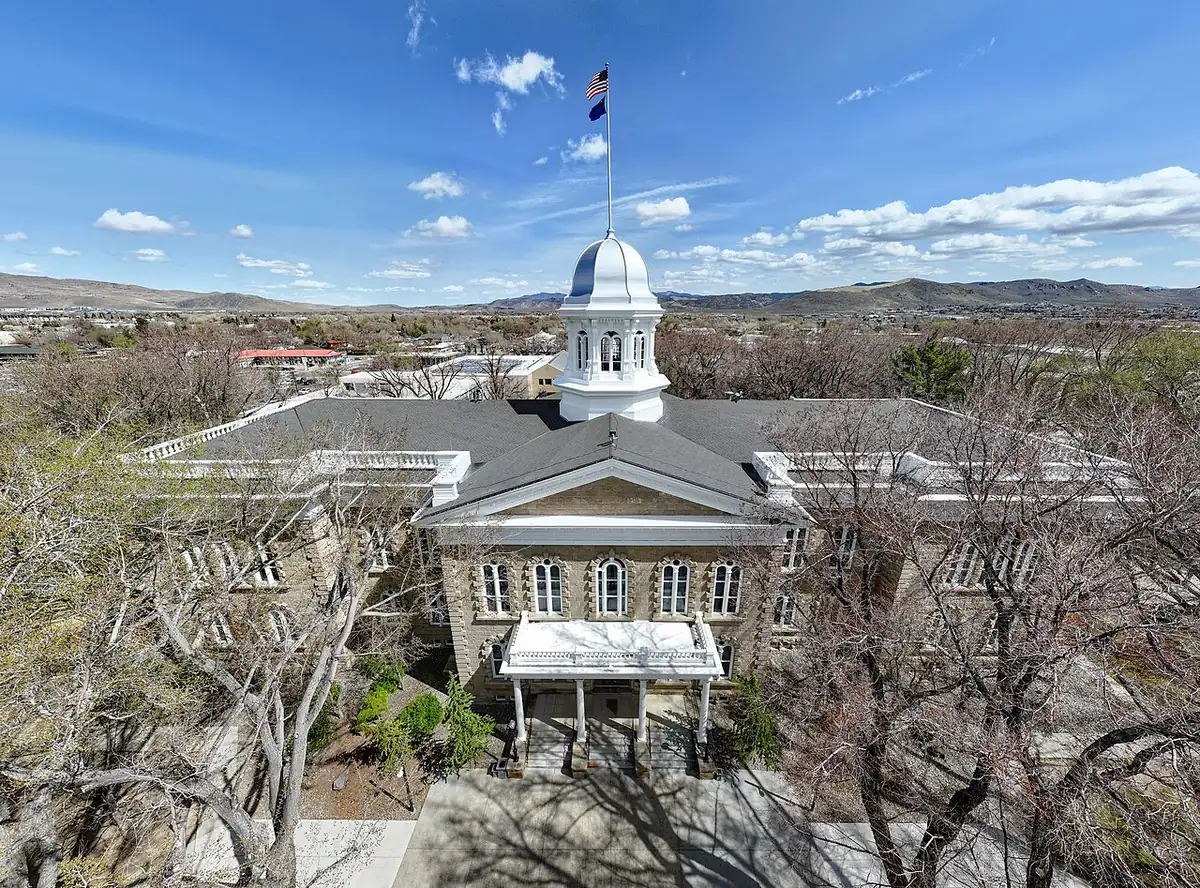
Carson City — the state capital, 25 miles south of Reno — operates on Carson City Public Works supply with mixed surface and well-water source. The pre-1900 historic district around the state capitol grounds and the surrounding heritage residential carry substantial heritage stock with original-glass survival rates comparable to the Reno Old Southwest. The State Capitol building itself (completed 1871) carries significant institutional heritage glass on a specialty conservation calendar.
The surrounding Genoa, Minden, and Gardnerville heritage corridor through Carson Valley carries scattered pre-1900 ranching-and-territorial heritage residential at lower density. Genoa in particular is one of the oldest continuously-occupied European settlements in Nevada (founded 1851) and contains a small but significant pre-1880 historic core.
Lake Tahoe High-Elevation Considerations
The Nevada side of Lake Tahoe — Incline Village, Crystal Bay, Stateline, Zephyr Cove, and the surrounding shoreline — carries substantial pre-1900 lakefront resort residential plus heavy post-1970 second-home concentration. The cleaning environment combines the high-altitude UV exposure pattern that Easton documents for the Colorado Front Range (Lake Tahoe sits at 6,225 feet, comparable to Denver elevation), the seasonal-resort property-management calendar that I documented for the Connecticut shoreline and the South Carolina Grand Strand, and the wildfire-smoke residue pattern that affects late-summer and early-fall operations.
The high-elevation UV exposure accelerates IGU seal degradation on post-1980 production stock, producing the early-failure pattern that Easton documents extensively. The cleaning protocol itself is unaffected — the UV consideration is a frame-and-seal diagnostic matter rather than a cleaning-chemistry issue — but operators working Tahoe residential should know to flag seal-failure indicators (interior condensation, visible desiccant migration in the gas-fill IGUs, frame-corrosion patterns on the older aluminum-clad sash) and document them for the customer.
The wildfire-smoke residue pattern is the more distinctive Tahoe operational consideration. The 2018, 2020, and 2021 California wildfire seasons produced documented particulate deposition on Tahoe-area residential and commercial glass at intensities comparable to the worst Bay Area or Sacramento exposure during those years. The protocol on smoke-residue cleaning is wet-rinse-first — the smoke particulate spreads on contact with insufficient water — followed by standard alkaline-soap wash with extended dwell. The intensity varies year-to-year and is unpredictable enough that crews working Tahoe residential plan for the worst case.
The seasonal-resort calendar at Tahoe runs heavy summer (Memorial Day through Labor Day) plus heavy ski-season (December through March) with shoulder-season residential and second-home property-management work concentrating around the spring and fall transitions. The crews that work this market long-term combine year-round Reno residential with seasonal Tahoe work, scaling crew capacity to the peak shoulder-season demand.
The Incline Village high-end residential book is one of the more concentrated lakefront-luxury residential markets in the western United States and operates on conservative-protocol logic comparable to the Gold Coast Connecticut work I covered in the Connecticut piece — house manager relationships, staff-managed access, careful pacing, and pricing that reflects the property values rather than the residential cleaning baseline.
What I Tell Crews About Working This State
A few things any operator running Nevada should internalize:
The chemistry is genuinely two-zone. Las Vegas Valley at a published 291 mg/L (extremely hard) on Colorado River-source supply requires extended citric pre-treatment (4 to 6 minutes), citric-rinse finish as standard, and customer pricing that reflects the longer cleaning time. Reno-Tahoe at a published 32–238 mg/L (soft to very hard) on Truckee River-source supply runs on standard alkaline-soap protocol with light citric finish. Crews moving between the two markets need to make the chemistry adjustment.
The Las Vegas mid-summer heat load is the most extreme working constraint in any state I cover. Pre-dawn and post-sunset working stretches are standard practice during the worst summer weeks. Midday work on south-facing and west-facing exposures in July and August is essentially impossible to do well. The seasonal pattern reverses the typical American residential-cleaning calendar — December through April is peak working season for Las Vegas residential, June through September is constrained-operating.
The Strip resort-property commercial work operates on perpetual-maintenance rather than quarterly cycles, requires rope-access certification (IRATA minimum) for the upper-floor curtain wall, and demands procurement-environment capabilities that include gaming-industry background-check compliance, substantial insurance and bonding, and operational coordination with property security and surveillance teams. The work is held by a small number of specialist commercial operations with established Las Vegas presence.
The Reno-Tahoe heritage residential at Old Southwest and Old Northwest deserves heritage protocol on pre-1900 original-glass properties. The conservation calculus is the same as the Denver Front Range pre-1925 work.
The Comstock heritage corridor at Virginia City, Carson City, and Genoa carries pre-1880 mining-and-territorial heritage at unusual density for the West. Conservation-grade protocol on the better-preserved properties — water-fed pole or hand-detail only, no scraping, extended dwell on alkaline-soap pre-treatment.
The Lake Tahoe high-elevation UV exposure accelerates IGU seal degradation comparable to the Colorado Front Range pattern. Document seal-failure indicators for customers. The wildfire-smoke residue pattern requires wet-rinse-first protocol during active fire seasons.
The rural Nevada market — Pahrump, Mesquite, Elko, Winnemucca, Tonopah — operates on heavily well-water-dependent residential with chemistry varying widely by aquifer and geographic dispersion that makes the trade challenging at scale. Local operators with established relationships hold the long-term work.
For broader Southwest and high-altitude context, the Arizona, California, Utah, and Colorado state pages cover the chemistry and elevation frameworks that bracket Nevada. For the operating protocols themselves, the article on deposits or etching covers the Las Vegas Valley chemistry, the article on foggy windows that will not clear covers the high-elevation UV-accelerated IGU degradation pattern that Tahoe demonstrates, and the article on heritage glass restoration covers the Comstock heritage work. Cross-references for technique: washing a window properly, what is actually on your windows, streaks come back overnight.
The big cities, in numbers
Las Vegas Valley Water District Colorado River and Lake Mead supply. Gaming-industry Strip commercial concentration unique in the country — the major Strip resort properties carry coated-glass IGU and curtain-wall maintenance on perpetual schedules. Downtown Las Vegas (Fremont Street) and the post-1990 Summerlin and Anthem master-planned communities. Mid-summer extreme heat load.
Henderson Water. Las Vegas metro southeast suburb. Post-1990 master-planned communities (Green Valley, MacDonald Highlands, Anthem) dominant residential. Limited heritage stock.
Truckee Meadows Water Authority Truckee River-source. Pre-1925 Old Southwest, Old Northwest heritage residential pockets. University of Nevada Reno campus heritage. Post-1985 downtown casino-and-mid-rise commercial. Truckee River corridor.
North Las Vegas Water. Las Vegas metro north suburb. Post-1990 production-suburban dominant. Aliante and Eldorado master-planned communities.
Las Vegas Valley Water District supply. Las Vegas metro west-side. Post-1990 production-suburban dominant. Spring Mountain Range adjacency.
Las Vegas Valley Water District supply. Las Vegas metro east-side. Mixed pre-1985 and post-1985 residential. Sunrise Mountain adjacency.
Las Vegas Valley Water District supply. Unincorporated Clark County immediately south of the Strip. McCarran International Airport. Substantial portion of the Strip resort properties technically within Paradise.
Truckee Meadows Water Authority Truckee River. Reno metro east-side. Pre-1925 historic core small. Post-1985 production-suburban dominant. Industrial-and-warehouse corridor.
Dedicated city pages in Nevada
Each city page carries its own water profile, neighborhood breakdown, cost range, and city-specific operating notes.
Rules for high-rise and rope-access window work
Private employers in Nevada answer to the state's own OSHA-approved program, held to at least the federal standard. That standard for rope descent (29 CFR 1910.27) sets owner-certified anchors good for 5,000 pounds, an inspection at the start of each shift, an independent fall-arrest line per worker and a 300-foot ceiling unless no safer access exists.
OSHA, State Plans: which states run their own programs · OSHA 29 CFR 1910.27: Scaffolds and rope descent systems · checked September 2026 · How we check local rules
What lands on the glass
| CONTAMINANT | SEASON | SEVERITY |
|---|---|---|
| Las Vegas Valley urban-particulate-and-dust | year-round, heavier summer | high on Las Vegas Valley residential and commercial |
| Combination of fine desert dust, urban traffic film, and the construction-related particulate from continuous Valley build-out. Wet-rinse-first protocol; the dust spreads on contact with insufficient water. Standard alkaline-soap dwell handles the urban traffic-film fraction. | ||
| Colorado River-source mineral residue | year-round on Las Vegas Valley properties | high on all Las Vegas Valley Water District properties |
| The municipal supply produces visible bicarbonate-residue streaking on standard wash protocols. Extended citric pre-treatment (4-6 minutes) plus citric-rinse finish standard practice. The single most useful chemistry adjustment is the pre-treatment. | ||
| Reno desert dust | year-round, heaviest spring and fall | medium on Reno-Sparks residential |
| Different chemistry from Las Vegas dust — more granitic-and-Sierra-derived rather than playa-and-alluvial. Dry-brush pre-clear handles it on the worst deposition days. Wind-driven deposition heaviest in spring and fall transition seasons. | ||
| Wildfire smoke residue (Reno-Tahoe late summer) | August through October in active fire seasons | high in heavy fire years, moderate in mild years |
| California wildfire smoke deposits fine particulate on residential and commercial glass throughout the Reno-Tahoe corridor during major fire events. The 2018, 2020, and 2021 fire seasons produced documentation of particulate deposition at levels comparable to the worst Bay Area or Sacramento exposure. Wet-rinse-first protocol; the smoke particulate spreads on contact with insufficient water. | ||
| Mid-summer flash-evaporation heat load (Las Vegas) | June through September, extreme July-August | extreme on Las Vegas Valley properties |
| Not a contaminant but the dominant working constraint. South-facing glass surface temperatures regularly 145-155°F at midday. Solution flash-evaporates on contact. Pre-dawn and post-sunset working stretches standard practice in the worst weeks. The most extreme operating environment in any state I cover. | ||
| Lake Tahoe high-elevation UV exposure | year-round, heaviest summer | medium on Tahoe-area residential |
| High-elevation UV (Lake Tahoe runs 6,225 ft elevation) accelerates IGU seal degradation comparable to the Colorado Front Range pattern. Not a cleaning protocol issue but a frame-and-seal diagnostic consideration. Same handling as Easton documents for Colorado. | ||
The year, in seasons
February through April is the heaviest booking pressure in Las Vegas — residential surge before the summer heat begins and Strip resort-property pre-season deep-cleaning push. Reno-Tahoe season starts later (April-May). Mid-spring pollen-and-dust deposition heavy.
June through early September production constraints severe in Las Vegas. Mid-summer flash-evaporation heat load defines the calendar — pre-dawn and post-sunset working stretches standard. Residential bookings drop into July as customers leave for cooler destinations. Reno-Tahoe summer steady. Wildfire-smoke deposition in late summer affects Reno-Tahoe.
September through November is the cleanest production stretch statewide. Las Vegas residential Q4 push. Reno-Tahoe second peak. Lake Tahoe second-home close-out work concentrated October. Strip resort-property pre-holiday booking push intense.
December through February permits year-round exterior work in Las Vegas Valley — winter is operationally the best working season. Reno-Sparks mild with occasional snow. Carson City moderate. Las Vegas commercial work runs steady through winter without the interior-only constraint that defines northern markets.
The articles that matter most for Nevada
Border states with their own guides
Land-adjacent states each get their own water-and-window profile. If you're working a regional route or moving across the border, these are the natural next reads.
Common questions about window cleaning in Nevada
How hard is the water in Nevada?+
The five utilities we cover in Nevada that publish hardness report 32 to 304 mg/L (as CaCO₃). The middle of those cities sits near 280 mg/L, which is extremely hard, meaning municipal water deposits aggressive mineral residue on every exposed pane and most cleaners run deionized rinse exclusively. Each city page gives its own utility's figure.
When is the best time of year to clean windows in Nevada?+
In Nevada, the working operator's calendar typically favors fall — september through november is the cleanest production stretch statewide. las vegas residential q4 push. reno-tahoe second peak. lake tahoe second-home close-out work concentrated october. strip resort-property pre-holiday booking push intense. For a full seasonal breakdown, see the cleaning calendar section on t
How much does window cleaning cost in Nevada?+
Residential window cleaning in Nevada typically runs $8–18 per pane or $200–500 for a standard single-family house exterior, depending on metro pricing, story height, screen condition, and frame type. Use our cost estimator for a calibrated quote for your home.
Why do my windows look dirty so quickly in Nevada?+
The dominant residue problem in Nevada is las vegas valley urban-particulate-and-dust (year-round, heavier summer). Combination of fine desert dust, urban traffic film, and the construction-related particulate from continuous Valley build-out. Wet-rinse-first protocol; the dust spreads on contact with insufficient water. Standard alkaline-soap dwell handles the urban traffic-fi
Do I need a professional to clean my windows in Nevada?+
Single-story homes with accessible glazing can be cleaned by homeowners using basic squeegee technique and the right solution. Multi-story houses, post-2010 coated glass, hard-water markets, and screens-plus-tracks work usually pay for themselves with a professional. See our hiring checklist below.
What's special about cleaning windows in Nevada's climate?+
Las Vegas mid-summer heat 105-115°F regularly, occasionally 117-120°F. Reno occasional winter snow events but minor. Wind events year-round on the western desert. Wildfire smoke from California fires affects Reno late summer and early fall. These conditions shape what a cleaner needs to know about scheduling, technique, and timing. The cleaning calendar on this page reflects th
Where can I find a window cleaner in Las Vegas, Nevada?+
Las Vegas is the largest market in Nevada and has the deepest concentration of professional window-cleaning services. Our "Find a Cleaner" page takes waitlist sign-ups while the local pro directory is built; meanwhile, read the Las Vegas section of this page for the city-specific water and cleaning context.
Drew Giordano
Editorial team contributor covering the Mid-Atlantic and Southwest beat plus long-form operator profiles. Articles bylined by Drew are researched and reviewed in collaboration with the Giordano Inc. editorial team and informed by interviews with practicing window-washing operators, plus published trade and IRATA rope-access references.
READ MORE BY DREW GIORDANO →