Window cleaning in Ohio: three states in one, from a Detroit cleaner who has worked a few routes across the line
PUB. MAY 10, 2026
Three distinct urban water profiles: Cleveland on Lake Erie, Columbus on Scioto-and-groundwater, Cincinnati on the Ohio River. Cleveland, Columbus and Akron publish moderately hard water, Cincinnati and Dayton hard. Outstate towns on the limestone belt lean on wells, and winter salt severity runs a north-south gradient.
- Three states, not one
- The water, by metro
- Cleveland and the northeast: the lake, the salt, the pre-war stock
- Columbus: newer housing, vinyl glass, and a different cadence
- Cincinnati: the river valley, the old housing, and the longest residential season
- Dayton: the hardest water of the major Ohio metros
- Outstate Ohio and the well-water question
- What the cross-state trade looks like in 2026
Need a window cleaner in Ohio?
We're building a local pro directory. Join the free waitlist.
I. Three states, not one
The first piece of practical knowledge I would pass to a cleaner moving into Ohio from anywhere else is that the state is three different markets stacked under one set of license plates. Cleveland and the northeast operate like a colder, slightly older version of suburban Detroit. Columbus operates like a faster-growing Indianapolis with more vinyl glass than any other state capital I have worked near. Cincinnati operates like a hill-country river city with the oldest residential housing stock in the Midwest west of Boston. And underneath all three, in pockets and counties most cleaners do not get to, sits an outstate population on private wells with the same iron-staining and hard-water problems I see across the line in outstate Michigan.
I do not run a route in Ohio. I want to say that up front. I run my route in the suburban Detroit corridor that I have been building since 2015, and I have been writing for this site for three years on the practical-fieldwork side. What I do have, with respect to Ohio specifically, is about a decade of accumulated cross-border work — a few weeks of fill-in for an aging cleaner I knew in Toledo who needed somebody to cover his commercial accounts after a back injury in 2019, three day trips a year to Cleveland for a property-management company that runs the same crew across both states, a season's worth of consulting for an independent operator in Columbus who was setting up his pricing for his first commercial route and needed somebody to walk him through the framework, and one extremely memorable day in Dayton in August 2022 where I learned more about hard-water sprinkler overspray in eight hours than I had learned in the prior five years.
That is the angle I am writing from. I am not the cleaner who has lived inside the Ohio market for fifteen years. I am the cleaner from the next state over who has worked a handful of routes on the other side of the line and noticed what is different. For some practical questions — pricing, water, the cross-state trade dynamics — that perspective is actually more useful than the one a long-time Ohio cleaner would give you, because the long-time Ohio cleaner has stopped noticing the things that make Ohio Ohio. For other questions — neighborhood-specific stuff, the local commercial customer base, the politics of any given regional trade group — I would defer to an in-state operator and have done so in this piece where it matters.
The state is large enough and varied enough that it deserves a section per metro. So I am going to give it that.
II. The water, by metro
The shorthand version: Cleveland is on Lake Erie at a published 105–130 mg/L (moderately hard to hard). Columbus blends Scioto surface water with limestone aquifer wells and sits at a published 120 mg/L (moderately hard). Cincinnati is on the Ohio River at a published 126–140 mg/L (hard). Dayton is on a deep aquifer at a published 155 mg/L (hard), the highest of the major metros. Akron sits at a published 76–150 mg/L. Outstate is on wells that no utility reports, and the answer depends on the underlying aquifer.
For the cleaner the practical implication is straightforward. Your standard residential protocol, the one you developed in whatever metro you came up in, will work without modification in Cleveland, Toledo, Akron, Columbus, and Cincinnati. It will not work without modification in Dayton, and it will not work at all in outstate well households. Those are the two adjustments to plan for.
I will go through each metro briefly with the working numbers.
Cleveland Division of Water pulls Lake Erie at four intake stations (Crown, Garrett, Baldwin, Nottingham). Cleveland sits at a published 105–130 mg/L (moderately hard to hard), close enough to the Detroit supply that the protocol does not change. Cleveland Water serves not just the city but a large suburban service area that includes Lakewood, Shaker Heights, Cleveland Heights, the inner ring east and south, and stretches out to the eastern suburbs through wholesale arrangements. If you are working anywhere in Cuyahoga County, the odds are very high you are on Cleveland Water. Confirm before you quote anything unusual.
Toledo Division of Water Treatment pulls Lake Erie at the Collins Park plant. Toledo publishes no hardness figure the site uses. The 2014 algal-bloom shutdown — when Toledo lost its water supply for two days because of microcystin contamination at the intake — is the reference point for everything that gets discussed about Toledo water and it is largely a residential-confidence issue rather than a cleaning-protocol one. The hardness profile did not change as a result of the response work; the lake-source water is what it has always been. Toledo runs comparable to Cleveland on the cleaning side.
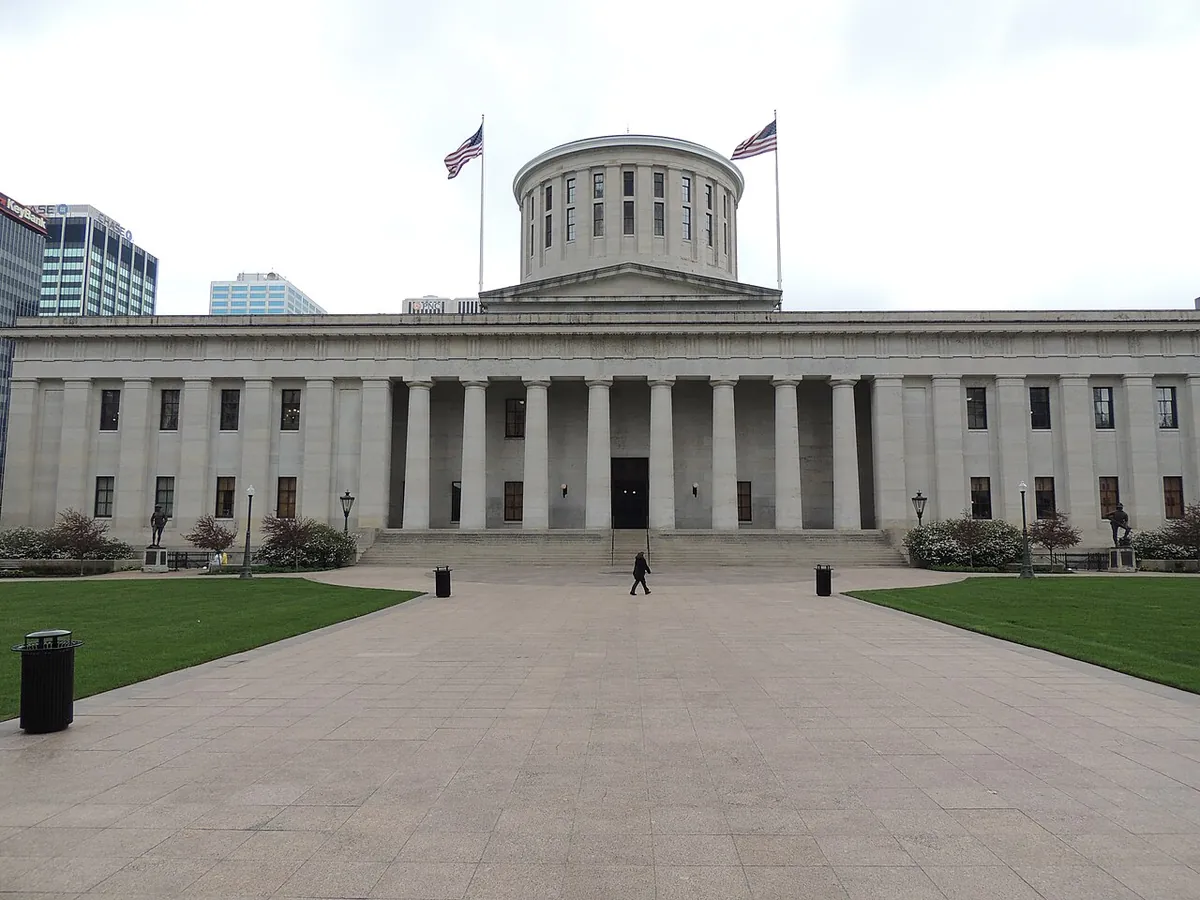
Columbus Department of Public Utilities blends Scioto River surface water from the three city reservoirs (Hoover, Griggs, O'Shaughnessy) with deep well water from the city well fields north of downtown. Sprinkler overspray work shows up faster here than in Cleveland but does not require an aggressive pre-acid pass on most accounts. Columbus is the fastest-growing major market in the state and the customer base is heavy on post-1990 single-family houses with vinyl-frame replacement glazing — easier to clean per pane than older stock, and the price points tend to reflect that.
Greater Cincinnati Water Works draws from the Ohio River at the California Treatment Plant intake on the east side of the city. Cincinnati sits at a published 126–140 mg/L (hard), but the bigger working consideration in Cincinnati is the river-valley humidity rather than the water chemistry — I will get to that in the Cincinnati section.
City of Akron Water Supply blends Cuyahoga River surface water (from reservoirs north of the city) with limestone groundwater. Akron sits at a published 76–150 mg/L (moderately hard to hard). The protocol is between Cleveland and Columbus, closer to Columbus.
City of Dayton Department of Water is the exception. Dayton draws almost entirely from the Great Miami Buried Valley Aquifer, one of the most prolific aquifers in the Midwest and a meaningfully harder source than any of the surface-water-fed metros. Dayton sits at a published 155 mg/L (hard), the highest of the covered Ohio cities, and your protocol needs to adjust. More on this below.
III. Cleveland and the northeast: the lake, the salt, the pre-war stock
The day-trip work I do in Cleveland is exclusively for the property-management contract I mentioned earlier — a company that runs apartment buildings in both metros and prefers to use the same crew for consistency. The work is mostly mid-rise residential, exterior commercial-grade glass with pole-and-pure-water access from ground level. It is not where I would learn the residential routes of the metro. But the trips have taught me what the regional cleaning profile actually is, which is this.
Cleveland and the inner-ring eastern suburbs — Shaker Heights, Cleveland Heights, University Heights, parts of Lakewood — carry the densest concentration of pre-1945 brick-and-wood-sash housing of any Ohio metro, and the density is comparable to what Mara writes about in the older Chicago neighborhoods and what Abby covers in his Brooklyn pieces. The water is not the working problem. The salt aerosol is the working problem in the winter and the cumulative pre-war glazing-putty failure is the working problem year-round. Cleaners who do residential work in Shaker Heights and Cleveland Heights are dealing with original wood sash from the 1910s through the 1940s, much of it on the edge of its glazing-compound service life, and the right protocol is the gentle-and-documented one that Mara has written about elsewhere on this site. Aggressive pre-acid passes on pre-war glass and pre-war glazing compound is how you get a customer who decides not to call you next year.
The lake-effect salt question is real. The northeast snow belt counties — Cuyahoga, Lake, Geauga, Ashtabula — apply more salt per lane-mile than most of the rest of the state, and the resulting aerosol problem is comparable to what I deal with in Macomb and Wayne counties on the Michigan side. The post-winter call is the entire spring residential season in northeast Ohio, just like it is in suburban Detroit.
The replacement-window wave moved through the postwar suburbs (Parma, Strongsville, Mentor, Lyndhurst) in the late 1990s through the early 2010s, on a similar timeline to Michigan. Most of that stock is now on vinyl-frame or aluminum-frame replacement units. The pre-war stock in the inner-ring suburbs is more often still on original wood sash because the owners value the historic glass and have chosen restoration over replacement. Two different markets, two different protocols, on parallel routes inside the same metro.
Toledo deserves its own brief note. Toledo is essentially the same lakefront water profile as Cleveland, the same salt-aerosol calendar, and a meaningfully more industrial-residue corridor along I-75 north and south of downtown. The auto-industry-particulate profile I wrote about in the Michigan piece — the heavy brake-dust and tire-wear deposition along Telegraph and Woodward — extends across the border into the Toledo corridor along I-75 and adjacent surface streets. If you are servicing residential or commercial property within a quarter-mile of I-75 in Toledo, expect the same denser-than-typical grime profile and pre-treat accordingly.
IV. Columbus: newer housing, vinyl glass, and a different cadence
The Columbus market is structurally different from Cleveland and Cincinnati and that structural difference shows up in every part of the cleaning protocol.
Columbus is the youngest of the three major metros by housing stock. German Village and Bexley and Upper Arlington carry the pre-war Columbus inventory and they are gorgeous and they are real, but they are a small share of the overall housing universe. The dominant housing type across the metro — through Westerville, Dublin, New Albany, Worthington, Hilliard, Pickerington, and the entire post-2000 exurban arc — is post-1990 single-family on small lots with vinyl-frame replacement glazing or original vinyl-frame double-pane units.
What this means for the cleaner is that the per-pane time is faster, the substrate is more forgiving, and the failure modes are different. The original wood-sash glazing-putty failure I deal with on the older Birmingham houses is essentially absent in Columbus. The cumulative pre-war coal-soot residue Abby writes about for Brooklyn is absent. The replacement-window failure modes — failed-seal IGUs that show interior condensation, vinyl-frame warpage from sun exposure on south-facing exposures, gasket aging on the early-generation 1990s units — are the dominant inventory of problems. Foggy-windows-from-failed-seal is the most common diagnostic question a Columbus residential cleaner gets, in my experience consulting the operator there. It is a homeowner question that has nothing to do with cleaning protocol and a lot to do with what to tell the customer about replacement timelines.
The water at one-seventy-five does produce sprinkler-overspray staining on a faster cadence than the lakefront metros, but not on the dramatic cadence you see in Dayton or in the central-Texas hill country. A two-percent citric pre-treatment on the patio doors and the ground-floor west-facing exposures is sufficient for most accounts. The cleaner I consulted with in 2022 was running the Columbus protocol he had learned from a Florida cleaner, which was aggressive and acid-heavy and was producing customer complaints about overcleaning. I walked him through dialing the protocol back to match the actual water conditions and his service quality and customer retention both improved within a season. The lesson there is that protocol calibration to local water matters and that imported protocols frequently miscalibrate in both directions.
The pricing structure in Columbus runs roughly fifteen to twenty percent below Cleveland and Cincinnati on a per-pane basis at comparable service tiers. The market is competitive, the customer base is younger, and the willingness-to-pay numbers I have seen are simply lower than in the older metros. New entrants to the trade can build a route faster in Columbus than in Cleveland or Cincinnati but the per-stop revenue ceiling is lower. That tradeoff is real and is worth understanding before you commit to a specific metro.
V. Cincinnati: the river valley, the old housing, and the longest residential season
I have spent the least time in Cincinnati of the three major Ohio metros and I am the most cautious about what I claim to know about it. The conversations I have had with cleaners who work the city full-time consistently emphasize three things and I am going to pass those along.
First, Cincinnati carries the oldest housing stock of any midwestern metro. The pre-1900 inventory in Over-the-Rhine, Mt. Adams, the West End, and parts of Clifton is not just old, it is meaningfully older than the comparable stock in Cleveland or Buffalo or Chicago. The Italianate rowhouses of Over-the-Rhine are mid-nineteenth-century. The hillside houses of Mt. Adams are similar vintage. The original glass that survives in those houses is genuinely historic and the cleaning protocol must treat it as such. Documentation before any aggressive cleaning. Gentle solutions. Surfactant-and-water as the default, citric only on confirmed deposits, nothing harsher than that without explicit homeowner consent.
Second, the river valley humidity profile is real and is distinct from the rest of the state. The Ohio River runs at a fairly constant temperature year-round and the valley walls trap moist air; the result is summer dew points sustained in the upper seventies for weeks at a time. This produces overnight condensation on east-facing glass that deposits a faint mineral-and-organic film by morning. The film is not heavy and the cleaning protocol is normal, but the cadence of cleaning is accelerated — Cincinnati customers tend to want service two or three times a year rather than the twice-a-year standard of the northern metros, and the local trade has structured itself around that.
Third, Cincinnati has the longest residential exterior season of any major Ohio metro. The hard-freeze window is shorter, the spring opens earlier (mid-to-late March is usable), and the fall extends through late November in most years. A Cincinnati cleaner who structures her route well can get three full service cycles into the year. The economics of that are meaningfully different from the lakefront metros, where the calendar imposes a two-cycle ceiling.
The one Cincinnati job I have personally run was a fill-in for a friend who was on vacation and needed a Saturday handled — a four-story Italianate in Mt. Lookout with original wood sash on the front elevation and replacement vinyl on the rear. The original glass was beautiful. The replacement vinyl was, predictably, the easier work. I made enough to cover the gas and the day rate and not much more, but the experience of cleaning glass from 1885 with a homeowner who knew exactly what she had and how she wanted it treated has stayed with me. If you are a cleaner who values that kind of work and that kind of customer, Cincinnati is the Ohio metro for you.
VI. Dayton: the hardest water of the major Ohio metros
I want to spend a section on Dayton specifically because the August 2022 day I mentioned in the opening was a Dayton day and because the hard-water profile is what it is.
Dayton draws from the Great Miami Buried Valley Aquifer at depth. The water leaves no doubt about its mineral content. Sprinkler overspray in Dayton produces visible white-cement deposition on patio doors and ground-floor west-facing windows within a single summer of unmaintained service. The post-summer call cadence is faster here than anywhere else in Ohio.
The Dayton day in 2022 was a favor I was doing for a cousin's husband who had bought a route in the Belmont neighborhood and was getting customer complaints about white spots that he could not remove. He had been running the same surfactant-and-water protocol he had developed in Indianapolis for commercial glass, and the protocol was simply inadequate for Dayton's residential sprinkler overspray on groundwater. I drove down on a Saturday in August, ran a citric-and-phosphoric pre-treatment ladder on three of his problem accounts, established a working protocol with him, and helped him build a pricing structure that reflected the additional time and chemistry the hard water required. He has been on that protocol since and the customer-complaint problem went away.
The working protocol in Dayton, distilled, is this: standard wash on horizontal indoor work and on shaded north-facing exterior glass. Citric-acid pre-treatment at three-to-five percent on ground-floor west-facing glass, patio doors, and any exterior surface within sprinkler reach. Phosphoric pre-treatment at three percent on the worst cases (mature staining, second-summer accumulation) with masonry-etching precautions. Pure-water final rinse where you have the equipment for it; clean-water hose rinse where you do not. Allow ten to fifteen percent additional time per stop compared to a Columbus protocol and price accordingly.
Cleaners moving into Dayton from elsewhere underprice the work because they do not yet understand the additional time. Frank, the guy I bought my route from in Royal Oak in 2014, told me in his binder of customer cards that the worst pricing mistake of his career had been on a small route he tried to expand into Dayton in 1996; he gave it up after eighteen months because he could not get the per-pane numbers high enough to cover the additional protocol time. The hard-water economics of Dayton are real and have been real for decades.
The Dayton metro and the surrounding counties (Greene, Montgomery, Warren on the south side, Miami on the north) all share the same aquifer system and run similar hardness numbers. The northern Miami Valley and the I-75 corridor between Dayton and Cincinnati share the profile. Anyone running residential work in this part of the state needs the hard-water protocol in their toolkit. The cleaners who do not have it produce work that looks acceptable for a week and then deteriorates.
VII. Outstate Ohio and the well-water question
The same well-water profile I wrote about in the Michigan piece applies across outstate Ohio with one important variation. The unglaciated southeast — Athens, Hocking, Vinton, Meigs, Washington, Morgan, and adjacent counties — sits on a different aquifer system than the rest of the state, and the iron-and-manganese content of those wells can run substantially higher than the Marshall-Sandstone profile I have worked on in the Michigan thumb.
The practical implication is that the iron-staining problem I described in the Michigan piece is worse in southeast Ohio than it is across the state line in the limestone-belt counties. Sprinkler overspray and well-water hose-down deposits produce an orange-rust band on lower-third glass that requires phosphoric or oxalic treatment for removal. The masonry-etching caveats I described for Michigan apply equally here. The aquifer also carries elevated manganese in some sub-basins, which produces a brown-black tint distinct from the iron-orange and which is harder to remove — manganese requires a specific reduction-based protocol that is outside the scope of standard residential window cleaning and that I would refer to a specialty contractor or a water-treatment professional.
The central Ohio limestone belt (Champaign, Logan, Union, Madison counties) carries a different well-water profile — more calcium, less iron, comparable to the central Michigan profile. Standard hard-water protocols apply.
The cleaners I know who work outstate Ohio operate on a different business model than the metro cleaners. The route geography is sparser, the per-stop revenue is higher (because the houses are larger and the customer base values the service more), the driving time is longer, and the seasonal calendar is more compressed because the winter weather is more severe in the southeast hills than in any of the major metros. A solo operator running outstate Ohio can build a viable business but it looks very different from a Columbus route or a Cleveland route. If you are a cleaner considering this work, your most useful first step is to spend a day with someone who already runs the routes and to listen to what they tell you about the customer base.
VIII. What the cross-state trade looks like in 2026
A few observations from my cross-border perspective that I think will hold up.
The Detroit-Toledo corridor is a single trade area in practical terms. Cleaners on both sides of the line work across it routinely. Pricing is comparable. The water is comparable. The salt is comparable. The auto-industry-corridor residue is comparable. The customer base is comparable. A cleaner who is building a route in either Toledo or southeast Michigan will benefit from working both sides and from understanding the cross-border franchise and independent-operator dynamics that connect the two metros.
The Cleveland-Pittsburgh corridor is a real cross-border trade area along the I-80/I-90 line — comparable lake-effect snowbelt climate, comparable rust-belt housing-stock profile, similar customer base. The Pittsburgh side is outside the scope of this Ohio piece but is worth a cross-reference for anyone working in Ashtabula or Mahoning counties.
The Columbus market has the most independent-operator growth I have seen in any Ohio metro since 2018. The corporate franchise expansion (Window Genie, Squeegee Squad, Fish) has been heavy here as well, and the per-pane pricing structures across both segments are converging toward a national mid-Midwest benchmark. If you are a new operator looking to enter the trade in Ohio, Columbus is structurally the easiest to enter and the hardest to scale a premium-pricing business in. Take that tradeoff seriously.
Cincinnati supports a smaller number of operators per capita but the per-operator revenue runs higher because the housing stock supports premium pricing and the customer base values long-term relationships. The cleaners I know in Cincinnati who have been doing the work for fifteen-plus years have small route books and high per-account revenue. The model is the opposite of Columbus and it is also a viable model. Different temperaments suit each.
The labor question I wrote about in the Michigan piece applies across Ohio with the same intensity. Reliable seasonal help is hard to come by everywhere in the Midwest in 2026, and the cleaners I know who are scaling beyond one or two trucks are dealing with the same retention and wage-competition issues across both states.
What I would tell a cleaner considering entry to the Ohio trade: pick a metro and commit. The state is too varied to run as a single market. The metro choice determines your housing-stock specialty, your water protocol, your seasonal calendar, your customer profile, and your scaling ceiling. Cleveland and Cincinnati support pre-war specialty work and premium pricing. Columbus supports volume residential and faster scaling. Toledo is a Detroit-corridor extension. Dayton requires the hard-water protocol and a willingness to charge for it. Outstate is a different business altogether. Pick one, learn it for three years before you generalize, and the work will pay you back.
What I would tell a homeowner: the windows on your house in Ohio look the way they do because of which metro you live in and which water you drink and which housing stock generation your house belongs to. Those things are knowable. A good local cleaner will recognize them and will tell you what is happening. If your cleaner cannot tell you the difference between the hard-water profile of Dayton and the Lake Erie profile of Cleveland, and you live in either of those metros, you are working with someone who has not done the homework that the trade rewards. The Ohio cleaning trade is, in 2026, deep enough and skilled enough that you can do better. Ask the questions. Listen to the answers.
The big cities, in numbers
Columbus blends Scioto River surface water with limestone-aquifer well water from the city well fields. The fastest-growing major market in the state and the one with the highest concentration of post-1990 single-family housing — vinyl-frame replacement units dominate the residential glass.
Cleveland Division of Water pulls from Lake Erie via the Crown, Garrett, Baldwin, and Nottingham intakes. The water serves Cleveland proper plus a large suburban service area (Lakewood, Shaker Heights, Cleveland Heights, and out to the eastern and southern suburbs). The pre-war housing stock in the inner-ring eastern suburbs is the regional cleaning specialty.
Greater Cincinnati Water Works draws from the Ohio River at the California Treatment Plant intake. Cincinnati carries the oldest housing stock of any Ohio metro by share — substantial pre-1900 inventory in Over-the-Rhine, Mt. Adams, and the West End — and the river-valley humidity is a working consideration distinct from the rest of the state.
Toledo pulls from Lake Erie at the Collins Park Water Treatment Plant. The 2014 algal-bloom shutdown reshaped public confidence in the supply but did not change the long-run hardness profile. The auto-industry residue from the I-75 corridor is comparable to the Detroit Telegraph profile.
Akron blends surface water from the Cuyahoga River and reservoirs with limestone groundwater. The mid-twentieth-century rubber-industry residential stock — bungalow and small Tudor revival concentrated in the inner neighborhoods — is the dominant housing type.
Dayton draws almost entirely from the Great Miami Buried Valley Aquifer, one of the most prolific aquifers in the Midwest. Sprinkler overspray work is heavier in Dayton than in any other Ohio metro on the same protocol — the city is the hardest-water major market in the state.
Dedicated city pages in Ohio
Each city page carries its own water profile, neighborhood breakdown, cost range, and city-specific operating notes.
Rules for high-rise and rope-access window work
Private window work in Ohio is under federal OSHA, because the state runs no OSHA plan of its own. For rope access that means 29 CFR 1910.27: the building owner certifies each anchor in writing to 5,000 pounds, the rig is inspected every shift, every worker has an independent fall-arrest line, and descents over 130 feet need stabilization at the work spot.
OSHA, State Plans: which states run their own programs · OSHA 29 CFR 1910.27: Scaffolds and rope descent systems · checked September 2026 · How we check local rules
What lands on the glass
| CONTAMINANT | SEASON | SEVERITY |
|---|---|---|
| Lake-effect salt and slush splatter | Dec-Mar | severe |
| Cleveland and the northeast snow belt counties (Cuyahoga, Lake, Geauga, Ashtabula) see the heaviest seasonal salt application in the state and the corresponding road-aerosol residue on ground-floor glass. Profile is comparable to suburban Detroit. The southern half of the state (Columbus and south) sees lighter salt and a correspondingly shorter post-winter spring cleaning season. | ||
| Industrial corridor particulate | year-round | moderate |
| The I-71 corridor through Cleveland, the I-75 corridor through Toledo and Dayton, and the I-90/I-71 confluence through Cleveland deposit auto-industry and freight particulate similar to the Detroit corridors. Akron and Youngstown carry a residual industrial-era grime profile from the rubber and steel eras that older masonry housing still sheds onto adjacent glass. | ||
| Hard-water sprinkler overspray (south and central) | May-Sep | high |
| Dayton at a published 155 mg/L (hard) produces the heaviest sprinkler-overspray staining of any Ohio metro. Columbus, at a published 120 mg/L (moderately hard), sees lighter staining. The unglaciated southeast Ohio well-water houses publish nothing; test them. The summer overspray season requires a citric or phosphoric pre-treatment pass on most ground-floor and patio-door work south of I-80. | ||
| Cottonwood and maple pollen | May-Jun | high |
| Cottonwood plantings along the Cuyahoga, the Scioto, and the Ohio River produce a seed-fluff wave in late May and early June matching the Detroit and Chicago profile. The hardwood pollen wave (oak, maple, sycamore) is heavy statewide and concentrated in the inner-ring suburbs of all three major metros. | ||
| Outstate iron staining | year-round (well households) | moderate |
| Well-water households across the unglaciated southeast (Athens, Hocking, Vinton, Meigs counties) and the central Ohio limestone belt carry elevated iron at the wellhead. Sprinkler overspray and hose-down work deposits an orange-rust tint on lower-third glass that requires a phosphoric or oxalic pass, with the same masonry-etching caveats that apply in outstate Michigan. Concentrated outside the major metro service areas. | ||
| Ohio River valley humidity film | Jun-Sep | mild |
| The Ohio River valley around Cincinnati runs at sustained dew points in the upper seventies for much of the summer. Overnight condensation on east-facing exposures produces a faint mineral-and-organic film by morning that is not seen in the same volume north of about I-70. Clears with a normal wash but accelerates the cleaning cadence on the affected exposures. | ||
The year, in seasons
April through May is the residential peak. The post-winter call drives volume across the northern half of the state in the first three weeks of April; Cincinnati springs earlier and has a less concentrated post-winter peak.
June through August is steady residential. The Ohio River valley humidity is the working consideration in Cincinnati; the rest of the state runs comparable to other midwestern states. Sprinkler overspray season runs heavier in Dayton and Columbus than in the lakefront metros.
September through November is the second peak. Pre-holiday cleaning drives October and November. Cincinnati extends the outdoor residential season later than the northern metros by two to three weeks on average.
December through March is largely commercial in the north. The Cleveland and Toledo residential exterior markets close for the hard-freeze season; Columbus runs a reduced residential schedule on warmer days; Cincinnati continues a reduced but real residential service through the season.
The articles that matter most for Ohio
Border states with their own guides
Land-adjacent states each get their own water-and-window profile. If you're working a regional route or moving across the border, these are the natural next reads.
Common questions about window cleaning in Ohio
How hard is the water in Ohio?+
The five utilities we cover in Ohio that publish hardness report 76 to 155 mg/L (as CaCO₃). The middle of those cities sits near 120 mg/L, which is moderate, meaning municipal water leaves visible spotting on dark glass and shows lower-sash residue over time. Each city page gives its own utility's figure.
When is the best time of year to clean windows in Ohio?+
In Ohio, the working operator's calendar typically favors fall — september through november is the second peak. pre-holiday cleaning drives october and november. cincinnati extends the outdoor residential season later than the northern metros by two to three weeks on average. For a full seasonal breakdown, see the cleaning calendar section on this page.
How much does window cleaning cost in Ohio?+
Residential window cleaning in Ohio typically runs $8–18 per pane or $200–500 for a standard single-family house exterior, depending on metro pricing, story height, screen condition, and frame type. Use our cost estimator for a calibrated quote for your home.
Why do my windows look dirty so quickly in Ohio?+
The dominant residue problem in Ohio is lake-effect salt and slush splatter (Dec-Mar). Cleveland and the northeast snow belt counties (Cuyahoga, Lake, Geauga, Ashtabula) see the heaviest seasonal salt application in the state and the corresponding road-aerosol residue on ground-floor glass. Profile is comparable to suburban Detroit. The southern half of the state (Columbus and
Do I need a professional to clean my windows in Ohio?+
Single-story homes with accessible glazing can be cleaned by homeowners using basic squeegee technique and the right solution. Multi-story houses, post-2010 coated glass, hard-water markets, and screens-plus-tracks work usually pay for themselves with a professional. See our hiring checklist below.
What's special about cleaning windows in Ohio's climate?+
Lake-effect snow off Lake Erie in the northeast corner produces the heaviest seasonal accumulation in the Midwest outside of the U.P. and western New York. The Ohio River valley sees occasional flooding that deposits silt on lower-elevation glass. The May-June pollen wave is heavy statewide. The 2014 Toledo water shutdown remains the regional reference point for surface-supply
Where can I find a window cleaner in Columbus, Ohio?+
Columbus is the largest market in Ohio and has the deepest concentration of professional window-cleaning services. Our "Find a Cleaner" page takes waitlist sign-ups while the local pro directory is built; meanwhile, read the Columbus section of this page for the city-specific water and cleaning context.
Jan Davenport
Editorial team contributor covering the Midwest and Great Lakes beat. Articles bylined by Jan are researched and reviewed in collaboration with the Giordano Inc. editorial team and informed by interviews with practicing window-washing operators in the region, plus published trade and small-business operations references.
READ MORE BY JAN DAVENPORT →