The Technique Library: how the canonical animations are built, and how to read a stroke from a still frame
What the eight chapters of the library cover, why technique has to be shown rather than written, how each animation encodes the working motion of a real cleaner, and how to read a stroke from a still frame the way a Copenhagen-trained instructor reads it. The library is what I would have wanted to have when I was an apprentice.
PUB. MAY 10, 2026
What the Technique Library does, in five points:
- It is a motion reference, not a video tutorial. Each chapter contains animated strokes that show the path of the tool, the angle of the blade, and the rhythm of the motion. A still frame from any chapter is meant to be readable on its own.
- Eight chapters cover the working day of a residential cleaner, from the squeegee strokes through the detail work, the application pass, the channel wipe, the bucket setup, the tilt-in reach, the razor scrape, and the pole technique.
- Every stroke has three things alongside the animation — a description of what is happening, three working notes for entry, mid-stroke, and exit, and a diagnostic that tells you what the failure mode looks like when the technique is done wrong.
- The chapters are designed to be revisited. A new cleaner reads them as instruction. A working cleaner returns to them when something stops working and they need to remember the principle they have stopped paying attention to.
- Reading a stroke from a still frame is itself a skill. The methodology section of this piece teaches it. Once you can read a still, you can read your own work in real time.
A trade taught only in motion is a trade most people cannot enter. The Technique Library is the closest I can get to walking onto a job site with someone and showing them the work. I have been doing the work for twenty-two years and I still come back to these animations when I feel a stroke going off.
The first thing my Copenhagen instructor said to me, on the first day of the apprenticeship, was that you cannot write down a fan stroke. He had been a working cleaner for thirty-one years at that point and he had taught the apprenticeship for nine of them, and he said this in the tone of a man who had given up trying to find a workaround. The fan stroke is a rotational arc that combines wrist pivot, blade angle, and forward motion in a single continuous gesture, and the only honest way to teach it is to show somebody and then watch them do it and then show them what they got wrong.
This was, depending on how you look at it, either why the apprenticeship was three years long or why the apprenticeship still existed in 2003 in a country where most other trades had moved to classroom instruction. The senior instructors in Copenhagen had decided, sometime in the 1970s, that you could not classroom-teach a stroke that took eighteen months of bucket-handle time to acquire. They were not wrong about that.
The Technique Library is my attempt to build the closest possible substitute for the apprenticeship, in the medium of a website. It is animated because the strokes have to move; it is structured because the chapters mirror the working day; it is honest about the limits because the substitute is not the thing. This piece is the methodology behind it — what the chapters are, how the animations are built, why the structure is what it is, and how to read a stroke from a still frame the way an instructor reads it.
If you have already used the library and want to know why it asks you to look at things in a particular order, this is the piece for that. If you have not used it yet, the library itself is where to start, and this piece is what to come back to once you have looked at the strokes a few times.
What technique actually is
A working cleaner's technique is the accumulated set of motions, decisions, and small calibrations that produce a clean window with the lowest possible amount of effort and the lowest possible amount of variance from one job to the next. It is the difference between the cleaner who finishes a residential job in ninety minutes and the cleaner who finishes the same job in three hours and leaves more streaks. The cleaner who finishes faster is not working faster. They are working with fewer wasted motions.
Technique is built, in a working cleaner, from three things layered on top of each other. The first is the canonical strokes — the small library of motions that every cleaner inherits from the cleaner who taught them. The second is the situational adjustments — the modifications a cleaner makes to a canonical stroke to fit a particular pane, a particular substrate, a particular reach. The third is the rhythm — the speed and economy of motion that emerges only after years of doing the work, and that cannot be taught directly.
The Technique Library can teach the first layer. It can show, with some precision, the second layer. It cannot teach the third. The third is hours on the bucket. There is no substitute for it.
Why the chapters are organized the way they are
The eight chapters of the library follow the structure of a working day, not the structure of a textbook. The Squeegee Strokes are first because they are what every cleaner thinks the trade is, and they are the chapter most users come to first. The Detail Stroke is second because it is the work that comes after the squeegee, the work that separates the cleaner who finishes a window from the cleaner who actually finishes it. The Application Pass is third because it is, sequentially, what comes before the squeegee, and reading it after the squeegee chapter clarifies why the squeegee chapter said what it said.
The next four chapters — the Channel Wipe, the Bucket Setup, the Tilt-In Reach, the Razor Scrape — are the supporting trades. The Channel Wipe is the small motion that resets the squeegee blade between strokes; without it the rest of the technique fails progressively over a working hour. The Bucket Setup is the staging that determines whether the day goes smoothly or breaks down at noon. The Tilt-In Reach is the geometry of working a double-hung sash from the inside. The Razor Scrape is the riskiest motion in the trade and the one most amateur cleaners try to do without instruction.
The eighth chapter, the Pole Technique, is for the working cleaner who has graduated to second-story and beyond. It is the chapter most weekend-cleaner readers will skip and the chapter that working professionals come back to most.
The order is not arbitrary. The library can be read out of order — and most users will — but the canonical sequence is the sequence in which a Copenhagen apprentice would have been taught the work, and the sequence in which the chapters teach each other.
How a chapter is built
Each chapter contains between two and four strokes. Each stroke is a self-contained motion study with five components: a name, a one-line italic descriptor, a working description, three named notes for the phases of the motion, and a diagnostic that tells the user what the failure mode looks like when the stroke is done wrong.
The animation underneath shows the path of the tool across the pane in real time. The duration is calibrated to the actual working speed of a competent cleaner — a fan stroke on a residential pane is six and a half seconds, which is what it actually takes. A straight-pull on the same pane is seven and a half seconds, slightly longer because the lift-and-reset between passes adds time. The animations are not sped up to look impressive. They are not slowed down to be pedagogical. They are the speed of the work.
The blade angle is shown as the rotation of the squeegee glyph relative to the path. The blade angle is the single hardest thing to teach a new cleaner — the difference between a 25-degree tilt and a 35-degree tilt is the difference between a clean stroke and a streaking one — and showing it as a rotating glyph is closer to seeing it on a real cleaner's hand than any verbal description gets.
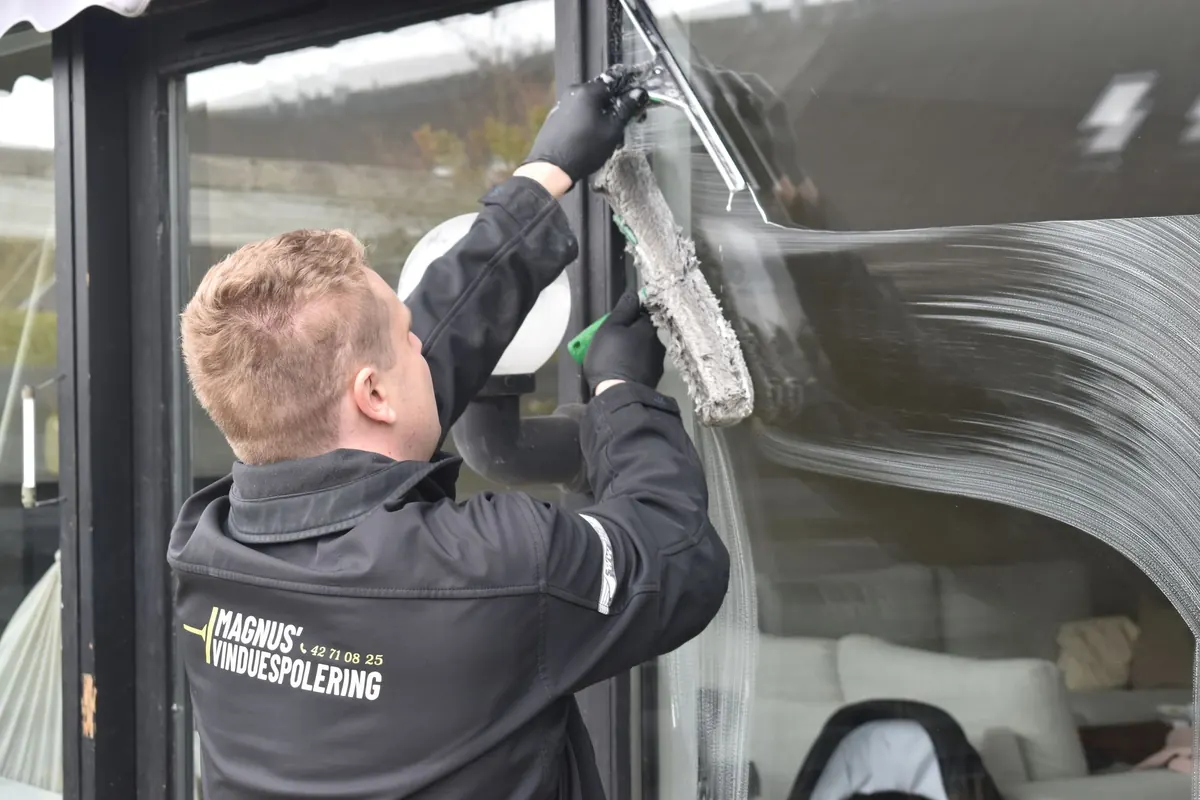
The trail behind the stroke shows the cleared glass. This is the most important visual cue in the library. A correct stroke clears glass behind it in a continuous, uniform width. An incorrect stroke leaves gaps, doubled passes, or trails that drift off the path. Watching the trail teaches the reader to watch their own trail in real time, which is the single most important diagnostic skill a working cleaner has.
How to read a stroke from a still frame
This is the part of the methodology that has the most direct transfer to reading your own work in the field. A still frame from any animation in the library can be read for four pieces of information.
The blade angle relative to the direction of travel. A correctly tilted squeegee shows the blade at an angle of about 25 to 35 degrees off perpendicular to the path. The leading edge of the rubber is making contact with the glass; the trailing edge is lifted slightly off the surface. In a still, this looks like the squeegee is leaning into the direction it is moving. A blade that appears perpendicular to the path is wrong — it is dragging the rubber edge-on across the glass and the water is going in both directions instead of the one direction the blade can clear.
The position of the trailing edge of the cleared glass. If the trail behind the squeegee is a clean continuous arc, the stroke is correct. If the trail has a slight wobble, the wrist is leading instead of following. If the trail is breaking up at the edges, the blade pressure is wrong — too light at the edges, often, because the cleaner is afraid of pressing too hard. Even pressure across the blade is the rule, and the trail tells you whether you are achieving it.
The relationship between the hand and the blade. In a correct fan stroke, the hand is leading the blade through the curve, and the blade is following with a small lag — perhaps a quarter of a second of rotation. In an incorrect fan stroke, the wrist rotates first and the blade rotates after, which produces a small bobble at every direction change. The library's animations show this lag explicitly. A still frame at the moment of direction change is meant to be readable: hand here, blade slightly behind, both rotating in the same direction.
The dwell time on the glass at the entry and exit points. A correct stroke has minimal dwell — the blade is moving by the time it touches the glass and is still moving when it leaves. An incorrect stroke has the blade stopped on the glass at one or both endpoints, which produces the small puddles of unclear water that show up as drips after the squeegee has moved on. The animations show the entry-and-exit speed, and a still at the entry point is meant to show motion blur — a signal that the blade is moving, not a signal of poor rendering.
These four reads, applied to your own work in real time, are the foundation of the diagnostic skill that separates the third-year cleaner from the fifth-year cleaner. Most cleaners learn this skill informally, by being corrected by a senior cleaner on the job. The library is an attempt to teach it directly, by showing the reads on idealized strokes and letting the reader pattern-match.
What the chapters teach each other
The squeegee chapter assumes the application pass has already happened. The application chapter assumes the bucket setup is correct. The bucket setup chapter assumes the cleaner knows what tools they are setting up. The detail stroke chapter assumes the squeegee has done its work. The chapters are organized so that each one points backward to the previous chapter and forward to the next, the way the working motions of a day point backward and forward through each other.
This is why the library is structured rather than alphabetical. A reader who comes for the fan stroke will, if they are paying attention, find themselves reading the application pass next, because the fan stroke does not work without the application pass that came before it. A reader who comes for the razor scrape will find themselves reading the angle test stroke first, because the razor scrape without the angle test is the razor scrape that produces the comet scratches Easton's scratches piece is about.
The chapters teach each other in the same way the work teaches itself. The library's job is to make this teaching visible.
What the library cannot do
The Technique Library is a motion reference. It is not a substitute for putting your hands on a tool and trying the motion on a piece of glass. The motor learning required to acquire a stroke happens in your hands and your shoulders, not in your eyes, and watching the animation a hundred times will not produce the same result as performing the stroke ten times.
The library can show you what the stroke looks like. It can show you what the failure mode looks like. It can give you the diagnostic vocabulary to identify what is going wrong. It cannot make the motion happen in your body. That is the apprenticeship. There is no shortcut.
The library also cannot show you the situational adjustments that take a canonical stroke and fit it to a particular pane. The third-story pivoting French pane that has to be cleaned through a half-open sash; the storefront with a fixed transom above an awning; the bay window where three of the five panes are at different angles to the others — these are situations the library does not document, because the situational adjustments are not canonical. They are improvisations from the canonical strokes, made in the moment by a cleaner who knows the canonical strokes well enough to improvise.
This is why the library has eight chapters and not eighty. The canonical motions are a small set. The situational adjustments are infinite. Teaching the canonical motions first is the only way the situational adjustments make sense later.
A note on the future of the library
Library V1, as the footer of the tool says, has eight chapters. Library V2 is planned to add four more — the rope-access chapter, the high-rise chapter, the post-construction chapter, and the seasonal chapter. These are chapters Drew will write the supporting articles for, and chapters that require working footage I do not yet have. They will ship when they are ready.
The current eight cover, by my count, about ninety percent of the working motions a residential cleaner uses on a normal job. The remaining ten percent is in the situational adjustments and in the four chapters that have not been written yet. The library will grow. The structure — chapter, strokes, animation, description, notes, diagnostic — will not change. It is the structure my Copenhagen instructor would have built, if he had been the kind of person who built websites instead of the kind of person who taught the work. He was not. I am, slightly, both. This is what the library is.
Glossary terms in this piece
- Fan stroke — the canonical professional squeegee motion; one continuous arc from corner to corner with rotational blade tracking
- Detail stroke — the microfiber pass after the squeegee that completes the perimeter and corner work
- Application pass — the wash phase that puts solution on the glass before the squeegee
- Channel — the metal handle of a squeegee that holds the rubber; the wipe between strokes is what keeps it clean
- Tilt-in sash — a double-hung window designed to pivot inward for cleaning of the exterior surface from inside the house
Sources
- National Glass Association, Glass Technical Paper FB01-00 (2023) — Proper Procedures for Cleaning Architectural Glass Products — the industry reference the canonical strokes are measured against: soak the surface, agitate with a non-abrasive applicator, remove the water with a squeegee, and keep metal off the glass in routine work.
- Occupational Safety and Health Administration, 29 CFR 1910.23 — Ladders — the placement and three-points-of-contact rules that bound which of these techniques can be performed off a ladder at all.
Where a technique in this library is a working convention rather than a documented procedure, the entry says so in its own description rather than borrowing authority from the sources above.
Abby Giordano
Editorial team contributor covering the Northeast and New England beat. Articles bylined by Abby are researched and reviewed in collaboration with the Giordano Inc. editorial team and informed by interviews with practicing window-washing operators in the region, plus published trade and apprenticeship technique references.