How to clean window screens
A screen is an air filter nobody changes, mounted over the glass it drains onto. The removal-first method, and the two mistakes that end a screen's life.
PUB. JUL 16, 2026
Your screens are the reason your glass stops looking clean. They are filters, and nobody changes them:
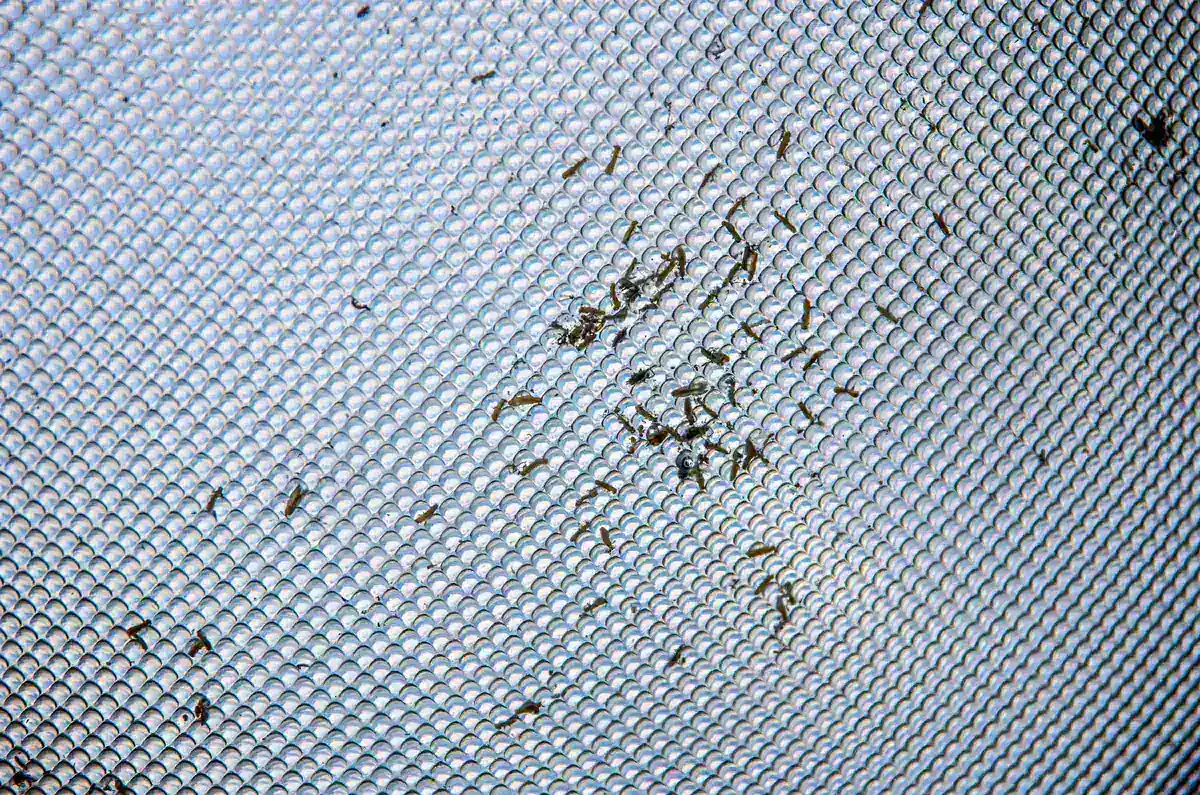
- A screen is an air filter over your window. Roughly 288 openings per square inch, catching pollen, dust, and soot — then rain runs through that load and drips it down your glass.
- Take them out. Label them first. Screens are cut to their own opening and are not interchangeable; the tape-and-marker step is the difference between a clean afternoon and a bad one.
- Never pressure-wash a screen. It stretches mesh, blows out the spline, and turns a $12 rescreen into a $90 replacement. A garden hose and a soft brush is the whole toolkit.
- Aluminum mesh oxidizes. That grey smear on your cloth is the mesh itself. Scrub it hard and you spread it onto the frame, the glass, and the siding.
- Screens come out before the glass gets washed, not after. Order of operations is most of the result — a wet screen reinstalled over a finished pane undoes the pane.
And one thing no cleaning method fixes: a screen is not a guardrail. The trade's own standards say so explicitly, and children lean on them every summer.
There is a question that arrives in our inbox every spring, usually in April, usually from somebody in the Piedmont who has just done everything right:
I washed the windows on Saturday. By Wednesday they were spotted again. What am I doing wrong?
Nothing. The windows are fine. The problem is hanging four inches in front of them, and it has been collecting since the last time anybody touched it, which — if the house is like most houses — was never.
The screen is an air filter, and nobody changes it
Take the arithmetic seriously for a second, because it reframes the whole object.
Standard fiberglass insect screening is woven at 18 × 16 — eighteen strands per inch one way, sixteen the other.¹ That's 288 openings per square inch. A perfectly ordinary 3-foot by 5-foot screen is 2,160 square inches, so it presents roughly 622,000 individual openings to the outside air, each one ringed by vinyl-coated glass fiber with a slight electrostatic affinity for exactly the sort of thing that floats.
Now put that in a wall and let a season of air move through it. Pollen. Road dust. Diesel soot if you're near a road that carries trucks. Mold spores, which are airborne most of the year and abundant in fall. Whatever the neighbor's mower throws. Every one of those particles has 622,000 chances to touch a strand on its way through, and a meaningful fraction of them stop there.
That's a filter. It's a filter with a face area of fifteen square feet and a service interval of never.
What it's holding depends entirely on where the house is, and the difference is not subtle. In the Southeast, spring screens are carrying pine pollen — a coarse, waxy, intensely yellow grain that arrives in quantities you can write your name in, and that turns to a sticky paste the moment it's wet. Along a coast, it's salt aerosol plus whatever the salt has already started doing to the frame. Near an arterial road it's brake dust and diesel soot, which is fine, black, greasy, and the one load on this list that genuinely needs a surfactant rather than water. In farm country it's soil in whatever the wind was doing at plowing. A screen in Charlotte and a screen in Tucson are the same object doing the same job on completely different diets, and the only thing they have in common is that neither has ever been washed.
And here's the part that matters to a site about glass: it drains onto your window. Rain hits the screen, wets down a season of accumulated pollen and soot into a slurry, and gravity does the rest — straight down the mesh, off the bottom rail, and onto the pane four inches behind it. That is the mechanism. The screen isn't a passive victim of the same dirt that lands on your glass; the screen is concentrating airborne dirt over months and then delivering it to the glass in one wash-down. This is a large part of why a window can look terrible three days after you cleaned it, and it's the piece missing from most of the folk explanations in the why-windows-look-worse piece.
Clean the glass and leave the screen and you have cleaned the thing downstream of the problem.
Order of operations, which is most of the result
Before any method, the sequence — because getting this wrong wastes the afternoon:
Screens come out first. They get washed first. They dry while you do the glass. They go back last.
The failure modes on either side of that are both common and both total:
- Screens washed after the glass: you're now rinsing a screen mounted over, or leaning against, a pane you just finished. Dirty water runs down clean glass. You will redo the glass.
- Screens reinstalled wet over finished glass: same outcome, delayed by twenty minutes. A wet screen weeps down its own bottom rail for a while after it looks dry, and whatever mineral is in your rinse water dries in place on the pane. If you're on hard water, that's spotting on a window you just did properly.
Pull every screen off the elevation you're working. Wash them. Set them somewhere they can dry standing up and out of the sun. Do the glass by the four-stage method. Reinstall dry. That order isn't fussiness; it's the difference between one pass and two.
Get them out without breaking them — and label them
Most screens on modern windows are held by two spring-loaded plunger tabs on one side, or by tension clips you compress toward one rail. Push the tabs in, swing that edge out, lift the opposite edge free. Older aluminum-frame screens on double-hungs often sit in a track and lift straight up before they'll come out at the bottom. If a screen won't move, stop and look for the retention mechanism rather than pulling — the tabs snap, and the tab is riveted, and now you have a screen that won't stay in.
Then the step everyone skips and everyone regrets:
Label each screen before it leaves the window.
Painter's tape on the frame, marker, note the room and which window: back bed, left. Screens are cut to their own opening. Two windows that look identical from the driveway routinely differ by a quarter inch, and a quarter inch is the difference between a screen that seats and a screen that falls out on a windy Thursday. On a house where the windows were replaced in more than one campaign — which is most houses over thirty years old — you may have three genuinely different sizes on one elevation.
The cost of skipping this is an hour of trial and error at the end of the day, in the dark, with fourteen nearly-identical screens and no memory of which is which. Ask how we know.
The two mistakes that end a screen's life
Everything else in this piece is recoverable. These two aren't.
Don't pressure-wash a screen. Not on the low setting. Not with the fan tip. Not "carefully." The mesh is held in its frame groove by a vinyl spline pressed in with a roller, and the retention is friction alone.³ Pressure lifts the spline, the mesh relaxes, and the screen bellies — permanently. The cruelty of it is the delay: the screen looks fine while it's wet and pinned flat against its frame, and reveals the damage the next day as a slack, rattling panel. A rescreen is cheap; it is also an afternoon and a spline roller you don't own. A garden hose at normal household pressure will not do this. Use the hose.
Don't scrub aluminum mesh hard. If your screens are older — mill-finish aluminum rather than charcoal fiberglass — the grey coming off on your cloth is not dirt. It's the mesh, oxidizing.² You can't remove it, because it isn't a deposit; it's the surface of the strand converting to powder and regenerating behind whatever you take off. Scrub aggressively and you accomplish two things: you spread grey aluminum oxide across the frame, the sill, the siding, and any glass in range, and you thin the mesh. Clean it gently, accept a little transfer, and read heavy shedding as information — an aluminum screen that blackens everything it touches is telling you its service life is over.
The method
Now that the hard parts are out of the way, the actual cleaning is almost boring. That's correct. It should be.
Where. Not on the lawn — grass stains vinyl-coated mesh, and you will step on one. Two sawhorses, a picnic table, a deck rail, or leaned at a slight angle against a fence with something soft underneath. Working at an angle rather than flat matters more than it sounds: flat, the rinse water sits in the mesh and dries there, and you get a screen that's clean and spotted. Angled, it runs off.
Wet it down. Garden hose, ordinary pressure, from the outside face. A surprising amount leaves right here. If a screen has never been washed, do this step twice and watch the color of what comes off.
Wash it. A soft brush — a car-wash brush, a soft-bristle deck brush, a large sponge — and a bucket of the mildest thing that works. A few drops of dish soap in a gallon of warm water is genuinely sufficient for pollen and dust. If you keep a proper cleaning mix on hand, the house-standard surfactant at normal dilution is more than enough. Work from the top down, both faces, with light pressure and long strokes. You are not scouring; you are giving the surfactant a chance to lift film off strands and letting the rinse carry it.
What you're not doing: no ammonia, no bleach, no degreaser, no acid. There's nothing on a window screen that needs any of them, and every one of them attacks either the aluminum frame, the vinyl coating on the mesh, or the spline.
Rinse it. Both faces, top down, until the water runs clear. Then rinse the frame, which has been quietly holding a bead of dirty water in its groove the entire time.
Dry it. Standing on edge, angled, out of direct sun. Shade matters if you're on hard water: sun on a wet screen dries the water before it can run off, and leaves the mineral behind as a haze on the mesh. Fifteen minutes in shade beats five in the sun. If you're impatient, shake it — one firm shake sheds most of what's left.
Reinstall dry. Tabs seated, both sides, actually engaged. A screen that's "mostly in" is a screen on the ground after the first real wind.
The version for screens you can't take out
Some screens don't come out: fixed exterior screens, second-storey windows on a house with no safe ladder position, sunroom panels, anything where the removal is genuinely more dangerous than the dirt is annoying. Don't fight it. The in-place method is worse, and worse is fine.
Vacuum first, dry. Brush attachment, light contact, both faces if you can reach. This pulls the loose pollen and dust load off without turning it into mud, and on a screen that's never been touched it's most of the available improvement.
Then a damp pass. A microfiber folded over your hand, lightly damp with the same weak surfactant, drawn down the mesh in overlapping vertical strokes. Support the mesh from behind with your other hand if you can reach — pressing on unsupported mesh is how you belly a screen by hand.
Don't rinse. There's nowhere for the water to go except down the wall and across the glass, which is the exact problem you're trying to fix. Damp, not wet.
And if the window's on the second floor and there's no safe way to reach it, that's a rope-and-ladder job or a pro's job, and neither the screen nor the view is worth the fall. Which brings us to the part of this article that isn't about cleaning at all.
A screen is not a guardrail
This has nothing to do with dirt and everything to do with why we bother writing about screens at all.
Every summer, children fall out of windows. The mechanism is nearly always the same: an open window, a screen in place, and a reasonable-looking assumption that the screen is a barrier. It isn't, and the trade is unusually direct about this.⁴ The Screen Manufacturers Association describes its own mission as educating the public that a screen is a device to provide ventilation and protection from insects, not a product designed as protection from falls. ASTM E1748 — the standard test for how well a screen stays in its window under load — writes the exclusion into its own scope: it is not intended for evaluating screens used as a restraint of occupants within the building as a means of preventing accidental falls.
Read that as the industry drawing a line under its own product. The people who make screens test how well they stay engaged, and then say in print that the number does not mean what you might want it to mean. A screen holds back a moth. It is a vinyl-coated fiberglass net held in a groove by friction, and it will not hold a child who leans on it.
If you have small children and windows that open, the answer is a window opening control device or a stop that limits travel to four inches, not a screen and not a hope. It's a $10 part. We mention it here because this is an article about screens that people will read while holding one, having just noticed how little it weighs.
When to stop cleaning and rescreen
There's a point where the honest advice is to stop.
Rescreen it if the mesh is torn, if it has a belly you can push more than an inch, if the spline has come out of the groove anywhere along a rail, or if an aluminum mesh sheds heavy grey no matter how gently you work. Mesh, spline, and a roller run about the price of lunch, and a rescreen takes fifteen minutes once you've done one. Any glass shop will do it for you for not much more.
Replace the frame if the corners have separated, if the frame itself is bent enough that it won't sit square in the opening, or if the tabs are gone. A bent frame will never seat properly and will be back on the ground every spring.
And be honest about the tradeoff you're maintaining. Even a perfectly clean standard screen costs you visible light and a measurable amount of view clarity — that's the price of 622,000 openings' worth of fiberglass sitting between you and the outdoors, and it's why a room feels transformed when the screens come out for winter. Solar screening costs considerably more of both, by design. If you have a window you never open, on a view you care about, the best available screen-cleaning method is a screwdriver and a shelf in the garage.
The rhythm
For most of the country, screens want washing once a year, and the timing isn't arbitrary: after the pollen ends, before the summer. In the South that's late May, once the pine is finished and the yellow has stopped falling. Further north it's June. Doing it before the pollen season is well-meant and wasted — you're cleaning a filter immediately before its heaviest month.
If you take screens out for winter, wash them on the way out in fall and store them dry and vertical. That's the version with no extra work in it at all: you were handling them anyway.
And then wash the glass. In that order.
Notes
- The 18 × 16 figure is the standard specification for ordinary fiberglass insect screening — eighteen strands per inch in one direction, sixteen in the other, woven from vinyl-coated glass yarns under ASTM D3656. Multiply and you get 288 openings per square inch, which is where the 622,000 figure for a 3 × 5 screen comes from. Charcoal fiberglass at 18 × 16 is what came on most windows built in the last forty years. Denser weaves exist and behave differently: no-see-um mesh runs 20 × 20 and finer, and solar screening is a wide, flat-strand weave designed to block sun rather than insects. Both catch and hold substantially more airborne debris than standard mesh, and both are more delicate about how it gets removed.
- On the aluminum smear: mill-finish aluminum mesh grows a natural oxide layer the moment it meets air, and outdoors, over years, that layer thickens and loosens into a friable grey powder sitting on the strands. It is not dirt sitting on the mesh — it is the surface of the mesh itself, converted. This is why an aluminum screen blackens a white cloth indefinitely no matter how many times you rinse: you are not removing a finite deposit, you are abrading a surface that regenerates. Scrub gently, accept that some grey transfers, and understand that a screen which sheds heavy grey onto everything it touches is a screen near the end of its service life. The same oxide chemistry is why the aluminum frames around your glass go chalky on the weather side and stay bright on the sheltered side.
- Pressure washers and screens, specifically: consumer electric units start around 1,300–1,900 PSI and gas units run 2,500–3,300. Screen mesh is held in a groove by a flexible vinyl spline pressed in with a roller — the retention is friction, nothing more. Even a fan tip at distance delivers enough force at the spline line to lift it, and once a spline is out at one corner the mesh relaxes and the screen bellies permanently. The damage frequently doesn't show while it's wet and pinned against the frame; it shows a day later when the screen is dry, back in the window, and visibly slack. The tell is a screen that suddenly rattles in wind after a cleaning it 'survived.'
- Screens are not fall protection, and this is not our opinion. The Screen Manufacturers Association states its mission as educating the public that a screen is 'a device to provide ventilation and protection from insects, not a product designed as protection from falls.' ASTM E1748, the test method for how well a screen stays engaged with its window, excludes the case explicitly in its own scope: it is 'not intended for evaluating the retention of insect screens being used as a restraint of occupants within the building as a means of preventing accidental falls.' The screen industry tests engagement against static load precisely so nobody mistakes that number for a safety rating. A screen will hold back a moth. It will not hold back a toddler, and it is not built to.
Sources
- ASTM International, D3656/D3656M — Standard Specification for Insect Screening and Louver Cloth Woven from Vinyl-Coated Glass Yarns — the spec that fixes the sizes and types of vinyl-coated glass-yarn screening sold for dwellings, patios and screen enclosures, and the louver cloth used in soffit vents
- ASTM International, E1748 Standard Test Method for Evaluating the Engagement Between Windows and Insect Screens as an Integral System — the scope note for screen-and-window engagement, including its exclusions
- Screen Manufacturers Association, SMA 1201, Specifications for Insect Screens for Windows, Sliding Doors and Swinging Doors — the trade standard for what an insect screen is. SMA sells its specifications rather than publishing them, so this is the association's own specifications index, which names the document and its current 2025 edition in full.
- Screen Manufacturers Association, Mission — the sentence article 39 rests on, in the association's own words: the primary intent of a screen is "to provide ventilation and protection from insects, not a product designed as protection from falls."
- The Aluminum Association, Care of Aluminum — cleaning methods for mill-finished and anodized aluminium, the two finishes a screen frame and its mesh arrive in
Elly Giordano
Editorial team contributor covering the South and Mid-South beat. Articles bylined by Elly are researched and reviewed in collaboration with the Giordano Inc. editorial team and informed by interviews with practicing window-washing operators in the region, plus published trade and historic-glass conservation references.