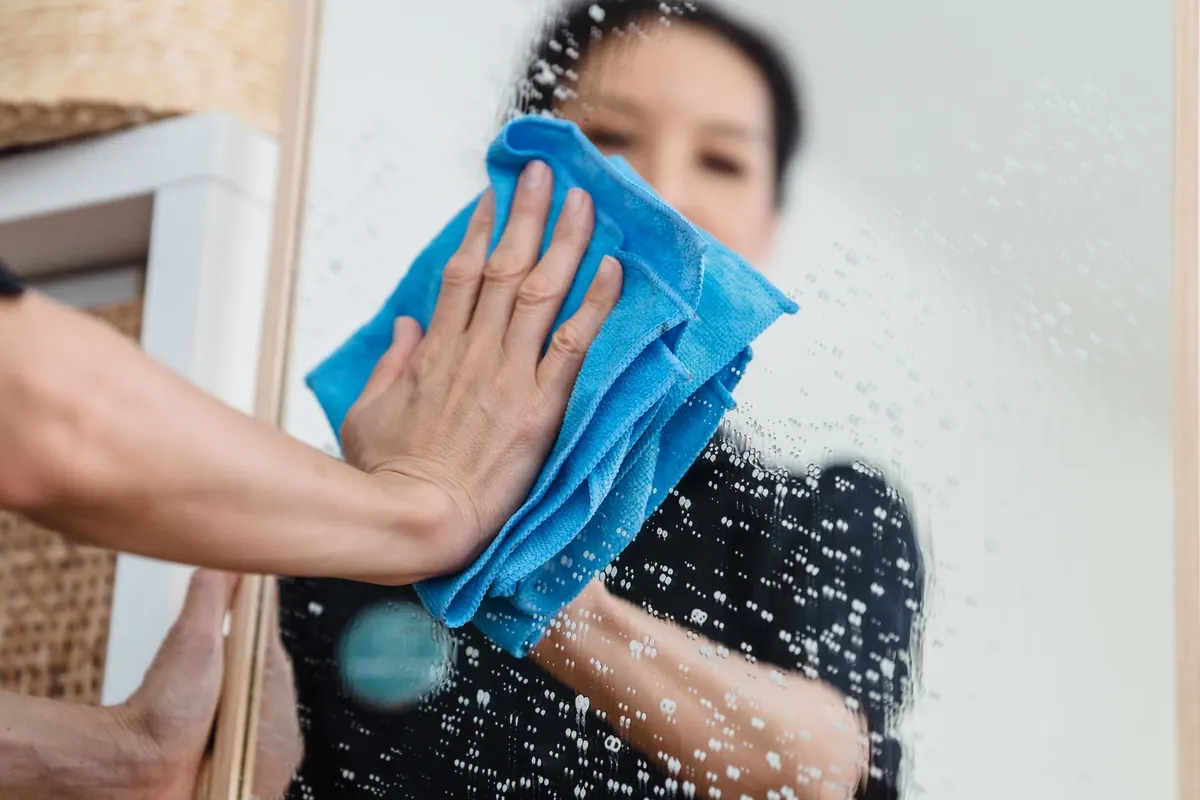
Microfiber and detail cloths: the textile reference for working with glass
The squeegee gets the credit and the rubber gets the post-mortem, but the cloth in your back pocket is what decides whether the finished pane looks finished. A working reference on detail cloths and microfiber — the fiber chemistry, the construction grades, the laundering rules that determine whether a clean cloth is actually clean, and the use-case sort that tells you which cloth belongs on which surface.
PUB. MAY 12, 2026
The cloth is half the finish. The short version:
- Microfiber is two fibers, not one — a polyester-polyamide split-fiber composite. The polyester is the structure, the polyamide is the absorbency, and the way the fibers are split open is what gives the cloth its grip on residue.
- GSM is the only spec that matters on the bag. Below 250 GSM is detail-grade. 300–350 GSM is general cleaning. Above 400 GSM is drying and absorbing. Buying the wrong weight for the wrong job is the most common mistake.
- Fabric softener and dryer sheets are the textile version of putting ammoniated cleaner on factory-tinted glass. They coat the fibers with a hydrophobic film that does not come out and that smears across every surface the cloth touches afterward.
- One cloth is not all cloths. A microfiber for detail work, a microfiber for absorbing, a separate piece of lint-free cotton or huck for polishing, and a sea sponge or sleeve for applying. Mixing them produces the cloth-cross-contamination failures that look like chemistry problems.
The fan stroke and the squeegee rubber get the finish to ninety percent. The detail pass with the right cloth, laundered correctly, is the last ten — and the ten that the homeowner sees first.
The most consistent question I get from homeowners after they have read the squeegee piece is some version of the same follow-up: fine, but what about the cloth? The squeegee gets the credit and the rubber gets the post-mortem when a window goes wrong, but the cloth in the working cleaner's back pocket is what decides whether the finished pane reads as actually finished or merely cleaned. The fan stroke and the squeegee rubber will get the glass to roughly ninety percent of a good finish; the detail pass with the right cloth, laundered correctly, is the last ten percent — and the ten percent the homeowner sees from across the room.
This piece is the textile reference. The structure parallels the squeegee piece deliberately: anatomy first, construction second, use-case sort third, and then the maintenance problem that determines whether the tool stays useful or quietly stops working without telling anyone. Microfiber is not the only textile on a working belt — huck towels, lint-free cotton, sea sponges, and surgical-grade wipes each have their own job — but microfiber is the dominant cloth in residential and small-commercial window-cleaning work in 2026, and the chemistry that makes it dominant is also the chemistry that makes it easy to ruin.
Before any of that, the rule, because it is the same rule and it bears repeating.
The rule
Identify the cloth before you put it on the glass.
The most common cause of streak-and-haze problems on otherwise-correctly-washed glass is cloth contamination — a microfiber that has been through laundry with fabric softener, or that has been used to wipe an oily surface earlier in the day, or that is the wrong construction for the substrate it is being used on. The diagnosis at the moment of failure looks like a chemistry problem: the homeowner has used the right solution, applied it correctly, and the glass is still streaky. The actual problem is in the cloth, and no amount of better solution will fix it.
This article is the diagnostic for what is in the cloth before it ever touches the glass.
What microfiber actually is
Microfiber is a composite synthetic — two distinct fibers extruded together and then split apart at the manufacturing stage to produce a single yarn that behaves like neither parent fiber on its own. The two parent fibers are polyester (structurally a polyethylene terephthalate, abbreviated PET) and polyamide (chemically a nylon, typically nylon 6 or nylon 6,6). The polyester contributes structure, dimensional stability, and resistance to chemical attack; the polyamide contributes absorbency, softness, and the fiber's bonding affinity for water and water-soluble residue.1
A working microfiber cloth is roughly 80 percent polyester and 20 percent polyamide by weight, sometimes 70/30, and on the high end 50/50.2 The two fibers are extruded as a single thick monofilament with the polyamide arranged as wedge-shaped segments embedded in the polyester matrix — picture a citrus fruit in cross-section, with the polyester as the rind and the polyamide as the pulp wedges. After extrusion the monofilament is mechanically split, which separates the wedges from the matrix and produces individual fibers that are an order of magnitude finer than the original yarn and that retain their wedge-shaped cross-section. The fineness is the part of the marketing that gets the attention. The wedge shape is the part that matters for cleaning.
A round natural fiber — cotton, silk, wool — pushes particulate along the surface as the fiber drags. A wedge-shaped split-microfiber fiber catches particulate in the angle of the wedge and holds it against the surface as the cloth moves past, lifting the residue off the surface and into the cloth structure. This is the mechanical advantage that distinguishes microfiber from older textile cleaning materials. It is also the reason microfiber holds residue more tenaciously when the cloth is contaminated: the same wedge geometry that catches dirt off a window also catches softener film and dryer-sheet residue, and holds them, and redeposits them on the next surface the cloth touches.
The relevant chemistry for the working cleaner is not which manufacturer wove the cloth or which color it was dyed. It is the fiber ratio, the GSM, the construction, and the laundering history. The first three are printed on the bag, sometimes; the fourth is invisible and is the problem.
The construction grades
The single useful spec on a microfiber package is the GSM — grams per square meter, the textile-industry weight rating that describes how much fiber is packed into a given area of cloth. Within the microfiber category, GSM correlates well with intended use, and a working cleaner can use the GSM number to sort cloth quality and purpose without needing to inspect the cloth in person.
Below 250 GSM is the detail-grade range. These are thin, lightweight cloths, often called "glass cloths" or "polishing cloths" in the trade, and they are the right choice for the final detail pass on a finished window. They lift residue without holding water, they fold cleanly into the quarter-fold pattern that working cleaners use for the perimeter pass, and they pass cleanly across a clean wet surface without leaving lint or drag-marks. The 200-to-220 GSM range is the residential trade standard.
250 to 350 GSM is the general cleaning range. These cloths are heavier, hold more water and residue, and are appropriate for the wash-side of the four-stage technique rather than the detail-side. A general-purpose cloth at 300 GSM is what most homeowners imagine when they think of a microfiber, and is the cloth that the major retail brands sell in bulk. It is the right cloth for kitchen counters, bathroom fixtures, and dashboards. It is not the right cloth for a finished window pane.
400 GSM and above is the absorbing and drying range. These are the thick, plush cloths sold for car-drying applications, for spill cleanup, and for cleaning shower glass in a single pass. They hold remarkable amounts of water — a 600-GSM cloth can absorb roughly seven times its dry weight — but they are too thick to fold into the detail-pass quarter-fold, and they shed lint at the edges if the hem is not properly stitched. They have a place in a working kit, but the place is not on the final pass.
The other construction variable, less consistently labeled, is weave versus pile. A weave microfiber is woven flat, with the wedge-shaped fibers arranged along the surface plane of the cloth. A pile microfiber has the fibers oriented perpendicular to the cloth surface, in tufted loops or twisted brushes, producing the plush hand that consumers associate with premium cloth. Pile cloths are softer and hold more water but have less direct fiber-to-surface contact under pressure; weave cloths are firmer and produce cleaner detail finishes. For window detail work the weave construction is correct. For absorbing and drying, the pile is the better choice.
A few brand-name examples a working cleaner will recognize: the Norwex Window Cloth and the E-Cloth Glass and Polishing Cloth are weave construction in the 200-to-250 GSM range; the standard general-purpose microfiber from any of the trade suppliers (Microfiber Wholesale, Spilfyter, ProTeam) is weave construction in the 300-GSM range; the plush car-drying towels from the auto-detail trade (Chemical Guys, Adam's, the Rag Company) are pile construction in the 600-to-800 GSM range. Each of these has its right use. Buying one of them for the wrong job and being disappointed in the result is the most common consumer-side error in the category.
The cloth is half the finish, and the motion the cloth makes is the other half. The detail-pass quarter-fold, the perimeter L-stroke, and the edge-finish technique referenced throughout the use-case sort below are all animated in the Technique Library — the detail strokes in Chapter 02 and the channel-wipe in Chapter 05 are the two chapters most relevant to this piece. The technique animations are useful in particular for the corner pinch, which is the one motion that does not read cleanly from a photo.
The use-case sort
A working cleaner's belt or wash bucket carries between two and five cloth types, sorted by use. The minimum-viable kit for residential window work is two — a wash cloth (300 GSM general weave) and a detail cloth (220 GSM detail weave) — but a typical professional carries three or four. The full sort:
Application cloth or sleeve. Not a microfiber. This is the textile that goes on first and that delivers the solution onto the glass. A sleeve (a fitted cotton or microfiber-blend sock that slides over a T-bar) is the working professional's tool; a sea sponge is the residential homeowner's tool; a fresh general-purpose microfiber is an acceptable third option. The job is to wet the glass uniformly and to lift the bulk of any loose contamination off the surface before the squeegee pass. A 300-GSM weave microfiber can do this job, but a sleeve does it faster and more cleanly.
Squeegee wipe. Not a microfiber. This is the cloth or scrim that wipes the squeegee rubber between strokes — covered in detail in the squeegee piece. The traditional choice is a cotton huck towel or a piece of cotton scrim, both of which absorb solution off the rubber without leaving lint on the rubber's working edge. A microfiber will do this job badly: the wedge-shaped fibers catch on the squeegee channel and deposit lint on the rubber, which then transfers to the glass on the next stroke. Use cotton huck.
Detail cloth. A 200-to-250 GSM weave microfiber, quarter-folded, used on the perimeter and corners after the squeegee pass to lift the bead of solution the squeegee left behind. The quarter-fold gives the cloth eight working surfaces (four sides, two folds) before it needs to be replaced or refreshed. The fan-stroke piece walks through the technique; this is the cloth that piece assumes you have in your back pocket.
Polish cloth. A 200-GSM weave microfiber kept clean and dedicated to dry polishing on a finished pane — used to lift any final haze the detail pass left behind, or to buff a mirror or a small interior pane that does not need a wet wash. Some working cleaners use the same cloth for detail and polish; the right answer is to keep them separate, because the polish cloth is the one that will be touching otherwise-perfectly-finished glass, and any contamination on it will be immediately visible.
Absorber. A 400-to-600 GSM pile microfiber, used for spill cleanup, for drying shower glass in a single pass, and for rough-stage absorbing on heavily-wet windows where the bulk of the solution needs to come off before the detail pass starts. The dedicated absorber stays in the bucket rather than on the belt.
Specialty cloths. Lint-free cotton (huck towels, surgical scrim), used for optical-grade work, mirrors, and stained-glass pieces where microfiber's residue-holding behavior is a liability rather than an asset. Cheesecloth and tack cloth, used in historic glass work where the cleaner is dealing with crown or cylinder substrates that microfiber's mechanical action can damage. These are the cloths that show up only on specific jobs, but on those jobs they are the right answer and microfiber is the wrong one.
What microfiber should not touch
A short list, because the omissions matter.
Uncured paint. A microfiber dragged across a paint film that has not fully cured will lift the surface of the paint into the cloth — the wedge-fiber action that grabs residue grabs uncured paint with the same enthusiasm. The damage is visible on the painted surface and the cloth is contaminated for any further use until it is laundered. A pre-1980 wood-frame repaint, or a recent latex repaint on a sill or sash, should be treated as off-limits to microfiber until at least a week past the cure date.
Coated or filmed glass at high cloth tension. Aftermarket window film and certain factory anti-reflective coatings are softer than glass at the surface, and the wedge-fiber action of a tightly-pressed microfiber can produce micro-scratches that develop into visible haze over many cleaning cycles. The fix is not to abandon microfiber on coated surfaces — it is the right cloth there — but to use light pressure and to keep the cloth clean. The damage case is heavy hand plus contaminated cloth, not microfiber itself.
Optical-grade surfaces. Camera lenses, eyeglasses, and the front element of binoculars and rifle scopes get a dedicated lens cloth, not a window microfiber. The two cloths look similar; they are not interchangeable. A window microfiber that has been used on a window — any window — has captured silica particulate that will scratch a lens coating.
Microfiber tolerates a narrow band of surfactant load before it starts retaining the surfactant in the wedge structure and producing the streak-and-haze pattern the laundering section below describes. The Solution Calculator carries the surfactant-load presets that microfiber pairs with cleanly — the residential cut at three drops of Dawn per gallon, the heavy-soil cut for the wash pass, and the rinse-grade preset for the detail pass when the previous job left soap film behind. The presets are calibrated to the cloth: anything stronger and the microfiber begins to fail; anything weaker and the surfactants are not doing the work the article above describes.
The laundering problem
This is the section that matters most, because the damage is invisible and the failure mode is silent.
Microfiber laundered with fabric softener or dryer sheets is permanently contaminated.3 The active ingredient in liquid softener is a quaternary ammonium cationic surfactant that bonds to textile fibers and produces the soft hand and reduced static the product is marketed for. On natural-fiber textiles the bonding is moderate and reversible across several wash cycles. On microfiber the same fiber-splitting that gives the cloth its mechanical grip on residue gives it an unusually high bonding surface for the surfactant; a single wash with softener can transfer enough surfactant to the cloth to render it unfit for detail work, and several washes will accumulate enough to render the cloth a residue-spreader rather than a residue-collector.
The contaminated cloth still feels normal. It still looks normal. It will still pick up dust and visible dirt. What it does not do is leave a clean dry surface behind it — every pass deposits a thin invisible film of surfactant that catches sun and produces the streaky-haze pattern why your windows look worse after a clean walks through under Problem 1. The diagnosis at the moment of failure looks like a solution-overload problem. The cause is in the cloth.
The same chemistry applies to dryer sheets, which deliver the same cationic surfactant via the heat of the dryer cycle rather than the wash bath. The damage is comparable. The household pattern that produces this contamination is a homeowner who keeps a single basket of "cleaning cloths" that gets thrown in with the regular family laundry every few weeks. The right answer is to keep microfiber laundering completely separate from any textile that touches softener.
The correct laundering protocol, drawn from manufacturer guidance that converges across the major brands:4
Wash separately from cotton or lint-producing textiles. Cotton lint embeds in microfiber's split-fiber structure and degrades the cloth's residue-capture geometry. A microfiber-only load is the standard.
Use a small amount of dye-free, fragrance-free detergent. Roughly half the dose recommended for a standard load. Microfiber holds detergent residue if overdosed.
No fabric softener of any kind. No dryer sheets of any kind. This is the rule that determines whether the cloths survive the year.
Wash temperature warm or hot, up to 140°F (60°C). Cold water does not adequately remove the oily residue microfiber captures during use; very hot water degrades the polyamide component faster than the polyester, which shifts the cloth's effective fiber ratio over time. The 100°F-to-140°F band is the working range.
Tumble dry on low or hang to dry. High heat degrades the cloth structure. Hang-drying is gentler and extends the service life by roughly 30 percent in my experience.
No bleach. Bleach attacks the polyamide component and produces a yellowing in the cloth that signals the chemistry has happened. The cloth is functionally compromised at that point and the only fix is replacement.
A working cleaner laundering five to fifteen cloths a day will get roughly two hundred wash cycles out of a quality microfiber before the fiber structure degrades enough to require replacement. A homeowner washing once a month should expect three to five years of service per cloth. The cost-per-cloth amortizes across hundreds of glass surfaces, which is the economic argument for buying the right cloth in the first place.
The replacement signal
A microfiber that has reached end-of-life will tell you in several ways. The cloth loses absorbency — water beads on the surface rather than wicking in. The cloth sheds lint in a way it did not when new. The fiber structure flattens into a smoother hand that feels softer but performs worse. The cloth no longer captures particulate cleanly; it pushes it around. Any of these signals indicates the cloth is past its working life, and the right answer is to retire it to general-purpose duty (auto-shop rag, garage cleanup) rather than continuing to use it on glass.
This is the same replacement-cadence discipline the squeegee piece describes for rubber. The tool is a consumable. Treating the cloth as a permanent piece of equipment, the way most homeowners treat a microfiber bought at the hardware store five years ago, is the editorial mistake that produces the streak-haze-and-confusion failure mode at the moment of failure.
The cloth is half the finish
The four-stage wash sequence is what the trade is built on. The first three stages — apply, squeegee, scrape — depend on the squeegee rubber and the solution chemistry, both of which this site has covered in their own canonical pieces. The fourth stage — detail — depends on the cloth, and until now this site has referenced the cloth in passing in fifteen separate articles without giving it a canonical home. This is the canonical home.
If you are doing the wash right and the glass is still finishing wrong, the cloth is the first thing to inspect. The chemistry is rarely the problem. The technique is sometimes the problem. The cloth, laundered through a year of dryer sheets and softener-stained towels, is almost always the problem. The fix costs eight dollars and a separate laundry load. Do the laundry separately. Buy the right cloth for the job. The window finishes the way the trade promises.
Sources
- Norwex Corporation, Microfiber Care and Performance Guide, 2024.
- Journal of Industrial Textiles, Surface Area and Particulate Capture Characteristics of Split-Fiber Polyester-Polyamide Composites, vol. 51, 2022.
- AATCC, TM8 Colorfastness to Crocking: Crockmeter Test Method — listed by name on AATCC's own standards index; the crocking test is why a dyed cloth's colour transfer is a measurable property rather than an opinion
- NHS England, An Integrated Approach to Hospital Cleaning: Microfibre Cloth and Steam Cleaning Technology — the ward-and-laboratory study behind the clinical microfibre claims here, including the finding that traditional cloths also reduce bio-burden
- U.S. Environmental Protection Agency, Safer Choice Standard and Criteria — EPA’s ingredient criteria for cleaning products, including surfactants
Footnotes
-
The fiber count claim that microfiber marketing has used for decades — that a single cleaning cloth contains millions of fiber ends per square inch — is approximately true but the way it is usually framed obscures what the working property actually is. The relevant number is not the count but the per-fiber surface area, which is two to three orders of magnitude higher than equivalent-weight cotton because of the splitting process. The splitting also produces a wedge-shaped cross-section that mechanically captures and holds particulate, rather than the round cross-section of a natural fiber that tends to roll particulate along the surface. ↩
-
The polyester-polyamide ratio is the spec that separates a detail-grade cloth from a general one. The two ratios that dominate the market are 80/20 (polyester/polyamide) and 70/30. The 70/30 cloths are more absorbent and softer, and they perform better at general cleaning and absorbing. The 80/20 cloths have a slightly more structured fiber, are less prone to lint-shedding, and are the right choice for final-detail and polish work. A 50/50 ratio is the high end; it is rare on the consumer shelf, common in industrial supply, and worth the price for cleaners working with optical-grade or anti-reflective surfaces. ↩
-
The fabric-softener problem is the textile version of the ammoniated-cleaner-on-tinted-glass problem documented in article 23. The active ingredient in liquid fabric softener is a cationic surfactant — typically a quaternary ammonium compound — that bonds to the slight negative charge on textile fibers and produces the soft hand and the static reduction softener is marketed for. On natural cotton this is benign for cleaning use. On microfiber it is permanent contamination: the same fiber-splitting that gives microfiber its grip on residue gives it an unusually high bonding surface for the cationic surfactant, and a single wash cycle with softener can render a microfiber cloth permanently unfit for detail work. The cloth still looks fine. It will still feel soft. It will still leave a film of surfactant on every surface it touches until it is laundered out of service or replaced. ↩
-
The microfiber-care guidance from the major manufacturers (Norwex, MicroFiber Wholesale, E-Cloth, and the trade-supply brands) converges on a narrow list: wash separately from cotton or other lint-producing textiles, use a small amount of dye-free and fragrance-free detergent, avoid all softeners and dryer sheets, dry on low or hang dry, do not bleach. Some manufacturers specify a maximum wash temperature; the consensus is 140°F (60°C) or below, which is comfortably above the temperature at which most residential cleaners normally launder. Higher temperatures degrade the polyamide component faster than the polyester, which shifts the cloth's effective ratio over time and reduces absorbency. ↩
Abby Giordano
Editorial team contributor covering the Northeast and New England beat. Articles bylined by Abby are researched and reviewed in collaboration with the Giordano Inc. editorial team and informed by interviews with practicing window-washing operators in the region, plus published trade and apprenticeship technique references.