Pure water systems: RO/DI for residential and small-commercial window-cleaning routes
The equipment evolution that quietly reshaped the cleaning trade between roughly 2005 and 2020 — what the carbon/RO/DI stack actually does, how a water-fed-pole rig works, what TDS metering tells you, when to regenerate resin, and the operational math of running pure water on a residential and small-commercial route. The complete reference.
PUB. MAY 12, 2026
Pure water cleans glass without leaving anything behind. The short version:
- The principle is simple. Water with nothing dissolved in it has nothing to leave behind when it dries — no minerals, no streaks, no spotting. The squeegee-and-detail sequence becomes optional rather than mandatory.
- The stack is three stages. Carbon filter for chlorine and organics, reverse osmosis for the bulk of the dissolved solids, deionization resin for the last fraction. Each stage handles a different fraction of what is in tap water, and skipping any one of them produces measurable residue on the glass.
- TDS metering is the only way to know it is working. A handheld total-dissolved-solids meter that reads in parts per million is non-negotiable. Below 10 ppm at the pole is the working standard; below 1 ppm is the professional standard for high-end commercial.
- The economics are about labor, not consumables. A water-fed-pole rig pays for itself by removing the squeegee-and-detail labor from second-story work, not by saving on solution. The break-even is typically eight to fourteen months for a residential operator running it on the right account mix.
Pure water is the right answer for second-story and ground-floor production work on uncoated glass. It is not the right answer for historic glass, for heavily-coated commercial substrates without verification, or for any account that wants a squeegee-finish appearance. Know which job is in front of you before you reach for the pole.
I have been running a residential and small-commercial route in the Midwest for long enough to remember the equipment evolution that quietly reshaped the trade between roughly 2005 and 2020, and I have been on both sides of it. The first ten years of my career were squeegee-and-bucket work on every pane the route touched, including the second-story work where a thirty-foot ladder and a working-at-height protocol were the only way to get to the glass. The second half has been split between the same squeegee work on ground-floor residential and a water-fed-pole rig for the second-story and the upper bands of low-rise commercial. The pole work is the part of the trade that did not exist as a routine option when I started and that now does not feel optional for any operator running a residential book with second-story exposure.
This piece is the encyclopedia entry on what makes a pole rig work — the carbon/RO/DI stack, the TDS metering, the resin regeneration cycle, and the operating economics of running pure water on a route. The principle is straightforward and the equipment is no longer exotic, but the working details determine whether a pole rig delivers a streak-free finish in year three or whether it slowly turns into a piece of equipment in the shed that nobody trusts to use on a customer's house. This is the reference for what the right answer looks like.
The principle
The first thing to understand about pure-water cleaning is that the chemistry is doing something the squeegee-and-bucket approach is not.
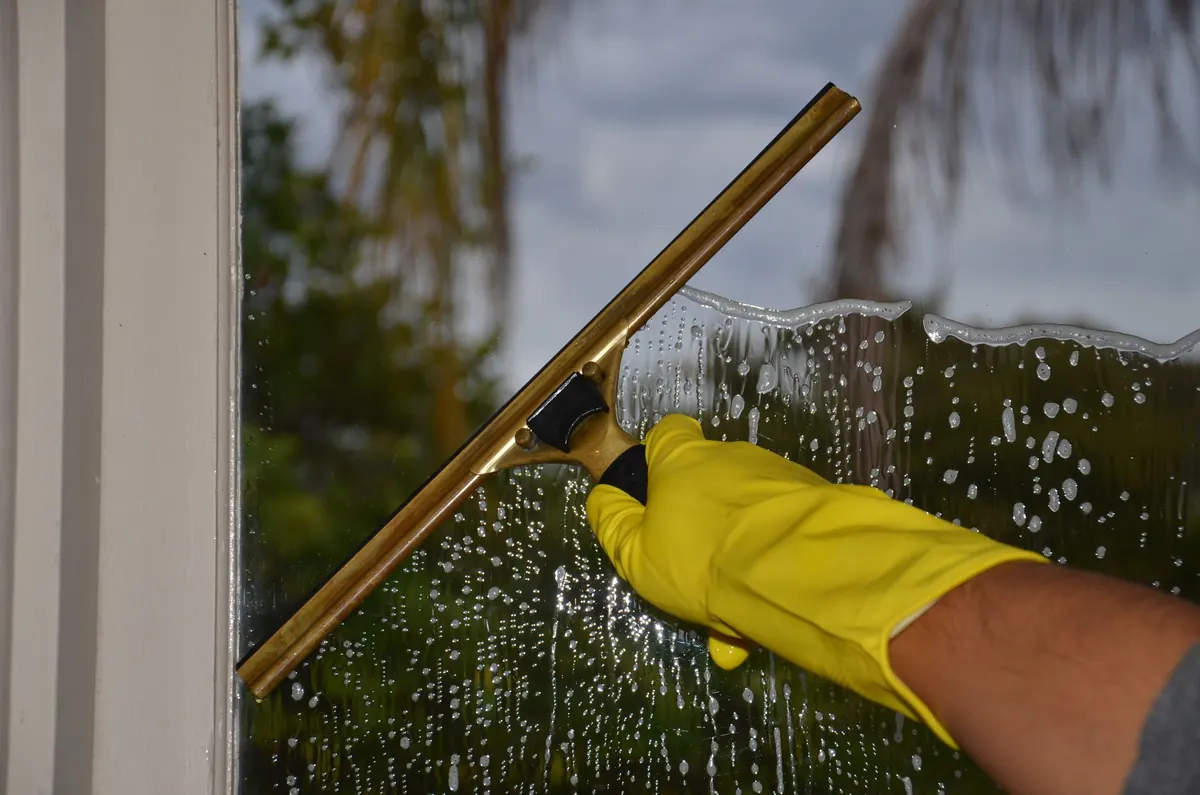
Squeegee work removes the bulk of the solution from the glass mechanically; the small bead the squeegee leaves behind is removed by the detail pass with a microfiber. The reason the detail pass is mandatory is that the solution itself — even a House-Standard distilled-water-and-Dawn mix — carries surfactant and trace dissolved solids that would dry to a visible film if left on the glass. The squeegee gets most of it. The detail cloth gets the rest. The finished pane is clean because nothing was left on the glass to dry.
Pure water cleaning is the same principle, achieved a different way. The water is brought to a TDS reading low enough that whatever is left on the glass dries to nothing visible — to a film thinner than the threshold of optical detection, which on residential glass under sun is roughly 10 parts per million dissolved solids. Below that threshold the water dries clean. The mechanical pass — the brushing at the head of the pole — agitates and lifts the contamination on the glass, and the flow of pure water rinses the dissolved and suspended residue away. There is no squeegee. There is no detail cloth. The finished pane is the wet pane after the rinse, and the wet pane dries to a clean dry pane on its own.
This is the part of pure-water cleaning that takes a working cleaner a year to fully internalize. The trade is built on the squeegee-and-detail sequence. The pure-water finish does not use either. The first time you walk away from a pole-cleaned pane that is still wet, and the homeowner asks if you forgot to dry it, you have to explain that the drying is what the chemistry does on its own. The second time you do not feel weird about it. The third time you have stopped explaining.
What "pure" actually means
The working specification for pure water in the window-cleaning trade is TDS at the pole below 10 parts per million, measured with a handheld electrical-conductivity meter that reads in ppm-equivalent.1 Below 10 ppm the water dries cleanly on uncoated residential glass. Below 5 ppm it dries cleanly on most coated and commercial substrates. Below 1 ppm is the professional standard for high-end commercial work where the finished pane is going to be inspected under directional light, and below 1 ppm is what the major trade suppliers (Tucker USA, Unger, IPC Eagle, Pure Water Window Cleaning Systems) calibrate their systems to deliver at the head of the brush.
For reference, the TDS of unfiltered municipal tap water in the United States typically falls between 50 and 500 ppm. Soft-water cities (the Seattle Cedar-River supply, which publishes 24–32 mg/L of hardness) run at the low end; Chicago's Lake Michigan supply, at a published 126–143 mg/L, sits in the middle. Hard-water cities (Phoenix, much of the Mountain West, much of the central plains, the limestone-karst suburbs Wade Marler covers in the Bluegrass and that Cal Hatcher covers in Middle Tennessee) run at the high end. Well water from karst-aquifer regions, like the central Texas hill-country supply that Jerry Davenport covers, can read 300 to 600 ppm and occasionally higher. The stack that gets any of these inlet conditions down to under 10 ppm at the pole is a three-stage filtration train, and each stage is doing a specific part of the job.
The stack
The standard pure-water system for residential and small-commercial work is three stages, in order: carbon filtration, reverse osmosis, deionization.
Stage 1: Carbon filtration
The first stage is a carbon-block or granular-activated-carbon cartridge that removes chlorine, chloramines, and dissolved organics from the inlet water. The reason this stage comes first is that the downstream reverse-osmosis membrane is sensitive to chlorine and to organic fouling — chlorine attacks the membrane chemistry directly, and dissolved organics coat the membrane surface and reduce its working life. The carbon stage is the cheap stage and the expendable stage; the cartridge runs roughly $15 to $40 depending on flow rating and is replaced every three to six months under typical residential-route use.
The carbon stage does not by itself reduce TDS in any meaningful way. The job of this stage is to protect the membrane downstream. Skipping it is the most common new-operator mistake and the one that turns a $400 RO membrane into a $400 mistake within the first season.
Stage 2: Reverse osmosis
The second stage is the reverse-osmosis membrane — a thin-film composite polyamide sheet wound into a cartridge that passes water under pressure across the membrane and rejects the bulk of the dissolved solids.2 A working RO membrane for window-cleaning use rejects 95 to 98 percent of inlet TDS, depending on inlet pressure, water temperature, and the chemical composition of the source water. A 50-gallons-per-day membrane running on a 50-psi residential supply at room temperature is the residential-route standard; a 100-gpd membrane is the standard for a small-commercial operator running two crews.
The RO stage produces two output streams: a permeate stream (the low-TDS water that goes on to the next stage) and a concentrate stream (the high-TDS reject water that carries away the rejected solids). The concentrate-to-permeate ratio is typically 3:1 or 4:1, which means a system producing 50 gallons of usable water per day is putting 150 to 200 gallons of reject water down the drain. This is the operating cost on the water-supply side, and on a high-volume route it is worth understanding the local water-and-sewer rate before assuming the RO stage is free water.
Stage 3: Deionization
The third stage is the mixed-bed deionization resin — a cartridge of paired cation and anion exchange resins that polishes the post-RO water down to the working TDS at the pole.3 The post-RO water still carries 2 to 5 percent of the inlet TDS load; the DI stage takes that residual fraction from a few ppm down to under 1 ppm.
The DI resin is the expensive consumable in the system. A residential-grade DI cartridge runs $80 to $200 depending on capacity; a commercial-grade tank runs $300 to $600. The cartridge or tank lasts anywhere from a few weeks to several months depending on the post-RO TDS load and the volume of water put through the system. Tracking the post-DI TDS with the handheld meter is how you know when the resin is exhausted and needs to be regenerated or replaced.
The brush-and-flow technique that runs on top of this stack is documented in the Technique Library — the water-fed-pole approach, the top-down rinse pattern, and the squeegee-finish techniques referenced below. The stack delivers the water; the technique converts the water into a clean pane.
Tank, cart, and trolley systems
The three stages of the stack can be packaged in several different physical configurations. The configuration that fits the route determines the operating workflow and the price.
Cart-mounted residential systems. A wheeled cart that holds the carbon, RO, and DI stages plus a pump and a hose reel, designed to be rolled out of the back of a van and connected to a residential spigot. The cart-mounted residential rig from the major manufacturers (Tucker, Unger, Streamline, Reach-iT) runs $1,800 to $4,000 depending on flow rate and tank size. This is the right configuration for a residential operator running solo or with one helper and working from a Transit-class cargo van or a similar route truck.
Tank-based commercial systems. A large external tank (often 200 to 500 gallons) holds pre-treated water, and a smaller cart holds the DI polish stage. The tank is filled at the shop in the morning using a stationary RO system; the cart taps the tank for the day's route. This configuration is the right answer for a higher-volume commercial operator who cannot afford the time-loss of producing water on-site at every customer's house. The tank-based commercial system runs $4,000 to $12,000 with the stationary RO; the tank itself is typically van-mounted or on a small trailer.
Trolley-cart systems. A compromise between the two — a smaller wheeled trolley that contains all three stages but draws from a pre-filled tank on the van rather than a customer's spigot. This is the configuration most working operators settle into after two or three years on the rig, because it combines the speed of a tank-based commercial system with the flexibility of a cart-mounted residential system.
The pole
The water-fed pole is the working tool at the end of the stack. It is a telescoping carbon-fiber or composite pole, typically 20 to 45 feet of working reach, with a brush head at the top and a water-feed line running internally to a flow valve at the brush. The pole reaches glass that would otherwise require a ladder and a safety protocol, and it reaches it from the ground.
The technique is mechanical at the brush and rinse-driven at the flow. The brush bristles agitate the contamination on the glass with light scrubbing — typically a flat-headed brush bristled with nylon or boar bristle — and the water flows continuously through the brush at 2 to 4 gallons per minute, rinsing the agitated contamination off the glass and down to the bottom of the pane. The final rinse is a top-down sweep with the flow on and the brush off the glass, which leaves the pane wet with pure water that dries clean.
The technique looks deceptively simple. The detail it depends on — even brush pressure, vertical bristle orientation, top-down rinse pattern — takes a season to internalize, the same way the fan stroke takes a season to internalize on the squeegee side. A new operator running a pole on the first week will leave streaks the customer can see; the same operator running the pole in week twelve will not. The learning curve is real, and underestimating it is the second most common new-operator mistake after skipping the carbon stage.
Before any of the equipment math matters, the question is what the local water is delivering at the spigot — because the harder the inlet, the harder every stage of the stack works, and the faster the resin runs out. The Hard Water Scorer takes the local TDS and hardness reading and returns a severity tier; the TDS-metering and regeneration section below is what that severity translates into operationally.
TDS metering and resin regeneration
The handheld TDS meter is the non-negotiable diagnostic tool for any operator running pure water. Reading the inlet at the spigot, the post-RO at the membrane outlet, and the post-DI at the pole tells the operator what each stage is doing and when each stage needs maintenance.
The working thresholds:
Inlet TDS is whatever the local water supply is delivering — typically 50 to 500 ppm. This is the diagnostic reading that tells you how hard the downstream stages are working. A high-TDS inlet means faster resin exhaustion and faster membrane fouling.
Post-RO TDS should run at 2 to 10 ppm for a working membrane and typical inlet conditions. A post-RO reading above 15 ppm is the signal that the membrane is fouling and needs to be replaced or, on better systems, cleaned with the manufacturer's recommended membrane-cleaning protocol.
Post-DI TDS at the pole should run below 10 ppm for general residential work and below 1 ppm for high-end commercial. A post-DI reading climbing above 10 ppm is the signal that the resin is exhausted and needs to be regenerated or replaced.
The three readings above — inlet, post-RO, post-DI — are the diagnostic triplet that tells the operator which component of the stack has failed when the pole reading starts to climb. The Pure-Water TDS Diagnostic takes those three readings (plus an operating-hours-on-resin input and the inlet hardness from the Hard Water Scorer if you have it) and returns a verdict naming the failing component: RO membrane fouled, DI resin exhausted, both stages compromised, or — the case operators often miss — a silica-loaded inlet where the meter reads low but the visible deposit on glass tells you the resin is leaking silica that the conductivity meter is under-counting. The diagnostic is the difference between replacing the wrong cartridge and replacing the right one.
Regeneration is the chemical recharge process that restores the resin's ion-exchange capacity.4 For most independent operators the regeneration service offered by the trade-supply distributors is the right answer rather than on-site regeneration, which requires hazardous-materials handling that most cleaning shops are not set up for. The regeneration cycle typically costs 30 to 50 percent of new-resin pricing, which is the economic justification for the regeneration-versus-replacement decision over a multi-year operating window.
The operating economics
The break-even math on a pure-water rig is mostly about labor, not consumables. The water itself is essentially free; the carbon and DI consumables run a few hundred dollars per year on a typical residential route; the membrane runs once every two to three years at $300 to $500 per replacement. None of these are the dominant cost.
The dominant cost is the labor that the pole saves on second-story work. A traditional squeegee-and-ladder approach to a two-story residential house takes a working cleaner roughly 60 to 90 minutes for the exterior pass, depending on pane count, with the ladder setup and breakdown alone accounting for 15 to 20 minutes. The same house with a water-fed pole runs 25 to 45 minutes for the exterior pass, with no ladder setup, no second-story safety protocol, and no descending-the-ladder fatigue between elevations. On a residential route doing twenty to forty two-story houses a month, the time savings amortizes the rig within eight to fourteen months for most independent operators.
The longer-side economic case is on the safety side. A working cleaner doing daily ladder work on second-story residential is running a non-trivial annual injury risk; the pole removes the exposure entirely. The insurance side of this calculation is rarely discussed in the trade literature but is meaningful for any operator carrying general-liability coverage that prices ladder work at a premium.
Whether the pure-water investment actually pays back depends on the specific region: inlet hardness, second-story housing-stock density, route economics, and the local protocol calibrations that the rest of this site covers. The Regional Protocol Generator is the per-region synthesis that takes those inputs and returns the operating protocol for a given region, including whether the pure-water rig is the right tool for the route or whether a traditional squeegee approach is still the better economic call.
What pure water will not do
Pure water cleaning is the right answer for a substantial fraction of residential and small-commercial work, but it is not the universal answer.
Historic glass. The brush-and-flow technique applies mechanical pressure to the glass surface, which is not appropriate for cylinder, crown, or other pre-1925 glass with surface irregularities the brush will catch on. The squeegee-and-soft-cloth approach is the right answer for historic stock.
Heavily-coated commercial substrates without verification. Some commercial low-E and solar-control coatings are exterior-surface coatings, and the brush mechanics of the pole can damage them over many cleaning cycles. The first job on any new commercial account with coated glass should be a substrate identification before the pole comes out.
Squeegee-finish appearance accounts. A small but real fraction of high-end commercial accounts (luxury retail, gallery installations, certain office-park property managers) want the visual signature of a squeegee-finished pane — the slight bead pattern at the edge that the squeegee-and-detail approach produces and that the wet-rinse approach does not. The right answer on those accounts is to leave the pole on the truck and run the squeegee.
The trade has not converged on pure water as a universal replacement for the squeegee, and it will not. Each approach has its right use. Knowing which one is in front of you, before the first pane, is the working-cleaner discipline that the equipment evolution of the last two decades has actually required.
Sources
- Tucker USA, RO/DI System Specification and Operating Reference, technical bulletin TUS-2024-WFP.
- Unger Global Inc., HydroPower DI Cleaning System Manual, 2023.
- Pure Water Window Cleaning Systems, Resin Capacity and TDS Operating Reference, 4th edition.
- American Water Works Association, Water Treatment Membrane Technologies: Principles and Practice, 2023.
- U.S. Environmental Protection Agency, Drinking Water Treatability Database — EPA's own reference on drinking-water treatment processes and what each removes, reverse osmosis among them
- Window Cleaning Resource Association, WFP Operating Economics Study: Residential and Small-Commercial, 2024.
Footnotes
-
The total-dissolved-solids reading on a handheld TDS meter is technically an electrical-conductivity measurement converted to a ppm equivalent using an assumed conversion factor (typically 0.65 to 0.70). The reading is not a perfect proxy for what is actually dissolved in the water — different ions contribute differently to conductivity, and silica is notably under-counted because it does not ionize in solution. For ordinary tap water the meter is accurate enough; for water from a well with unusual silica content, the meter can read well under 10 ppm while still leaving a visible deposit on the glass after drying. The right answer in that case is a silica-specific resin in the DI stage, which the major trade suppliers will spec on request. ↩
-
The reverse-osmosis membrane in a working window-cleaning rig is essentially a thin-film composite polyamide membrane similar to the membranes used in residential drinking-water systems and in desalination plants. The membrane is rated by gallons-per-day throughput at a specified pressure and temperature, and by the percentage of dissolved solids it rejects at those conditions. A working WFP rig membrane typically rejects 95 to 98 percent of inlet TDS, which means the post-RO water still carries 2 to 5 percent of the inlet load — and which is exactly why the deionization stage downstream is essential. RO alone is not pure water; RO plus DI is. ↩
-
The DI resin in a pure-water rig is a mixed-bed of cation and anion exchange resins that exchanges the remaining dissolved ions in the post-RO water for hydrogen and hydroxide ions, which then combine into water itself. The resin has a finite capacity — typically rated in grain-equivalents — and the capacity depends on the TDS load coming into it. Higher post-RO TDS exhausts the resin faster. A working operator running a route from a moderate-TDS municipal supply through a properly-sized RO stage can expect a DI cartridge to last several months before the post-DI TDS climbs above the working threshold and the resin needs to be regenerated or replaced. ↩
-
Resin regeneration is the chemical-recharge process that restores the ion-exchange capacity of spent DI resin. The cation resin is regenerated with hydrochloric or sulfuric acid; the anion resin is regenerated with sodium hydroxide. The regeneration is performed off-site by a trade-supply service company, with the regenerated resin returned in exchange for the spent resin. For most independent operators the regeneration service is the right answer rather than on-site regeneration, which requires hazardous-materials handling and waste-stream management most cleaning shops are not set up for. The regeneration cycle typically costs 30 to 50 percent of new-resin pricing, which is the economic justification for the regeneration-versus-replacement decision over a multi-year operating window. ↩
Jan Davenport
Editorial team contributor covering the Midwest and Great Lakes beat. Articles bylined by Jan are researched and reviewed in collaboration with the Giordano Inc. editorial team and informed by interviews with practicing window-washing operators in the region, plus published trade and small-business operations references.