The House Standard: surfactants in window cleaning, the recipe that organizes this site, and why the smallest amount that wets the glass is the right amount
The reference recipe used as the default across the Solution Calculator and cited in roughly half the articles on this site. What it is — distilled water and three drops of Dawn — what it does at the molecular level, why dilute is the right answer rather than concentrated, why this particular surfactant rather than another, and what the four documented working variants (the summer heat-load variant, the Cold-Weather Mix, the Vinegar Cut, the route-grade Pro Concentrate) actually change. The complete reference for the chemistry the trade is organized around.
PUB. MAY 12, 2026
The House Standard is distilled water and three drops of Dawn per gallon. That is the entire recipe. The point is not the ratio. The points behind the ratio:
- Surfactant is a wetting agent, not a cleaning agent. The job of the surfactant in a window-cleaning solution is to reduce the surface tension of the applied film so it spreads uniformly across the glass and lifts soil into suspension. It is not the job of the surfactant to dissolve soil chemically. That distinction is the foundational principle of dilute-surfactant cleaning, and almost every working failure of a glass-cleaning protocol begins with confusing the two.
- The smallest amount that wets the glass is the right amount. Adding more surfactant does not produce cleaner glass; it produces residue. The surface tension of the working film is reduced by the first meaningful surfactant addition (roughly 50–100 ppm by weight), and additional surfactant past that threshold contributes nothing to the wetting and adds a measurable residue load that the rinse has to clear.
- Dawn works because it is reliably formulated and because the bottle is consistent. The specific surfactant blend in liquid Dawn is alkyl sulfate plus alkyl ether sulfate plus an amine-oxide stabilizer, with a pH near neutral and a dilution-tolerant formulation that performs predictably across the wide range of working concentrations the trade uses. There are other surfactants that work; there are very few that work as predictably.
- The variants that matter are calibration changes, not chemistry changes. Jerry Davenport's Texas summer variant raises the surfactant load to keep the film alive against flash evaporation. Linnea Jorgensen's Cold-Weather Mix adds isopropyl alcohol for freezing-point depression. The Vinegar Cut and Pro Concentrate documented in the Solution Calculator are workflow variants, not new recipes. The House Standard is the same recipe across all of them; what changes is the operating envelope, not the chemistry principle.
The recipe is the cheapest part of the trade. Distilled water costs about $1 a gallon and a bottle of Dawn cleans roughly 500 gallons of working solution before it runs out. The expensive part of the trade is everything else — the technique, the substrate-identification discipline, the route economics, the seasonal scheduling. The House Standard recipe stays out of the way so the rest of the work can be done well, and that is exactly what it is supposed to do.
The recipe printed at the top of the Solution Calculator is the recipe I have been working from since 2014, and it is the recipe I argued for during the original Solution Calculator build in 2019 when our engineering team asked me what the default preset should be. The recipe is one cup of distilled water with one drop of Dawn surfactant, scaled linearly to whatever volume the working day requires — at a working bucket the standard mix is three drops of Dawn per gallon of distilled water. That is the entire recipe. There are four documented working variants of it on this site, each of which is a calibration change rather than a chemistry change, and each of which is appropriate for a specific operating context. The variants are real and they matter. But the recipe itself is what it is, and the point of this piece is to explain why the recipe is what it is — and why the right amount of surfactant in a window-cleaning solution is the smallest amount that wets the glass.
I have had a productive twelve-year argument with our science editor, Easton Giordano, about the role of acetic acid in residential glass care, and the vinegar piece is where most of that argument lives. The argument is foundational to what this site publishes about chemistry. The argument over whether to add vinegar to the House Standard is, however, not actually an argument about the House Standard — it is an argument about whether the working cleaner needs an acid pass at all, and the answer is sometimes yes and most of the time no. The House Standard itself is the unmodified water-plus-surfactant working solution, and the point of this piece is what the water-plus-surfactant part of the working solution is actually doing.
What surfactants do
The working starting point for understanding any window-cleaning solution is what the surfactant in the solution is actually doing on the glass.
The surfactant is not the cleaning agent. This is the single most important sentence in this piece. Most homeowners, and a meaningful fraction of working cleaners, believe that the surfactant in a window-cleaning solution is the part that does the cleaning — that the soap dissolves the dirt and lifts it off the glass. This is wrong. The surfactant is the wetting agent. Its job is to lower the surface tension of the water so the water itself can spread across the glass in a continuous film and lift the soil into suspension mechanically.[^1] The water is the cleaning agent. The surfactant is the part that lets the water do its job.
Pure water — distilled, deionized, or condensed — has a surface tension of about 72 millinewtons per meter at room temperature, which is high enough that water dropped on a clean glass surface forms discrete beads rather than a continuous film. The cohesive forces between water molecules at the air-water interface are stronger than the adhesive forces between water and glass at most realistic angles, and the result is that pure water on glass beads up and rolls off rather than spreading and lifting. This is a problem for cleaning. The water cannot lift soil from the glass surface if the water itself does not stay in contact with the glass.
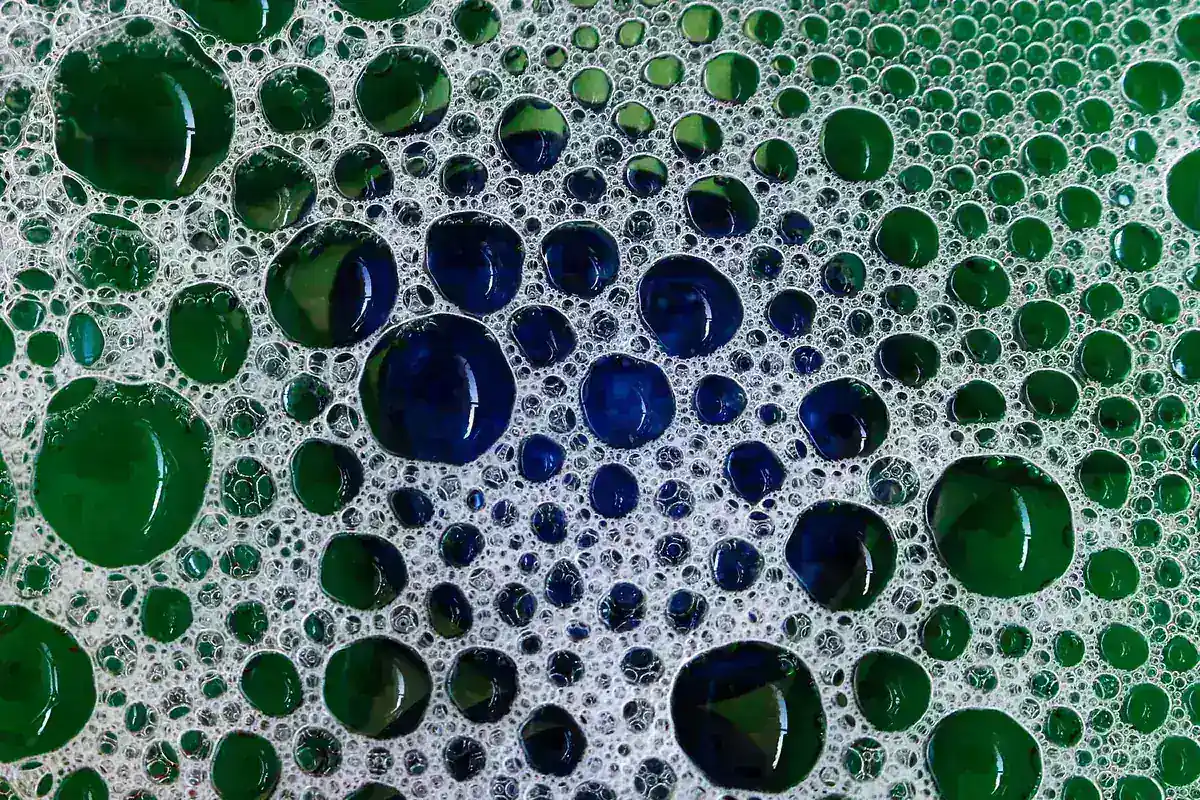
A surfactant — short for surface-active agent — is an amphiphilic molecule, meaning one end is hydrophilic (water-attracting) and the other end is hydrophobic (water-repelling). When added to water, surfactant molecules migrate to interfaces, where they orient with their hydrophilic ends in the water and their hydrophobic ends pointing into the air (or into oil, or into any non-aqueous phase the water is in contact with). The presence of surfactant molecules at the air-water interface disrupts the cohesive forces between water molecules at that interface, which lowers the surface tension substantially. A dilute surfactant solution at 50 to 100 parts per million typically reduces the surface tension of water from 72 mN/m to 30–35 mN/m — well below the threshold for continuous-film formation on glass.
That is the surfactant's job: lower the surface tension so the water film stays on the glass. Once the film is on the glass, the water lifts soil into suspension through standard solution chemistry — soluble minerals dissolve, organic particulates suspend in the water column, and the mechanical action of the squeegee or detail cloth removes the loaded film from the surface. The water is doing the work. The surfactant is the part that lets the water be where it needs to be.
Why dilute
The corollary to the surfactant-is-a-wetting-agent point is that the right amount of surfactant in a working solution is the smallest amount that produces continuous film formation on the glass.
The surface tension reduction curve for any working surfactant is steeply non-linear. The first 50 to 100 ppm of surfactant addition to water produces dramatic surface-tension reduction (72 → 35 mN/m). The next 500 ppm of surfactant addition produces a modest further reduction (35 → 30 mN/m, approximately). The additional surfactant past the critical micelle concentration[^3] produces essentially no further surface-tension reduction; instead, the additional surfactant molecules form bulk-phase micelles in the water column and contribute residue rather than wetting performance.
The practical consequence of the non-linear curve is that adding more surfactant to a working solution does not produce cleaner glass; it produces residue. The first meaningful surfactant addition (a few drops of Dawn per gallon) wets the glass. Subsequent additions add nothing to the wetting performance and add a measurable residue load that the rinse has to clear. Operators who use the "more is more" approach to surfactant — a tablespoon of Dawn per gallon instead of three drops — produce solutions that wet the glass no better than the dilute version and that leave a measurable surfactant residue after drying. The residue is visible as a faint film under directional light, and the streak-diagnostic workflow identifies it as a routine cause of streaking on cleanings that the operator believes were done correctly.
The House Standard's three-drops-per-gallon ratio corresponds to roughly 0.04 percent surfactant by weight in the working solution, which is comfortably below the CMC of the Dawn surfactant blend (approximately 0.10 to 0.15 percent for the SLS-SLES-amine-oxide mixture). The summer variant Jerry Davenport runs in Texas — five drops per gallon — is approximately 0.07 percent surfactant by weight, which is still below the CMC. The point at which the working concentration crosses the CMC and starts producing measurable residue is approximately ten drops per gallon, which is more surfactant than any working protocol on this site uses or recommends. The protocols on this site are all designed to operate below the CMC by a comfortable margin.
Every variant referenced in the four-variants section below — the Vinegar Cut, the Cold-Weather Mix, the summer heat-load adjustment, and the Pro Concentrate scaling — is a named preset in the Solution Calculator, scaled to a spray bottle, a 1-gallon residential bucket, or a 5-gallon route-grade bucket. The calculator's purpose is exactly the math this section describes: keeping the surfactant fraction below the CMC while delivering the right operating envelope for the specific job. The Pro Concentrate preset in particular is the one that catches the linear-scaling mistakes the section above warns about.
Why Dawn specifically
There is nothing magical about Dawn. There are other surfactants that work for window cleaning, and there are surfactant suppliers (notably the trade-supply houses Unger and Tucker) that sell professional-grade window-cleaning surfactants formulated specifically for the trade. The reason I specify Dawn in the House Standard, and the reason most working cleaners I know use Dawn, is not that it is the best surfactant for window cleaning. It is that it is the most reliable surfactant for window cleaning that is available consistently across every retail outlet in the United States and that has had a stable formulation for forty years.
The Dawn surfactant blend is sodium lauryl sulfate plus sodium laureth sulfate (the workhorse anionic-surfactant fraction), with a smaller fraction of lauramine oxide (an amphoteric stabilizer that contributes foam stability and improves wetting performance on greasy substrates), and a sodium chloride viscosity adjuster.[^2] The pH is approximately neutral, which matters more than the surfactant industry sometimes admits — many of the alternative dish detergents available retail (some Palmolive formulations, most commercial-grade kitchen-degreaser products) are alkaline, and the alkaline pH causes problems on aluminum and softer wood-frame substrates that the frame substrates piece documents. Dawn's neutral pH is appropriate for the wide range of substrates a working window-cleaning route encounters in a given day. The neutral pH is also what makes Dawn appropriate as a working solution for substrate-uncertain situations — if you are working a frame whose substrate identification is incomplete, a neutral-pH dilute surfactant is the safest first move.
The trade-supply alternatives — Unger's Stingray solution concentrate, Tucker's High-Reach concentrate, Pure Water Window Cleaning Systems' wash concentrate — work, and some of them are formulated specifically to address operating conditions Dawn was not designed for (extended dwell time on commercial glass, high-temperature applicator-pad use, hard-water-resistant chemistry for the rinse-side). For high-volume commercial operators these professional-grade alternatives can be the right answer. For job-by-job residential work, and for the great majority of working operators, Dawn is the right answer. It is the cheapest of the options, the most consistent across batches, and the surfactant whose performance characteristics are documented in the broadest range of working conditions.
The water side
The other half of the House Standard is the water. The recipe specifies distilled water, and there is a reason for that specification.[^4]
A working window-cleaning solution that uses tap water inherits whatever is dissolved in the tap water. In Chicago — where I do my own work — the municipal supply publishes 174–180 mg/L total dissolved solids, of which the dominant fractions are calcium and bicarbonate from the Lake Michigan source. In Texas hill-country well-water households the inlet can run 400 to 600 mg/L. In Phoenix the municipal supply publishes 560–686 mg/L. None of these dissolved-solids loads are removed by the surfactant in the working solution; the surfactant lowers the surface tension, but it does not extract dissolved minerals from the water. The dissolved solids stay in the working film, the squeegee removes most of them with the bulk of the film, and the remainder dries on the glass as a residue. The residue is a hard-water film whose composition mirrors the composition of the municipal supply.
Distilled water — water that has been vaporized and recondensed — carries effectively zero dissolved solids and, when used as the carrier for the working solution, contributes nothing to the residue on the glass. The only residue from a House Standard solution that uses distilled water is the trace surfactant film, which is well below the visible-detection threshold at three-drops-per-gallon dilution. The combination of distilled water and below-CMC surfactant produces the cleanest possible working solution from a residue standpoint, which is exactly what the recipe is supposed to do.
The cost of distilled water at retail is approximately $1.00 per gallon, which on a working bucket basis is about $0.25 per gallon of working solution. A residential cleaner running a typical route uses 30 to 50 gallons of working solution per week and spends roughly $7 to $12 per week on distilled water. This is a real but small operating cost, and it is the cost that produces the clean-finish result that the working protocol is designed to deliver. Operators who try to save the $10 per week by running tap water through the House Standard recipe produce a measurably worse finish on the glass, and the saving is illusory.
The pure-water alternative — the carbon/RO/DI stack documented in the pure water piece — produces water with a lower dissolved-solids load than distilled water (typically below 5 ppm at the pole) and is the right answer for high-volume commercial operators where the per-gallon cost of distilled water becomes material at scale. For job-by-job residential work, distilled water from the grocery store remains the right answer. The chemistry of the working solution is the same in both cases; only the source of the water changes.
The recipe is the chemistry side of the wash. The motion that converts the recipe into a clean pane lives in the Technique Library — the sleeve application that lays the working film down in Chapter 04, the squeegee strokes that clear the loaded film in Chapter 01, the channel-wipe that keeps the rubber loaded with fresh solution between strokes in Chapter 05, and the detail-pass in Chapter 02 that lifts the perimeter bead. The House Standard recipe is calibrated for that sequence specifically — the surfactant load is set for the sleeve-and-squeegee motion, not for spray-and-walk-away. Anyone running the recipe through a different mechanical sequence will produce a different finish than the chemistry section above predicts.
The four variants
The House Standard recipe has four documented working variants on this site, each of which is a calibration change for a specific operating context. Each variant is appropriate for its context and inappropriate for the others. The variants are documented in the Solution Calculator as presets that the working operator can select for the specific job in front of them.
Variant one: the Vinegar Cut. One cup of distilled white vinegar, two drops of Dawn, fifteen cups of distilled water. The vinegar in this variant is a mild acid additive that addresses hard-water mineral residue on the glass — calcium carbonate, magnesium bicarbonate, and other alkaline-side residues that the routine wash will not lift. This variant is a maintenance pass for accounts where the previous cleaning interval was too long and mineral residue has accumulated, and it is the right answer for that specific condition. It is the wrong answer for routine residential cleaning, where the vinegar contributes nothing to the wetting performance and produces a faint sharp odor that customers sometimes object to. The full discussion of when to run the vinegar variant and when not to lives in the vinegar piece.
Variant two: the Cold-Weather Mix. One cup of 70 percent isopropyl alcohol, two drops of Dawn, fourteen cups of distilled water. Linnea Jorgensen's Cold-Weather Mix adds isopropyl alcohol as a freezing-point depressant for sub-freezing exterior work. The alcohol fraction lowers the freezing point of the working solution from 32°F to approximately 28°F, which extends the working envelope of the solution down to roughly 20°F glass-surface temperature. This is a calibration change for cold-weather operating conditions and is appropriate only for those conditions; running the Cold-Weather Mix at room temperature contributes nothing useful and adds a measurable alcohol-evaporation streak that the rinse has to clear.
Variant three: the summer heat-load variant. Five drops of Dawn per gallon of distilled water, pre-cooled in a chest cooler. Jerry Davenport's summer variant for the Texas heat-load operating envelope raises the surfactant load to keep the working film alive against flash evaporation on 130°F glass. The five-drops-per-gallon ratio is still well below the CMC, and the higher surfactant load extends the working life of the film against flash evaporation by a meaningful margin. This is a calibration change for high-heat operating conditions and is appropriate only for those conditions.
Variant four: the Pro Concentrate. A working bucket of the standard House Standard plus a route-grade volume scaling adjustment for the working day. The Pro Concentrate is not a different chemistry — it is the same recipe scaled to a route-grade working bucket (typically 5 gallons rather than the 1-gallon residential mix) with the same three-drops-per-gallon ratio applied at scale. The preset exists in the Solution Calculator because the linear-scaling math is what working operators most often get wrong, and the preset prevents the common mistake of either under-dosing (one tablespoon of Dawn in a 5-gallon bucket, which is too little) or over-dosing (a quarter cup of Dawn in a 5-gallon bucket, which is too much by an order of magnitude).
The variants are real and they matter for their specific operating contexts. The House Standard itself, however, is unchanged across all of them — it is distilled water and a below-CMC surfactant fraction, and what changes from variant to variant is the operating envelope rather than the underlying chemistry principle. The point of having a canonical recipe is that the working operator can adjust the variant to the operating condition without having to re-derive the chemistry from first principles every time. The recipe stays out of the way; the operator focuses on the technique, the substrate identification, and the customer.
What the recipe is not
The House Standard is not a cleaning agent for severe contamination. It is not the right solution for sap, tar, bug residue, or other organic contamination that the solvent ladder addresses. It is not the right solution for hard-water etching or built-up mineral residue, which the hard-water ranking piece covers in detail. It is not the right solution for ice-dam meltwater residue, which the percarbonate-citric ladder addresses. It is not the right solution for coated commercial substrate cleaning where the manufacturer specifies a particular wash chemistry, which the glass types piece covers.
What the House Standard is is the working solution for routine residential and small-commercial glass cleaning in conditions that have not exceeded the operating envelope it is designed for. It is the default that the rest of the protocols on this site work outward from. It is what comes out of the working bucket on a typical Tuesday morning in Chicago, or Austin, or Saint Paul. The variants exist for the working contexts that require them. The recipe is the floor below the variants, and the floor holds.
How the recipe fits the four stages
The four stages of the routine wash — application, agitation, removal, and detail — that the how-to-wash piece documents are the technique side of the working protocol, and the House Standard is the chemistry that those four stages are designed to operate on. The application stage uses the wetting performance of the dilute-surfactant solution to spread a continuous film across the glass. The agitation stage uses the soil-suspension behavior of the loaded solution to lift contamination into the working film. The removal stage uses the squeegee to clear the loaded film mechanically. The detail stage uses a microfiber to clear the residual bead the squeegee leaves behind. The four stages and the recipe are paired; modifying either one without understanding what the other is doing produces working failures the operator cannot diagnose.
This is the part of the trade that is most often misunderstood by operators who learned from internet video tutorials rather than from working apprenticeship. The video tutorial tradition tends to focus on the squeegee technique — the wrist motion, the stroke angle, the rubber pressure — and to treat the working solution as a generic input. The working trade tradition treats the chemistry as foundational and the technique as a consequence of the chemistry. The four stages exist because the chemistry of a dilute-surfactant solution behaves the way it does. A different recipe would require a different sequence. The House Standard is what makes the four stages work the way they work.
The ammonia question
A note on what the House Standard does not include and why. The recipe specifies distilled water and Dawn. It does not specify ammonia. The ammonia piece covers in detail why ammonia is a substrate-specific additive rather than a routine ingredient — it is appropriate for some interior commercial work and some specific cut-glass restoration cases, and it is inappropriate for the routine residential and exterior work that the House Standard is designed for. Ammonia in a routine working bucket is a chemistry mistake. The cleaning industry's long-standing love affair with ammoniated glass cleaners (Windex and its retail descendants) is a marketing artifact rather than a chemistry recommendation. The working trade has known this since at least the 1980s. The fact that the consumer-facing literature has not caught up is one of the reasons this site exists.
That is what a canonical reference recipe is supposed to do. Twelve years in the trade, three of the ten tallest buildings in North America cleaned with this recipe at the working bucket, and approximately two hundred articles' worth of editing across this site have not produced a working condition for which the underlying chemistry of the House Standard recipe needed to change. The variants change. The recipe does not. The chemistry, when the variables are honored, performs reliably.
That is the entire point.
Notes
- Surface tension is the energy per unit area of the interface between a liquid and the air (or another phase) above it, expressed in millinewtons per meter. The surface tension of pure water at room temperature is approximately 72 mN/m, which is high enough that water on a clean glass surface forms discrete droplets rather than a continuous film — the cohesive forces between water molecules at the surface exceed the adhesive forces between water and glass at most realistic contact angles. The addition of a surfactant disrupts the cohesive interactions at the air interface by inserting amphiphilic molecules (one end hydrophilic, the other hydrophobic) that prefer to sit at the interface and reduce the effective surface energy. Even a dilute surfactant solution — 50 to 100 parts per million by weight of an effective surfactant — typically reduces the surface tension of water to roughly 30 to 35 mN/m, which is well below the threshold for continuous-film formation on glass. Additional surfactant past this concentration produces diminishing returns on surface tension reduction (the air-interface population saturates at the critical micelle concentration, beyond which additional surfactant molecules form bulk-phase micelles rather than adding to the interfacial population) and produces measurable residue loading on the cleaned surface after rinse.
- Liquid Dawn — the original-blue dishwashing formulation, not the various derivative products Procter & Gamble has marketed under the Dawn brand — has a surfactant blend that has been documented by the manufacturer and by independent analytical laboratories over the four decades the product has been on the market. The active surfactant fractions are sodium lauryl sulfate and sodium laureth sulfate (anionic surfactants, the workhorse fraction), with smaller fractions of lauramine oxide (an amphoteric surfactant that contributes foam stability and wetting performance) and a sodium chloride viscosity adjuster. The pH is approximately neutral (7.0 ± 0.5), which is the property that distinguishes Dawn from many of its competitors and that makes it appropriate for use on the wide range of substrates a working window-cleaning route encounters. Alkaline dish detergents (some Palmolive formulations, most commercial-grade kitchen-degreaser products) work as surfactants but introduce a pH issue on aluminum and softer wood-frame substrates that the frame substrates piece documents.
- The critical micelle concentration (CMC) of a surfactant solution is the concentration above which additional surfactant molecules form bulk-phase micelles rather than adding to the air-interface population. For sodium lauryl sulfate in water at room temperature the CMC is approximately 8 millimolar, or roughly 0.23 percent by weight, which corresponds to about 8.7 ml of pure SLS per liter of solution. For Dawn — which contains an SLS-and-SLES mixture plus the lauramine oxide stabilizer — the effective CMC is somewhat lower, in the range of 0.10 to 0.15 percent by weight of the working dish detergent. For working window-cleaning purposes, the relevant observation is that three drops of Dawn per gallon of water (the House Standard) is approximately 0.04 percent by weight, which is well below the CMC and which produces effective surface-tension reduction without contributing micelle-phase residue. The summer variant Jerry Davenport runs in Texas (five drops per gallon, roughly 0.07 percent) is still below the CMC. The point at which the working concentration crosses the CMC and starts producing measurable residue is approximately ten drops per gallon, which is more surfactant than any working protocol on this site uses or recommends.
- Distilled water is the right water for the House Standard recipe because the dissolved-solids content is below the detection threshold of practical metering. Filtered tap water and softened tap water both carry some dissolved-solids load that contributes to the residue produced by the working solution — softened water carries elevated sodium chloride, and filtered tap water carries whatever fraction of the municipal load the filtration train did not remove. The cost differential between distilled water and tap water on a per-gallon basis is real but is not large in the context of the overall route economics. A working operator running 500 gallons of solution per season spends roughly $500 on distilled water at retail and produces a measurably cleaner finish than the same operator running on filtered tap. The pure-water alternative (see the pure water piece) is an equipment investment that produces water with a lower dissolved-solids load than distilled water — typically below 5 ppm at the pole — and is the right answer for high-volume operators. For job-by-job residential work, distilled water from the grocery store remains the right answer for the House Standard.
Sources
- Procter & Gamble, Dawn Ultra Original Dishwashing Liquid: Technical Data Sheet and Surfactant Composition, 2023.
- American Cleaning Institute, The Chemistry of Cleaning — the surfactant mechanism in plain terms: a hydrophobic hydrocarbon tail that holds oil and grease, a hydrophilic head that holds water, and between them the reason water wets a surface it would otherwise bead on
- Rosen, Milton J., and Joy T. Kunjappu, Surfactants and Interfacial Phenomena, 4th edition, Wiley, 2012 — anionic surfactant chemistry and the critical micelle concentration framework underlying the dilute-recipe principle.
- The Soap and Detergent Association, Soaps and Detergents, 2nd edition — why detergent surfactants displaced soap in hard water: soap reacts with hardness minerals to form an insoluble curd, while most detergent surfactants are far less sensitive to them and will not form that film
- U.S. Environmental Protection Agency, Safer Choice Standard and Criteria — EPA’s ingredient criteria for cleaning products, including surfactants
- Cardinal Glass Industries, Technical Service Bulletin CG06: LoĒ-i89® Coated Glass — the manufacturer's own care and cleaning limits for coated glass: soap solution or standard glass cleaner is fine, hydrofluoric-acid rust removers and abrasives are not, and a squeegee must have no exposed metal edge
- ASTM International, D1331 Standard Test Methods for Surface and Interfacial Tension of Solutions of Surface-Active Agents — how surfactant solution surface tension is actually measured
- Solvay, Linear Alkylbenzene Sulfonate (LAS): Technical Reference, 2023.
Mara Whitfield
Senior editor of Window Washing Guide, covering the chemistry and foundations beat: surfactants, water hardness, and the House Standard solution recipe. Articles under this byline are researched and reviewed with the Giordano Inc. editorial team against published materials-science and trade references. Insufferable about Windex.